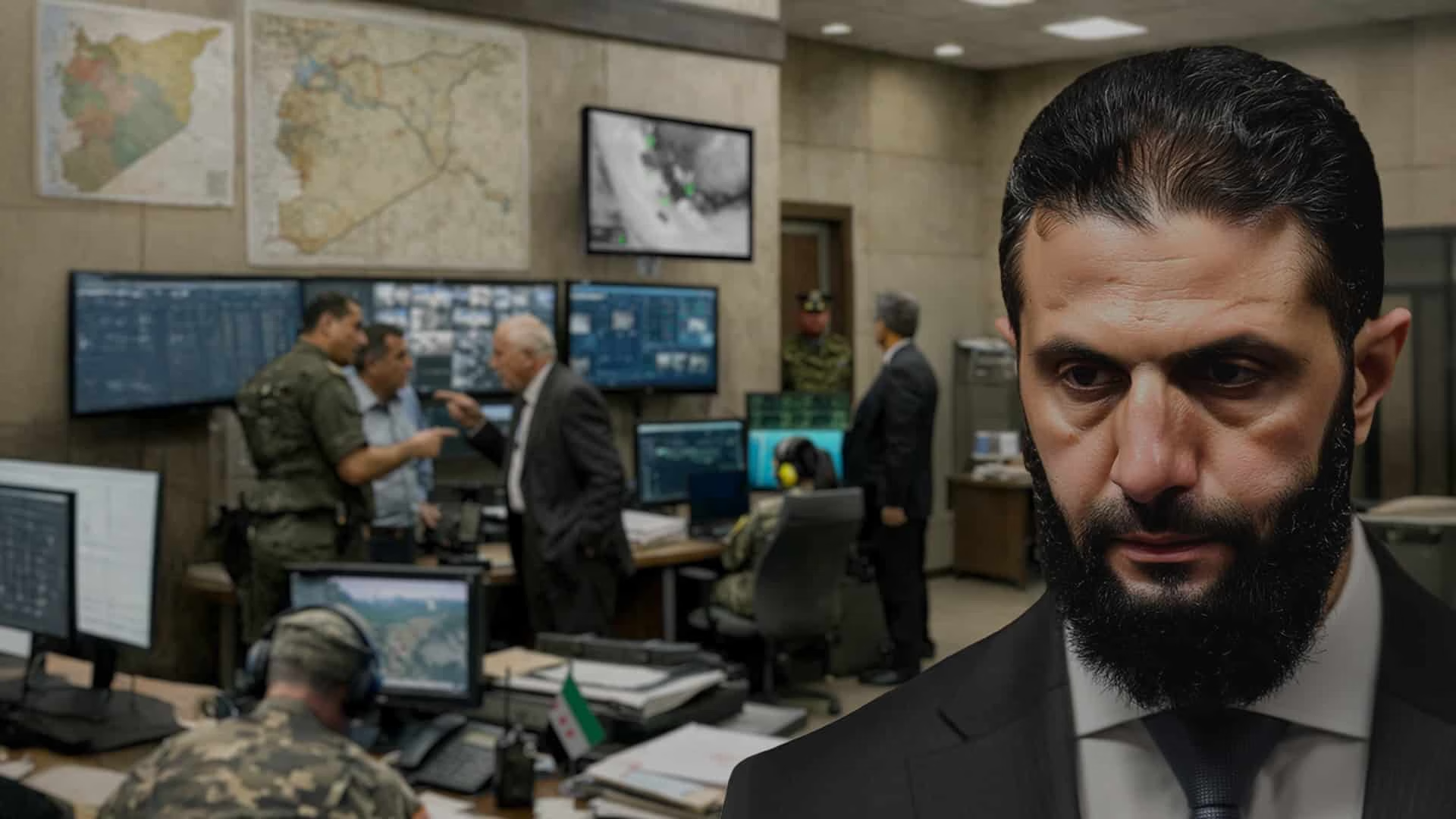
Damascus’s formal accession to the Global Coalition to Defeat ISIS late last year was seen by many outside Syria as part of President Ahmed al-Sharaa’s effort to gain international recognition. From this perspective, the question then became whether joining the coalition conferred “legitimacy” on the new authority in Damascus and how much it might help ease Syria’s regional and international isolation.
This surface-level analysis overlooked al-Sharaa’s deeply domestic calculations: accession could help him reshape the military landscape in Syria, rein in cross-border jihadist networks, and shift from opaque, ad hoc coordination with foreign powers to a more manageable, formal framework. Through this domestic lens, the questions then become: what kind of state is Al-Sharaa building? What are the limits of his pragmatism? And what might be the domestic costs of the path he is taking, especially as Syria begins 2026 rife with social and military tensions?
Quiet Security Coordination Under Assad
The newly announced coordination between Damascus and the international coalition sits atop a long, disconcerting history of security contacts between the West and Syria under the former Assad regime, which persisted despite the public split following Syria’s 2011 uprising-turned-civil war. Even at the height of open hostility between President Bashar al-Assad and Washington over the regime’s brutality against its own citizens, selective intelligence exchanges with the West endured, focused on specific networks, routes, and zones of activity for cross-border jihadist actors loosely grouped under the al-Qaeda label.
Such is a common dynamic in geopolitics: security imperatives are detached from the public political rhetoric and handled in a separate, deniable track. What is so notable about the current moment is that the Syrian government is saying the quiet part out loud.
In parallel, a more pragmatic European approach emerged. Security agencies in countries such as France and Germany maintained limited communication with Syrian counterparts, largely focused on exchanging information about foreign fighters—their identities, travel routes, and logistical support networks inside Syria. This cooperation was driven by concerns over “returnees,” not by a political shift toward the Assad regime. It remained confined to undisclosed channels and a narrow margin of trust. Ironically, the umbrella classification used at the time included actors from the same jihadist milieu from which Ahmad al-Sharaa later emerged, alongside the Islamic State.
This pattern reflects an established tradition in international politics: separating security imperatives from political discourse. Yet it also highlights the scale of the current shift. What was once treated as a technical security exception with an isolated regime is now being reproduced within a formal framework—by a transitional authority seeking to convert the same cooperation into an instrument of internal reorganisation. What had previously been managed as a technical security exception —and handled within an ad hoc framework—is now being reproduced within a formal structure, with the transitional authority seeking to use this same cooperation as a tool for reorganizing its domestic affairs.
Turkey as a mediator – the Baghdadi model
Hakan Fidan‘s statements about ‘excellent intelligence cooperation’ with Hayat Tahrir al-Sham were not isolated, but rather reflected this pattern of long-term instrumental coordination that allows for the exchange of highly sensitive information without announcing formal partnerships.
In this context, Turkey’s role should not be seen as circumstantial mediation. It is part of an undeclared structure managing interaction between the transitional authority in Damascus and international actors. Ankara has provided a central back channel that enables intelligence cooperation without forcing direct political alignment. It has done so by leveraging geography, its security footprint in northern Syria, and its entangled relationships with multiple armed factions.
Hakan Fidan’s statements about “excellent intelligence cooperation” with Hayat Tahrir al-Sham were therefore not incidental. They reflected a longer pattern of instrumental coordination—one that allows the transfer of highly sensitive information without formalising partnerships.
As the Islamic State surged between 2013 and 2015, information moved through intermediaries rather than joint command rooms: tips on cell movements, field commanders’ whereabouts in Syria and Iraq, and the logistics that sustained them. This was security cooperation without declared partnership – conducted through indirect channels and stripped of any formal political commitment.
In Europe, a parallel, more narrowly pragmatic track took shape. Intelligence services in states such as France and Germany maintained limited contact with Syrian counterparts, focused almost entirely on foreign fighters – their identities, travel routes, and support networks inside Syria – driven by fear of returnees rather than any rehabilitation of Assad. These communications remained buried in unofficial channels and operated within a tight margin of trust.
Such is a common dynamic in geopolitics: security imperatives are detached from the public political rhetoric and handled in a separate, deniable track. What is so notable about the current moment is that the Syrian government is saying the quiet part out loud. What used to be a discreet security channel with an isolated regime has been publicly formalised by a transitional authority eager to turn the cooperation into international recognition and a domestic tool for reordering the state.
The Evolving Roles of Western and Turkish Intelligence
In the first year since Al-Sharaa took power in December 2024, cooperation between Damascus and the coalition was real but deliberately narrow, amounting to regular intelligence exchanges rather than joint command. Information flowed regarding ISIS cell movements, areas of concentration, and supply lines – especially in southern Damascus, the Badia desert, and rural belts around the capital – giving coalition forces better targets while keeping Syrian operations formally “national.”
But the bargain is inherently fragile: it keeps coordination on a technical-security track, while the government still struggles to impose a unified command structure across its fragmented military and to rein in factious elements.
After Syria’s formal entry into the Global Coalition in November 2025, this cooperation deepened, with a stronger focus on blocking inflows of foreign fighters and tightening the net around ISIS remnants. The Syrian foreign ministry publicly framed the country’s accession as an invitation to the United States and other member states to back Syria’s “efforts to combat terrorism” and restore regional security and stability. The result has been an intelligence-first model that gives the Syrian leadership room to manoeuvre: It can tap coalition targeting and surveillance capabilities while preserving enough ambiguity at home to blunt accusations of subordination to Washington.
But the bargain is inherently fragile: it keeps coordination on a technical-security track, while the government still struggles to impose a unified command structure across its fragmented military and to rein in factious elements. That is why the core fight against ISIS has remained concentrated in Syria’s intelligence and internal security units, with regular army formations kept largely at arm’s length.
Turkey is also key to the undeclared machinery that links the transitional authority in Damascus to outside powers. Ankara offers a back channel that enables deep intelligence cooperation without forcing Damascus or Western capitals into overt political alignment, drawing on its geography, its military presence in northern Syria, and its established ties with myriad armed factions in Syria.
Turkish Foreign Minister Hakan Fidan, in a December 2024 interview, noted his country’s “excellent intelligence cooperation” with Hayat Tahrir al-Sham (HTS), the rebel group, formerly affiliated with Al-Qaeda, that Al-Sharaa had led to victory over Assad. Fidan’s statement alluded to an instrumental coordination that had conveyed highly sensitive information – including on ISIS leadership – while avoiding the formalities, obligations, and political costs that come with declared partnerships.
The 2019 killing of former ISIS leader Abu Bakr al-Baghdadi in Idlib captured both the limits and possibilities of this model. The raid depended on field intelligence routed through regional services, with Turkish intelligence playing a key role in tracking aides and movements, showing how indirect cooperation can deliver strategic results without political recognition or institutional fusion between the players.
That operation set a template: use intermediaries to neutralise “high-level” threats that local authorities cannot manage on their own. The same logic is now being reused in more open form under Syria’s formal accession to the coalition, with Turkey again positioned as the conduit that turns deniable security contacts into a more organised, if still carefully hedged, framework.
Coalition Abroad but Risks from Within
Damascus’ accession to the anti-ISIS coalition, and the accompanying upgrade in information-sharing, has allowed more coordinated operations against ISIS remnants. As importantly from the Syrian side, it has also imported an external reference point for sorting through the country’s armed actors, helping to parse between the forces that can be folded into the state-building project and which must now be treated as liabilities or outright threats.
“International legitimacy” thus arms the leadership with new tools for control and restructuring, while also imposing tangible political and security risks. The implicit commitments that come with accession – on the conduct of forces, rules of engagement, and the handling of designated groups – sit uneasily atop a still half-rewired HTS military‑ideological apparatus. Indeed, Al-Sharaa’s public embrace of the coalition has reopened old fault lines inside the transitional authority’s military order, especially around factions with more extremist jihadist pedigrees. Gradual integration has turned some of these groups into nominally regular units within an emerging national army, but the process is shallow and uneven, particularly at the ideological level.
Fragility is concentrated in specific segments: foreign fighters tied to transnational jihadist networks, local combatants whose identities were forged outside any state framework, and marginal armed networks still only loosely bound into new chains of command. The main risk they pose is not a classic coup-style confrontation, but asymmetric disruption – from sabotage and leaks to the ability to stir unrest in sensitive localities
Their grievances are broader than opposition to coalition accession. They flow from perceived political sidelining, loss of battlefield privileges, and the unravelling of wartime patronage networks, making low-intensity but high-impact violence – targeted attacks, obstruction, or selective defections – more likely. So far, the leadership has contained these pressures through institutional reshuffles, rebalancing of power centres, and using international commitments as cover for selective control and exclusion. But that containment is conditional. Salafi‑jihadist ideas rooted in parts of the militant base cannot be stripped away quickly; they demand long-term rehabilitation and firm organisational discipline. The danger is less an immediate large-scale split than the slow accumulation of small breaches that, under political or security stress, could harden into a systemic threat to the new state’s security architecture.
Recent appointments at the division level suggest cohesion at the top and lower the odds of open factional fracture. They also underline the depth of trust between the leadership and commanders with radical jihadist pasts, including those heading the Republican Guard, Division 70, and Divisions 82 and 84, where many foreign fighters have been clustered. Yet the Salafi‑jihadist currents running through the rank-and-file of these units will not dissipate on their own. Without sustained rehabilitation programmes and tighter control, the risk remains of internal shocks emanating from within the very institutions meant to safeguard the transition.
Choosing a Controlled Impact
In formalizing accession to the anti-ISIS coalition, rather than maintaining unofficial coordination, the Syrian government made the domestic calculation that absorbing a controlled shock now was less dangerous than maintaining an open-ended arrangement that could become increasingly difficult to manage, both in practical logistics terms and for optics as it seeks to build legitimacy with the Syrian population. In the short term, accession has lowered the risk of open internal conflict and bought time to restructure the military and refine tools of control and containment. But while the state can harvest security gains – better intelligence, tighter operations against ISIS – these will not automatically translate into political stability.
Syria’s formal entry into the Global Coalition to Defeat ISIS is less a decisive endpoint than a risky open corridor where security imperatives, internal governance, and regional repositioning intersect. So far, the transition from informal to formal engagement has produced mixed results: tangible gains in international engagement and operational coordination, alongside unresolved structural tensions in the security apparatus. The core question now is whether Al-Sharaa and his government can maintain the security partnership without it morphing into a wider channel for external interference, while also preventing it from seeding domestic fragility as they try to rebuild the state.
The views expressed in this article are solely those of the author and do not necessarily reflect the views of BADIL | The Alternative Policy Institute or its editorial team.