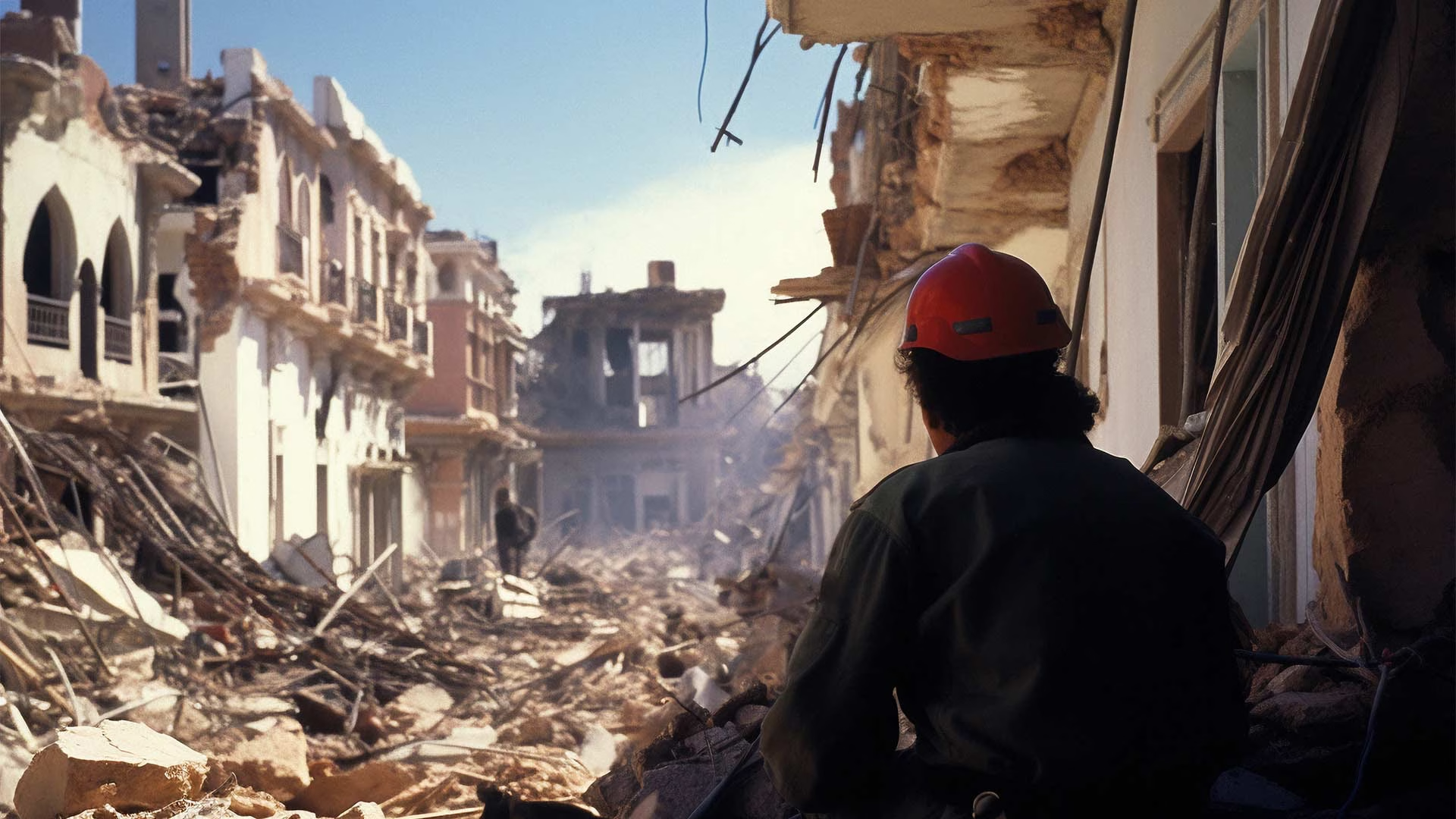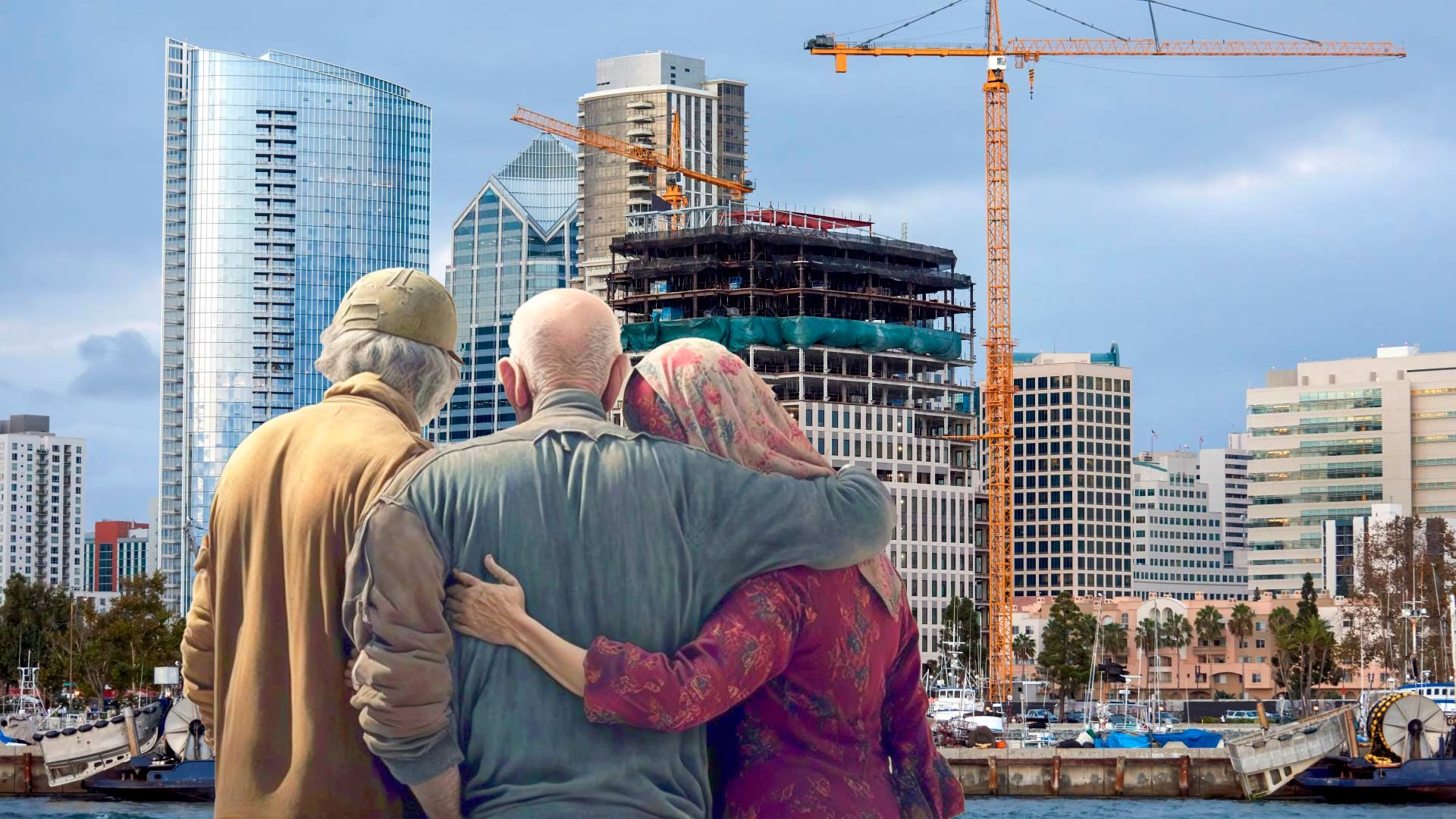
Today, the Levant is witnessing the collapse of a historical structure that has underpinned its shared life for centuries. The problem is no longer the mere existence of differences in religious doctrine, but the absence of the “breadth of vision” that, over many centuries, provided the political and philosophical framework for managing those differences. As Damascus retreats from its role as the centre of this wider horizon, hardline and opposing discourses are on the advance across the region, and are turning religion into an instrument in struggles over power and identity. What is crumbling here is not a matter of creed or a ritual, but an entire model of governance and social organisation.
Damascus has long served as a political and philosophical laboratory that brought together jurist and mystic, Sunni, Shi‘i and Druze within a common framework that allowed difference without disintegration. This model, articulated by Ibn Arabi in his expansive vision of existence, and later adopted by the Ottomans as the basis for managing the diversity of their empire, was no spiritual luxury. It was an effective instrument of governance that enabled the Levant to absorb its internal contradictions. As the Great Sheikh Ibn Arabi said: “The whole earth is a mosque, and Damascus is its mihrab.” If the direction of this mihrab is disturbed, the region’s spiritual qibla is thrown off balance.
The danger of the current moment lies in the fact that every side sees itself as the “guardian of true Islam.” The Iranian religious establishment presents its intervention as defending “the Islamic umma and the resistance axis.” Salafist movements frame their practices as a “purification of doctrine.” The ousted regime in Damascus claimed to defend “pluralism” even as it instrumentalised sectarian fear to entrench its rule.
At the same time, the Druze community today stands at a decisive crossroads: between the legacy of the Tanukhid emir who laid the foundations for a historic understanding with the official Sunni centre, and isolationist currents or alliances seeking to loosen its ties with its Islamic surroundings. Against this backdrop of political and sectarian turmoil, the voice of Ibn Arabi, of unity within difference, and of an Islam that accommodates plurality rather than negating it, has fallen silent.
The crisis of the Levant, then, does not revolve solely around religious disagreements. It reflects a fundamental struggle between two visions of politics: a narrow vision that reduces society to a single identity and drives it towards confrontation; and a broader vision that treats pluralism as the basis for stability and for the unity of the political field.
Perhaps the question facing the region today—from Tehran to Baghdad, Damascus and Diyarbakir—is which of these two visions will shape the future of the Levant: that of closure, or of expansiveness.
A sober reading of the trajectory of Levantine Islam from the legacy of Ibn Arabi to today’s sectarian conflict, and from the Ottoman equilibrium to the disorder of the post-colonial era, reveals that the Levant is not only facing a political or geopolitical crisis, but a jurisprudential and spiritual crisis that strikes at the core of how Islam has been conceived in this region.
Ibn Arabi and the Levantine-Ottoman conception of unity
Before the Ottomans inherited Damascus and elevated Ibn Arabi’s legacy within state institutions, the city itself had since the late Mamluk era been a vast laboratory of juridical and spiritual plurality. It was home to major scholars such as Imam al-Nawawi, who embodied piety and the Shafi‘i school; Ibn Kathir and Ibn al-Qayyim, who articulated more balanced Sunni formulations in the face of Ibn Taymiyyah’s own hardline; and prominent Sufi shaykhs such as Sheikh Mu’in al-Din Chishti buried on Mount Qasioun. The influence of Afif al-Tilimsani who spread Akbarian Sufism a century before the Ottomans arrived, also extended from Damascus. At the same time, figures such as the Tanukhid emir Abdallah played a key role in shaping a historic relationship between the Druze and the Ash‘arites, to the point that he was granted the green turban in Damascus as an honour from Sunni scholars.1See the footnotes to the treatise Nahr al-Jumān fī Sharḥ Gharīb Āyāt al-Qur’ān by Sayyid Amir Jamal al-Din Abdallah al-Tanukhi, edited by Sheikh Farhan al-Aridi and jurist Rabih Zahr al-Din.↓ When the Ottomans entered the city in 1516, they found a fully formed spiritual order grounded in breadth and inclusiveness. Their project was to codify and extend it, not to rebuild it from scratch.
The influence of Ibn Arabi on Ottoman intellectual life can scarcely be overstated. As Huseyin Yilmaz2Huseyin Yilmaz, professor of political thought at Georgetown University and one of the leading scholars of Ottoman political imagination, argues that the intellectual transformation of the sixteenth century was not merely political but represented a metaphysical turn that redefined the meanings of caliphate and authority in the Ottoman world. In his seminal book, Caliphate Redefined: The Mystical Turn in Ottoman Political Thought (Princeton University Press, 2018), Yilmaz shows how the Ottomans adopted core elements of Ibn Arabi’s Akbarian tradition and integrated them into a political-ethical framework that justified the idea of a universal imamate and the unification of sects, cities, and regions under a single center. According to Yilmaz, this fusion of Akbarian mysticism and political legitimacy enabled the Ottomans to articulate a new conception of the caliphate grounded not only in power but in a unifying metaphysical vision that rendered the sultanate an embodiment of “the unity of being” in the political sphere. This reading offers a deeper understanding of Selim I’s policies and their symbolic expressions, including the restoration of Ibn Arabi’s tomb, as elements of a spiritual architecture of statehood rather than isolated administrative or architectural acts.
Link: https://press.princeton.edu/books/hardcover/9780691174808/caliphate-redefined?srsltid=AfmBOorIqs9wmJH-FNuWAy4gaiZW57racCfMG5CO2RvvO_FBUdcROWBt↓ (2018) and Ahmed Zildžić3Ahmed Hamdun Zildžić, Friend and Foe: The Early Ottoman Reception of Ibn Arabi, PhD dissertation, University of California, Berkeley, 2012. Link: https://escholarship.org/uc/item/6jn6f796↓ (2012) demonstrate, the early Ottomans encountered his works through the students of Sadr al-Din al-Qunawi in Konya. By the fifteenth century, the core Akbarian corpus, especially Fusus al-Hikam and al-Futuhat al-Makkiyya, had anchored the curricula of religious schools and shaped generations of jurists and Sufis alike. Ottoman thinkers such as Dawud al-Qaysari and Shams al-Din al-Fanari treated Ibn Arabi’s ontology not as a set of isolated esoteric meditations, but as a framework for the ethics of state and sultanate: if all existence flows from a single divine origin, then the multiplicity of peoples, sects, and religions within the state can be understood as manifestations of that origin, not as threats to it. This symbolic edifice reached its zenith when Sultan Selim I restored Ibn Arabi’s tomb in Damascus. According to Ottoman sources and local accounts, the sultan was guided to the neglected grave by a visionary dream, the Sufi legend known as “the entry of sīn upon shīn,” that is, the entry of Selim (sīn) into al-Sham (shīn).4Ekrem Buğra Ekinci, “Mighty Sovereigns of the Ottoman Throne: Selim I,” Daily Sabah, Arts Section, 2017. https://www.dailysabah.com/arts/portrait/mighty-sovereigns-of-ottoman-throne-sultan-selim-i↓ Whether read literally or symbolically, the story reveals the Ottoman imagination at work: Damascus, once again, as the locus of divine effusion. The Selimiye tekke thus became both a Sufi centre and an architectural statement that the universality of the spirit was to be the foundation of the state.
The future of the region will not be determined by armies, border lines, or conferences convened in foreign capitals. It will be shaped by a single question: which Islam will govern al-Sham, Iraq, Diyarbakir, and Istanbul? An Islam that sees plurality as a threat, or an Islam that sees plurality as one of the faces of truth?
By “venerating” Ibn Arabi and placing him at the heart of the state’s intellectual identity, the Ottomans effectively anchored a metaphysics of coexistence. Unlike the Mamluks’ reliance on rigid juridical formalism, and unlike the later Wahhabi impulse toward “purification,” the Ottomans wove Sufi plurality into the fabric of governance. The Akbarian principle that “God is known in every form” conferred legitimacy on an imperial policy that accommodated local jurisprudential traditions, regional saints, and multi-religious communities. This “breadth of vision” became an unspoken yet operative doctrine of state, turning Damascus into a spiritual and administrative centre that linked the Arab and Anatolian worlds within a single Ottoman sphere.5William Chittick, The Sufi Path of Knowledge: Ibn al-Arabi’s Metaphysics of Imagination (Albany: SUNY Press, 1989).https://www.amazon.com/Sufi-Path-Knowledge-Metaphysics-Imagination/dp/0887068855↓
The Ottoman embrace of Ibn Arabi’s metaphysics was more than a matter of intellectual taste or spiritual inclination; it became the organising framework of the entire regional order. By the seventeenth century, Sufi zawiyas and takkīyas stretched across Damascus, Aleppo, and Cairo, functioning as soft institutions of the sultanate. These networks translated Sufi abstraction into social discipline: education, mediation, and a form of moral authority that transcended sectarian and tribal lines. Through this spiritual network, the Ottomans achieved what many “modern” states still struggle to realise: a pluralistic order grounded in a shared cosmology rather than in a coercive, homogenising ideology.
The collapse of sacred geography
The collapse of the Ottoman Empire in the early twentieth century shattered that vision at its roots. The new Middle East that emerged under colonial tutelage, the Sykes-Picot Agreement, and the French and British mandates, replaced metaphysical unity with administrative partition. Where the Ottoman state had sought harmony through layered forms of authority, the colonial powers entrenched division through identity. Damascus, once the connective tissue between Anatolia and the Arabian Peninsula, became a truncated capital hemmed in by artificial borders. With the abolition of the Caliphate in 1924, Islam’s symbolic centre fragmented even further. The modern nation-state turned religion into a bureaucratic apparatus, and thus pushed spirituality and mysticism out of the political sphere.
Ibn Arabi’s vision of diverse divine manifestations was recast as spiritual literature or cultural ornament, while a literalist, legalistic discourse, first consolidated under colonial rule and later weaponised by Islamist movements, moved in to fill the void. By the late twentieth century, this spiritual impoverishment had hardened into a violent binary: Islam versus the state, or “authentic Sunna” versus “heresy.” The Ba‘athist regimes in Damascus and Baghdad responded to sectarian tension with repression rather than reconciliation, while Islamist movements, stripped of their spiritual depth, sought purity through negation and exclusion. Without the “shared spiritual grammar” that had characterised the Ottoman age, coexistence grew fragile; what had been possible under Ibn Arabi’s capacious imagination became arduous in its absence. Syria today is the starkest expression of this unraveling. The civil war—political in appearance—is, at its core, a struggle over the very meaning of divine presence in the world. Competing doctrines (Salafi, Shi‘i, Alawi, Druze) fight not only over land but over the right to define how God appears in history.
Damascus, once known as the “abode of unity,” now risks becoming the burial ground of Islam’s pluralistic legacy. Unless a new integrative vision emerges, the Levant will remain hostage to an annihilating war waged in the name of “Sunna” or “truth.” The urgent question is not whether Ibn Arabi can be invoked as a symbol of tolerance, but whether his ontology of unity can be reactivated as a political framework capable of absorbing difference without erasing it. In the absence of such a metaphysical centre, the region’s religious landscape will fracture further, dissolving into doctrinal militias, each claiming a monopoly over divine truth.
Ibn Taymiyyah and the jurisprudence of exclusion
If the Ottomans had made Ibn Arabi the spiritual grammar of their empire, the post-Ottoman Levant inherited a jurisprudence closer to its inverse: the stringent legal literalism of Ibn Taymiyyah. Born in 1263, Ibn Taymiyyah’s intellectual revolt against philosophical Sufism and metaphysical speculation unfolded in Mamluk Syria, where Mongol invasions and internal upheavals had shaken the authority of traditional religious elites. His call to return to the earliest Sunnah (the salaf) was an effort to re-anchor Islamic certainty on a purified textual basis. Yet his polemics against intercession through saints, against appeals to baraka, and against philosophical interpretation would later become the raw material out of which contemporary exclusionary Islamist jurisprudence was fashioned.
It is important to note, however, that Ibn Taymiyyah was not the extremist militant imagined by some Islamists today. As Yahya Michot6See also: Yahya Michot, “Ibn Taymiyyah’s position on jihad”, The Muslim World, 89 (1999)↓ explains, his writings combine rigour with flexibility, and his advocacy of jihad was, more often than not, defensive. But once his thought was transplanted into a collapsing political landscape charged with sectarian anxieties, his concern with the “boundaries of creed” was transformed into a metaphysics of hostility.
By the twentieth century, Islamic movements from Najd to Aleppo had begun weaponising his thought. Salafi-Wahhabi currents recast Ibn Taymiyyah as the “Imam of Purification,” while organisations such as al-Qaeda and later ISIS stripped his arguments from their juridical contexts and turned his reasoning into an algorithm of takfīr. Thus the Ottoman juristic inheritance was inverted: where Ibn Arabi saw God manifest in every form, today’s takfiri movements see the devil in every difference. Their obsessive drive to eliminate ambiguity—in creed, conduct, or ritual—has mutated into a project of annihilation.
In Syria, this distorted appropriation of Ibn Taymiyyah has ravaged the spiritual architecture of Islam itself: Sufi shrines have been levelled, mosques bombed, and entire communities, the Druze of Jabal al-Summaq and Suwayda, the Alawites of Latakia, and the Christians of Maaloula, have been marked as “heretical.”
Even Sunni orthodoxy has not escaped this rupture. Ash‘ari scholars, once a foundational pillar of Sunni theology, now find themselves accused of bid‘a. The doctrinal centre has collapsed, and the landscape has become a battleground of small, competing orthodoxies. Syrian scholars who remain on the ground walk a razor’s edge: denouncing extremism while trying to avoid the wrath of armed factions that claim a monopoly over speaking in God’s name.
This is the tragedy of the contemporary Levant: a jurisprudence originally crafted for defence has become a weapon of internal demolition. The crisis is not merely theological but existential. By denying the possibility that divine truth may manifest outside one’s own group, Sunni extremism has launched a war not only on Shi‘a and Christians, but on the very principle of pluralism within Islam itself. Damascus, the city that once held Ibn Arabi and Ibn Taymiyyah together in its intellectual life, now lives the clash of their visions as ruin and bloodshed.
The new ruler of Damascus, Ahmed al-Sharaa, despite his relative success in managing a delicate external balance, has been unable to craft a new “symbolic garment” for the city: a vision that rises above sectarian belonging, restores the meaning of shared life, and offers both majority and minority communities a common frame through which to organise their existence within a single state. Thus Damascus, once a centre of meaning and the cradle of a capacious Levantine jurisprudence, now appears as a city without a narrative, without a symbolic mihrab, and without a spiritual or political project capable of gathering Syrians, or the wider region, back into a single horizon.
The new ruler of Damascus, Ahmed al-Sharaa, despite his relative success in managing a delicate external balance, has been unable to craft a new “symbolic garment” for the city: a vision that rises above sectarian belonging, restores the meaning of shared life, and offers both majority and minority communities a common frame through which to organise their existence within a single state. Thus Damascus, once a centre of meaning and the cradle of a capacious Levantine jurisprudence, now appears as a city without a narrative, without a symbolic mihrab, and without a spiritual or political project capable of gathering Syrians, or the wider region, back into a single horizon.
A legal frame for majority and minority alike?
After the 2017 constitutional referendum, through which Recep Tayyip Erdoğan secured sweeping executive powers and transformed Türkiye’s system of government from parliamentary to presidential, he sought to craft a symbolic narrative commensurate with the profound political shift the country had undergone. As part of this symbolic architecture, he visited the tomb of Sultan Selim I in Istanbul, and placed upon it the sultan’s traditional cloak, still marked with the soil of the scholars. The ritual was invoked as an extension of Selim’s legacy: the ruler who unified Anatolia, bound it to the Levant and Egypt, and revived the shrine of the Great Sheikh Muhyiddin Ibn Arabi in Damascus.7“Erdogan places Sultan Selim I’s cloak on his tomb,” TurkPress, August 6, 2017 https://www.turkpress.co/node/33502↓
The gesture was less about protocol than about asserting that Türkiye under Erdoğan sees itself as part of a wider Sunni sphere, capable of playing a central role in reordering the Levant by fusing contemporary electoral legitimacy with enduring Ottoman symbolism.
In parallel to this Ottomanised use of Sunni symbols, Walid Jumblatt turned to his own symbolic repertoire within the landscape of minorities. Thus, the construction of the Shakib Arslan Mosque in Mukhtara in 2016 was not a simple architectural project. It was a subtle diplomatic message about what Islam could look like in a pluralistic setting. The choice of Shakib Arslan’s name, the Druze Islamic thinker who tied Druze destiny to the Sunni majority and the Caliphate, and who helped lead political and military alliances against colonialism, reconnects the mountain to the centrality of the Levant. It summons a legacy that insists minorities cannot survive outside a broader Levantine horizon.8The historian Michael Provence, author of The Last Ottoman Generation, would likely see in this moment a confirmation of his central thesis: that Ottoman elites not only shaped the contours of the Levant in the post-colonial era, but continue to exert socio-political influence in the present and into the future. The movements, leaders, and symbols emerging today in Türkiye, Lebanon, and Syria operate within a historical field still structured by Ottoman-era ideas about pan-Islamism, minority balance, and Levantine unity. What Provence termed the “last Ottoman generation” did not vanish; it became an intellectual and political formation that renews itself at each historical juncture, reproducing its logic through new alliances and new actors.↓
This symbolic deployment cannot be separated from the Druze community’s internal calculations, nor from the Jumblatt leadership’s need to consolidate its position amid a shifting Levantine landscape. The mosque, with its modern architecture and calm aesthetic, becomes an attempt to sketch a conciliatory Islam that reassures minorities without severing its thread to the majority. In this sense, Ankara and Mukhtara appear as actors within the same tableau: the majority searching for a unifying legal and symbolic frame, and the minority seeking its guarantees within that same frame.
Yet neither symbol, the mausoleum of Selim I in Istanbul nor the Shakib Arslan Mosque in Mukhtara, necessarily points to a single or coherent project. Erdoğan, despite his skill in mobilising Ottoman imagery, remains constrained by domestic and external power dynamics. Jumblatt, despite invoking the lineage of his grandfather Shakib Arslan, remains the representative of a community that has faced (and continues to face) an existential threat.
But this choreography of symbols does not answer the deeper questions: What do these gestures mean to the people of Suwayda who lost thousands of loved ones? To the Alawite families whose villages in the south were wiped out? To the Sunnis and Sufis whose mosques were torn apart by takfiri groups? And who restores dignity to the thousands of families killed by the Assad regime?
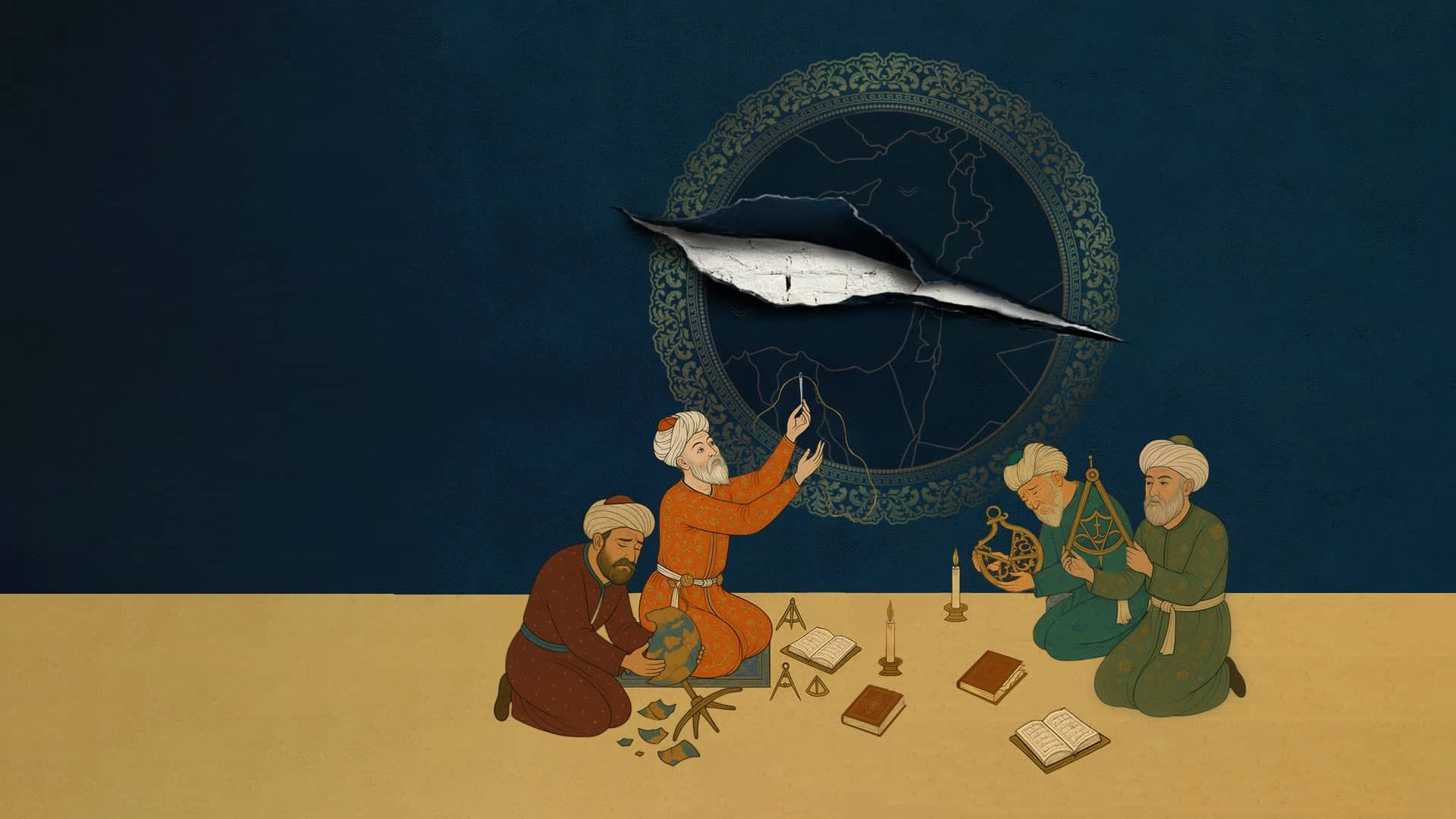
Put simply: who will mend the sky, now punctured and torn over Damascus?
Ibn Arabi was not simply a Sufi mystic; he was the architect of a system that understood plurality as the precondition for unity, and that shari‘a cannot stand without a breadth of vision. When the region abandoned this inheritance and replaced it with a combative literalism fed by fear, sorting, and takfīr, the spiritual centre that had, for centuries, linked Damascus with Anatolia and the mountain interior collapsed.
What further complicates the picture is that the new ruler of Damascus, Ahmed al-Sharaa, and despite his relative success in managing a delicate external balance, has been unable to craft a new “symbolic garment” for the city: a vision that rises above sectarian belonging, restores the meaning of shared life, and offers both majority and minority communities a common frame through which to organise their existence within a single state. Thus Damascus, once a centre of meaning and the cradle of a capacious Levantine jurisprudence, now appears as a city without a narrative, without a symbolic mihrab, and without a spiritual or political project capable of gathering Syrians, or the wider region, back into a single horizon.
A sober reading of the trajectory of Levantine Islam from the legacy of Ibn Arabi to today’s sectarian conflict, and from the Ottoman equilibrium to the disorder of the post-colonial era, reveals that the Levant is not only facing a political or geopolitical crisis, but a jurisprudential and spiritual crisis that strikes at the core of how Islam has been conceived in this region.
Ibn Arabi was not simply a Sufi mystic; he was the architect of a system that understood plurality as the precondition for unity, and that shari‘a cannot stand without a breadth of vision. When the region abandoned this inheritance and replaced it with a combative literalism fed by fear, sorting, and takfīr, the spiritual centre that had, for centuries, linked Damascus with Anatolia and the mountain interior collapsed.
The future of the region will not be determined by armies, border lines, or conferences convened in foreign capitals. It will be shaped by a single question: which Islam will govern al-Sham, Iraq, Diyarbakir, and Istanbul? An Islam that sees plurality as a threat, or an Islam that sees plurality as one of the faces of truth? Our predecessors understood which of the two paths was sounder. For that reason, they placed Ibn Arabi at the heart of their political imagination, making Damascus a sanctuary of unity long before it became a seat of power.
Even if that vision lies today beneath layers of dust, it falls to the Levant, its scholars, its policymakers, its intellectuals, to brush it off once more, and to reclaim the spiritual orientation lost amid the jurisprudence of exclusion and the sectarianisation of politics.
Either we revive this breadth of vision, or we brace ourselves for another century of strife.
Footnotesالهوامش
- 1See the footnotes to the treatise Nahr al-Jumān fī Sharḥ Gharīb Āyāt al-Qur’ān by Sayyid Amir Jamal al-Din Abdallah al-Tanukhi, edited by Sheikh Farhan al-Aridi and jurist Rabih Zahr al-Din. ↩︎
- 2Huseyin Yilmaz, professor of political thought at Georgetown University and one of the leading scholars of Ottoman political imagination, argues that the intellectual transformation of the sixteenth century was not merely political but represented a metaphysical turn that redefined the meanings of caliphate and authority in the Ottoman world. In his seminal book, Caliphate Redefined: The Mystical Turn in Ottoman Political Thought (Princeton University Press, 2018), Yilmaz shows how the Ottomans adopted core elements of Ibn Arabi’s Akbarian tradition and integrated them into a political-ethical framework that justified the idea of a universal imamate and the unification of sects, cities, and regions under a single center. According to Yilmaz, this fusion of Akbarian mysticism and political legitimacy enabled the Ottomans to articulate a new conception of the caliphate grounded not only in power but in a unifying metaphysical vision that rendered the sultanate an embodiment of “the unity of being” in the political sphere. This reading offers a deeper understanding of Selim I’s policies and their symbolic expressions, including the restoration of Ibn Arabi’s tomb, as elements of a spiritual architecture of statehood rather than isolated administrative or architectural acts.
Link: https://press.princeton.edu/books/hardcover/9780691174808/caliphate-redefined?srsltid=AfmBOorIqs9wmJH-FNuWAy4gaiZW57racCfMG5CO2RvvO_FBUdcROWBt ↩︎ - 3Ahmed Hamdun Zildžić, Friend and Foe: The Early Ottoman Reception of Ibn Arabi, PhD dissertation, University of California, Berkeley, 2012. Link: https://escholarship.org/uc/item/6jn6f796 ↩︎
- 4Ekrem Buğra Ekinci, “Mighty Sovereigns of the Ottoman Throne: Selim I,” Daily Sabah, Arts Section, 2017. https://www.dailysabah.com/arts/portrait/mighty-sovereigns-of-ottoman-throne-sultan-selim-i ↩︎
- 5William Chittick, The Sufi Path of Knowledge: Ibn al-Arabi’s Metaphysics of Imagination (Albany: SUNY Press, 1989).https://www.amazon.com/Sufi-Path-Knowledge-Metaphysics-Imagination/dp/0887068855 ↩︎
- 6See also: Yahya Michot, “Ibn Taymiyyah’s position on jihad”, The Muslim World, 89 (1999) ↩︎
- 7“Erdogan places Sultan Selim I’s cloak on his tomb,” TurkPress, August 6, 2017 https://www.turkpress.co/node/33502 ↩︎
- 8The historian Michael Provence, author of The Last Ottoman Generation, would likely see in this moment a confirmation of his central thesis: that Ottoman elites not only shaped the contours of the Levant in the post-colonial era, but continue to exert socio-political influence in the present and into the future. The movements, leaders, and symbols emerging today in Türkiye, Lebanon, and Syria operate within a historical field still structured by Ottoman-era ideas about pan-Islamism, minority balance, and Levantine unity. What Provence termed the “last Ottoman generation” did not vanish; it became an intellectual and political formation that renews itself at each historical juncture, reproducing its logic through new alliances and new actors. ↩︎