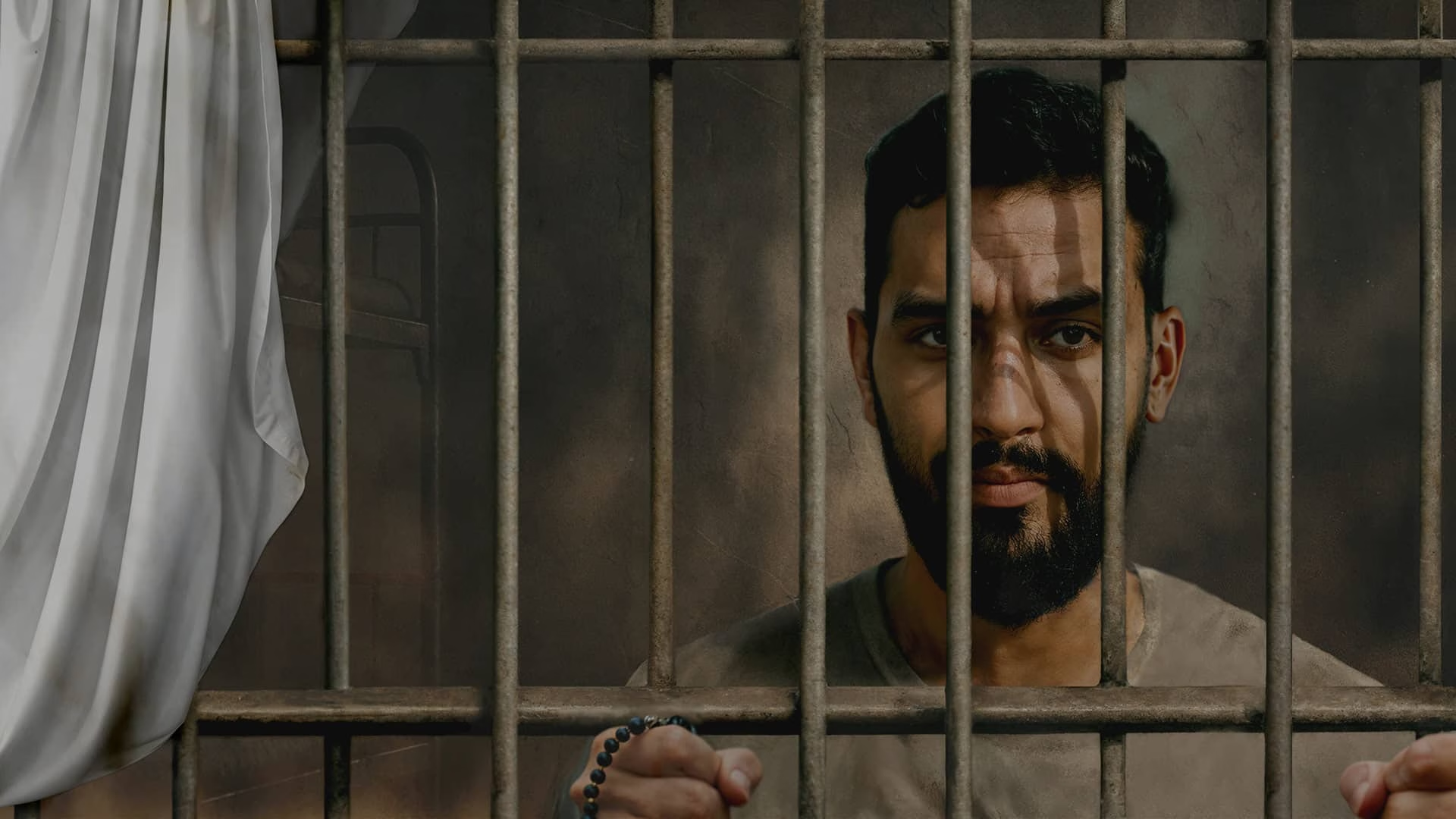


When Syria’s prison gates swung open after Bashar al-Assad’s fall in late 2024, images of released detainees became defining scenes of the transition. Emptied cells stood as emblems of a break with the former regime’s machinery of coercion, heralding the promise of political renewal under President Ahmad al-Sharaa’s transitional government.
But Syria’s new chapter has yet to deliver recovery for survivors or closure for families of those who vanished behind prison walls. For many, this rupture with the old order remains largely symbolic, unmatched by the institutional capacity to address the torture, forced disappearances, and mass executions that defined life behind those walls.
Institutions in the Making
Few Syrian families were left untouched by arbitrary detention, making it one of the most pervasive grievances shaping expectations of transitional justice. Over 112,400 people remain forcibly disappeared, reflecting the sheer scale of state violence. In the months following the Assad regime’s collapse, transitional authorities repeatedly returned to detention sites, granting access to the media to search for traces of the missing and document the discovery of mass graves. These gestures signaled a willingness to reckon with the past, even as deeper institutional responses lagged behind.
Steps toward institutionalizing justice and accountability began taking shape when al-Sharaa appointed Mazhar al-Wais, himself a former detainee, as Minister of Justice in March 2025. Al-Wais soon announced the abolition of exceptional courts, pledging to safeguard detainees’ rights and ensure fair, transparent trials. In May 2025, two new bodies were established by presidential decree: the National Commission for Transitional Justice and the National Commission for the Missing, mandated to investigate human rights violations, document disappearances, and support victims and their families.
While internationally welcomed as long-overdue accountability measures, the national commissions’ narrow focus on state crimes highlights the constrained political space in which transitional justice operates. Lessons from other post-conflict contexts show that their effectiveness depends on coordination with ministries, local authorities, and service providers closest to victims’ needs. So far, this coordination has yet to materialize.
Partial Fixes, Persistent Challenges
Families of the disappeared continue to face a fragmented and opaque system, shuttling between offices without knowing who is responsible for what or receiving official communication about the fate of their loved ones. For Syrians in exile, these challenges are compounded by geographic distance and limited access to emerging state mechanisms. Civil society organizations have become de facto intermediaries, absorbing demands that fall within the remit of public institutions. After enduring years of uncertainty under the previous regime, families experience this bureaucratic limbo as a perpetuation of harm.
Former detainees encounter similar gaps in support, especially those who left prison with physical injuries. Human rights documentation reveals a consistent pattern of untreated fractures leading to permanent deformities, paralysis, and nerve damage. Yet no national system exists to assess medical needs, document abuse, and provide specialized healthcare to survivors of torture. International humanitarian actors and Syrian civil society organizations have stepped in with emergency assistance, but these efforts cannot substitute for a coordinated national response.
Psychological harm is even more systematically neglected. Survivors frequently experience severe post-traumatic stress that limits their ability to work, participate in public life, or rebuild relationships. Without formal state mechanisms, the burden of mental health and psychosocial support falls on humanitarian clinics and survivor-led organizations already stretched thin by international funding cuts. Many former detainees are left relying on solidarity networks and personal resources for urgent treatment.
The economic picture is equally bleak. With one in four Syrians jobless, the post-war labor market structurally excludes individuals whose life trajectories were profoundly altered by years of imprisonment. Survivors carrying physical and psychological scars find themselves navigating the transition from its margins, with limited prospects for economic reintegration.
Closing the Gaps: From Policy to Practice
These patterns point to a wider limitation of the transition: the effects of detention are unfolding in domains that courts alone cannot address. Many perpetrators have fled, disappeared, or died, making prosecutions increasingly difficult. Meanwhile, former detainees are asked to recount traumatic experiences repeatedly, often without psychological support, as their needs go unmet. Justice, in this context, must go beyond trials to address survivors’ daily struggles and provide answers for families of the missing. Four practical steps would begin to close that gap.
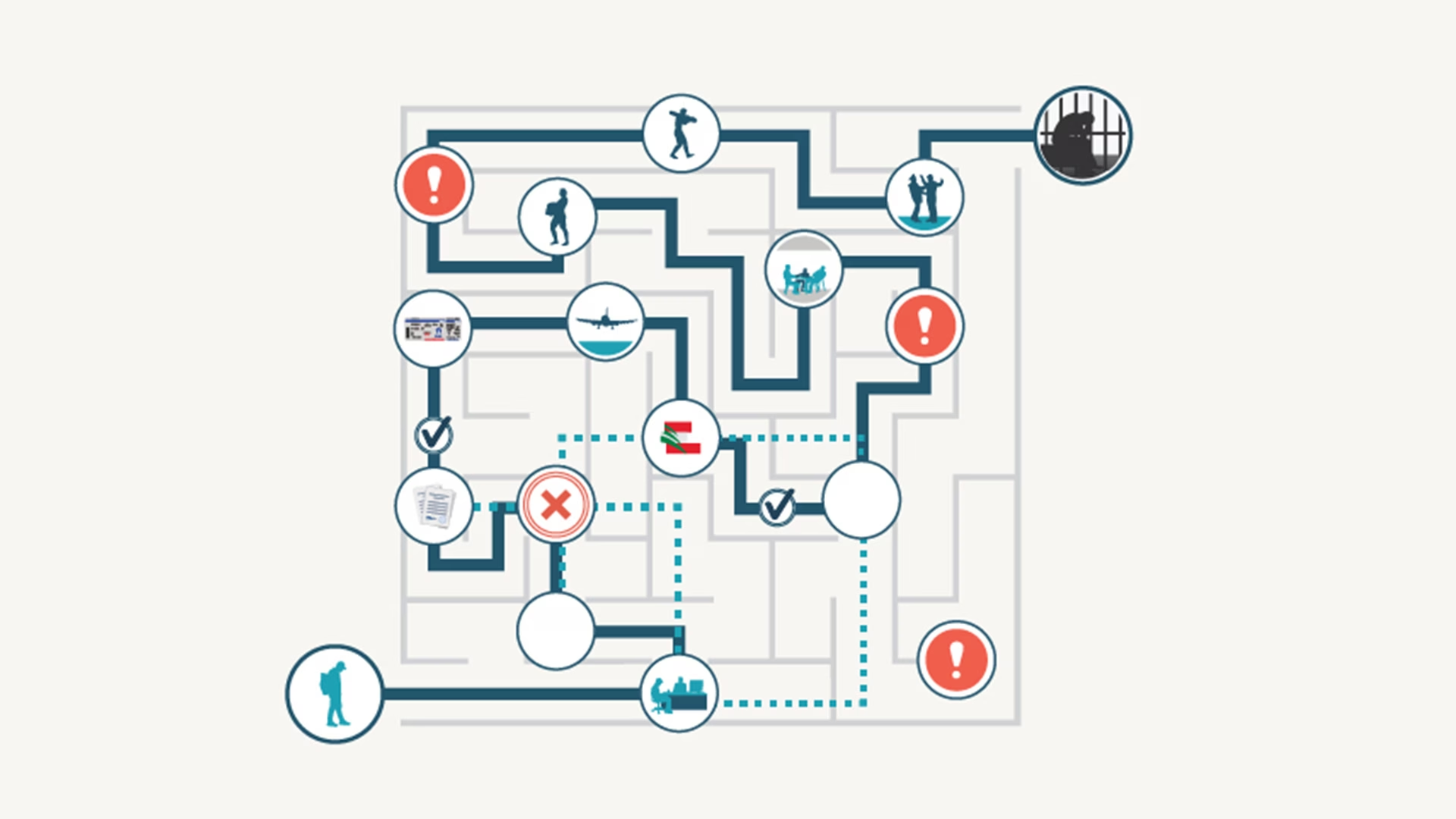
First, families need clear administrative channels to seek information and submit documentation. The National Commission for the Missing should create a unified registry for cases of forced disappearance, in cooperation with the Ministry of Justice and local authorities. By integrating documentation already collected by Syrian and international organizations, the registry would allow families to submit claims and track investigations without having to maneuver through a maze of offices with unclear jurisdiction.
Second, standardized procedures for documenting detention-related harm are both a clinical necessity and a foundation for justice. The Ministries of Health and Justice should jointly develop protocols based on international standards to systematically document torture, disability, and other forms of abuse. These efforts would facilitate survivors’ access to appropriate care while preserving evidence for future accountability and reparation processes.
Third, rehabilitation for survivors of torture must move beyond ad hoc humanitarian programs. Specialized centers should be established within the public health system, integrating physical rehabilitation, mental health, and legal support. By treating detention-related disability as both a public health and justice issue, these centers would help survivors rebuild their lives through sustained, coordinated care and a pathway to recovery.
Finally, socioeconomic reintegration policies are essential to prevent the permanent marginalization of former detainees. Targeted employment programs, disability accommodations, and inclusion in reconstruction and public sector initiatives would help restore survivors’ agency, access to livelihoods, and ability to participate in civic life.
None of these measures will resolve the legacy of detention overnight. Transitional justice processes are inherently slow, particularly in contexts where institutions remain fragile. But taken together, they represent concrete steps toward transforming symbolic rupture into meaningful change. In a country where disappearance touched such a vast portion of the population, the credibility of Syria’s transition will ultimately be judged not by the fall of its prisons, but by what it builds for those who survived them.
Salma Daoudi is a Non-Resident Fellow at Badil | The Alternative Policy Institute
The views expressed in this article are solely those of the author and do not necessarily reflect the views of BADIL | The Alternative Policy Institute or its editorial team.