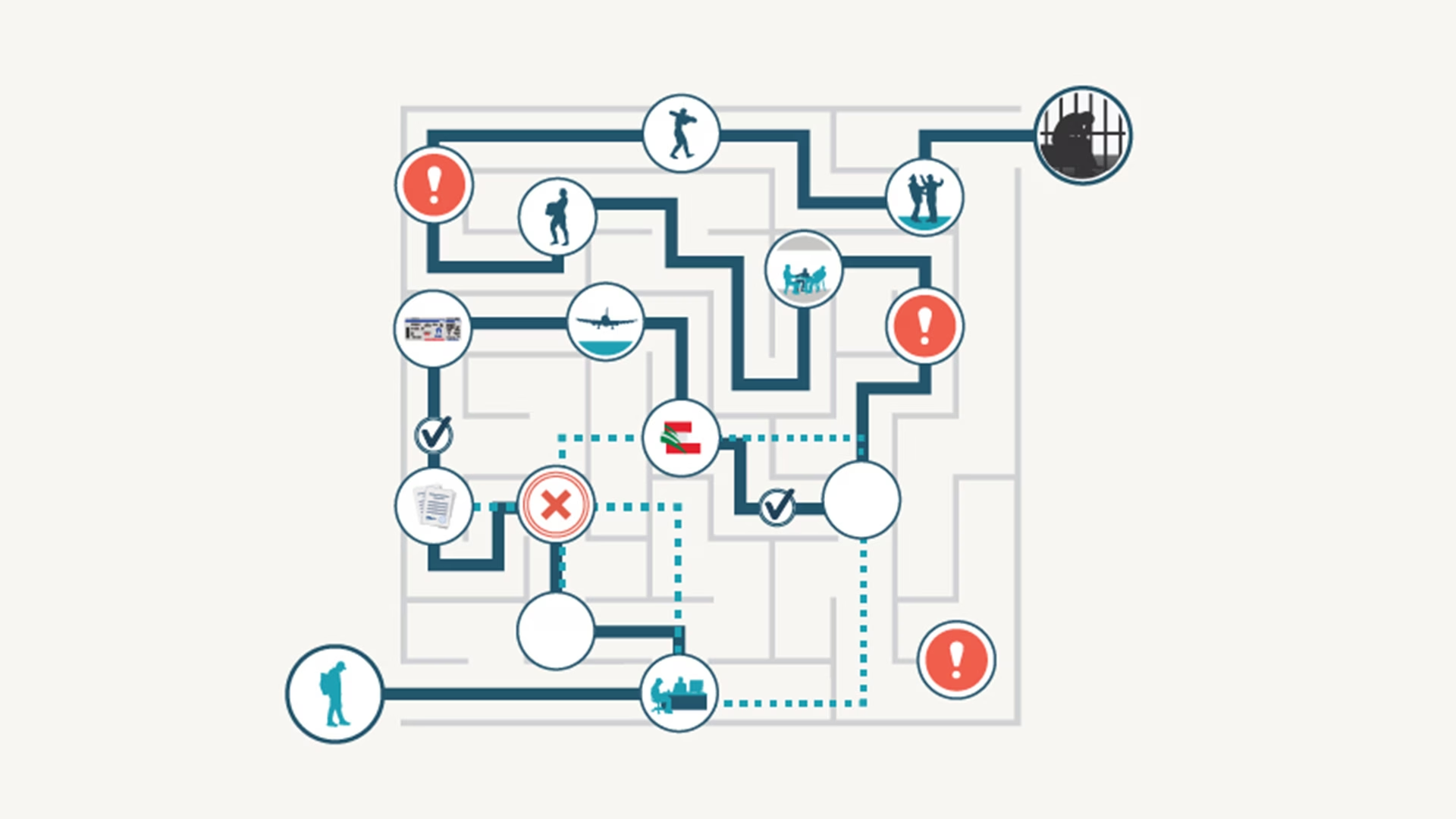
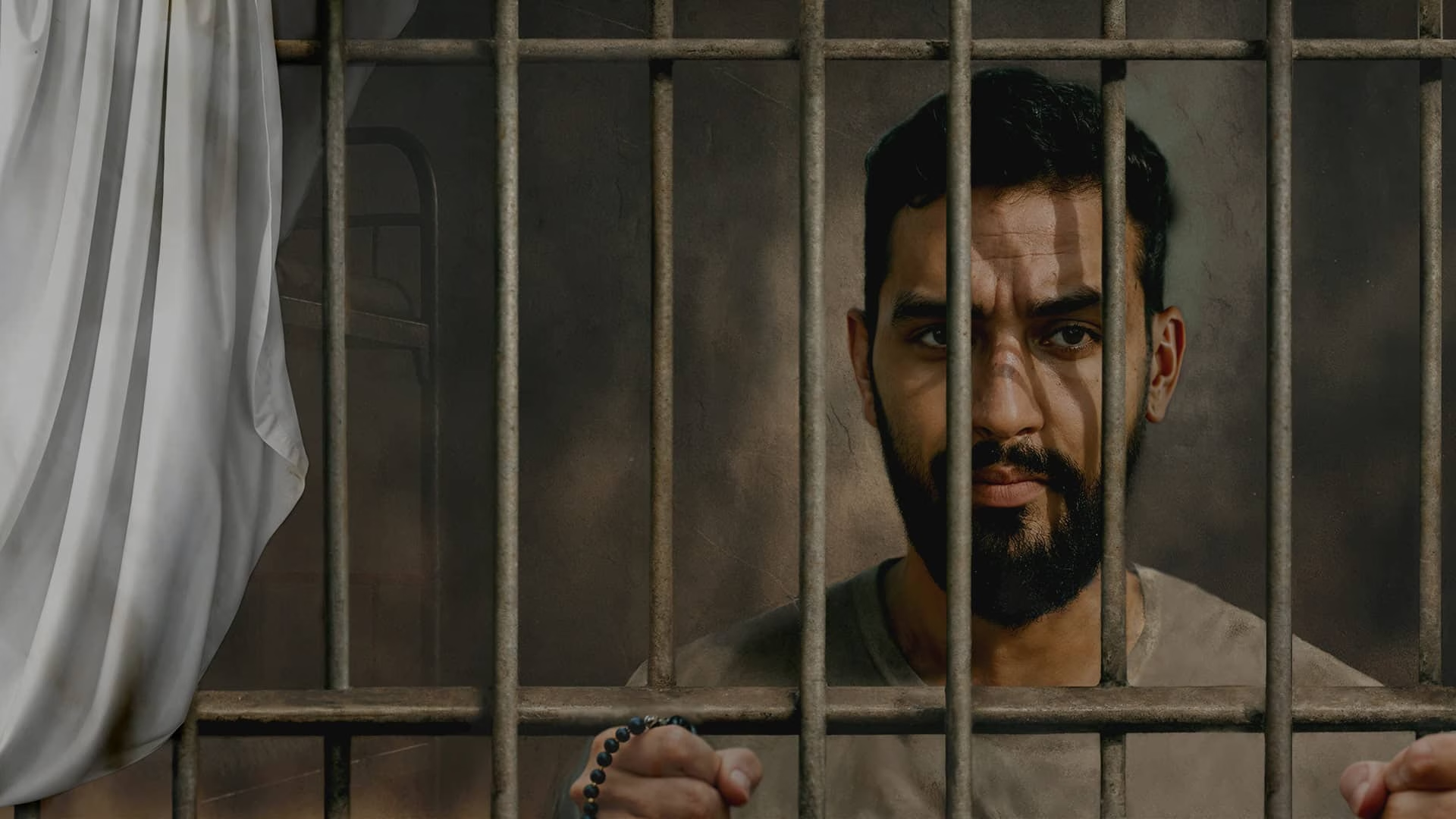

For thousands of Syrians facing indefinite detention in Lebanon, the cells are built with judicial dysfunction and geopolitics as much as iron and concrete. Most recently, these inmates have become a central point of tension between Beirut and Damascus as the two new governments seek to renegotiate their relationship. However, some of these inmates have been detained for more than 10 years without a formal charge or trial; others are serving convictions that rights groups and lawyers say resulted from due process violations, political interference, or confessions attained under torture. Others still appear to have been rightfully convicted for having committed crimes, though all face the same dire conditions: Lebanon’s prisons are severely overcrowded and unable to provide basic needs, such as food and healthcare.
The Syrian authorities’ approach of classifying every detainee as a “prisoner of conscience” is as problematic as Lebanon’s blanket characterization of them all as dangerous criminals or terrorists. Genuine justice demands a thorough, case-by-case assessment grounded in actual evidence. Individuals who are conclusively shown to have engaged in terrorism should be punished in accordance with the law, while those found to be innocent must be freed. Unfortunately, Lebanon’s judicial system has for more than a decade failed to uphold these essential principles, leading to a collective miscarriage of justice.
As the new Lebanese government seeks to stake out a reformist path for the country, the Syrian inmates are a litmus test: will Lebanon become a state that respects due process, timely access to justice, and judicial independence, or will its justice system remain stalled at the intersection of systemic abuse, institutional dysfunction, political interference, and indifference to wrongful detention? The story of how thousands of Syrians ended up in Lebanese jails reveals the mechanisms that perpetuate indefinite detention and legal limbo, the geopolitical weight the issue has taken on in the past year, and the high stakes for Lebanon’s justice system as it navigates a fragile relationship with Damascus.
How So Many Syrians Were Imprisoned in Lebanon
As Syria’s 2011 uprising escalated into civil war, hundreds of thousands of Syrians – civilians and combatants alike – entered Lebanon. The number of Syrians in Lebanese prisons promptly surged. While the total number remains unclear, estimates suggest roughly 2,000 Syrians are incarcerated in Lebanon today. Those arrested broadly fall into three categories: those charged with involvement in the Syrian conflict or its spillover into Lebanon, those targeted for their political affiliations, and those facing ordinary criminal charges.
The Lebanese army’s recapture of Arsal was followed by the first in a years-long series of mass arrest campaigns, as widespread anti-Syrian sentiment and increasingly repressive security measures against refugees took hold in Lebanon.
A turning point was the 2014 Arsal battles, when Syrian jihadist factions briefly took control of the northern Lebanese town, killing and capturing Lebanese troops. The Lebanese army’s recapture of Arsal was followed by the first in a years-long series of mass arrest campaigns, as widespread anti-Syrian sentiment and increasingly repressive security measures against refugees took hold in Lebanon.
Hezbollah, a staunch ally of the Assad regime, held predominant influence over the Lebanese political process and bureaucracy for most of the past 15 years. The prevailing environment in the country then allowed the group to leverage state institutions to “target opponents of the Syrian-Iranian-Hezbollah axis,” according to former chief military judge Peter Germanos, in speaking to BADIL. This led to Sunni Syrian refugees regularly facing accusations of being terrorists for real or imagined links to militant groups from ISIS to the Free Syrian Army.
At the start of the Syrian uprising, the debate inside Lebanese institutions centered around whether Syrian rebel groups, such as the Free Syrian Army, could be considered terrorist organizations, according to Ghida Frangieh, a lawyer and legal researcher at the Legal Agenda. With the rise of Syrian jihadi groups, the battles in Arsal, and other attacks in Lebanon, Frangieh said a Syrian with any perceived links to militant groups became considered a security threat, even for providing logistical or financial support to friends and family.
These courts have faced criticism for unfair trials, such as relying on confessions obtained under torture. Several analysts also suggested that there were numerous cases of Syrians facing dubious terrorism charges.
These shifts had important implications, given that Lebanese law permits the trial of terrorism and state security cases in military courts staffed by officers from the Ministry of Defense, even for nonviolent charges. These courts have faced criticism for unfair trials, such as relying on confessions obtained under torture. Several analysts also suggested that there were numerous cases of Syrians facing dubious terrorism charges.
“They can manipulate case files to give the appearance of security charges to target individuals for political reasons,” Germanos explained, pointing to instances where political critics were labeled as ISIS sympathizers or even Israeli agents. Rights groups estimate that almost 200 of the Syrians held on terrorism or security-related charges in Lebanon are, in reality, political prisoners. While the full scope is uncertain, these practices disproportionately affected Sunni Syrian refugees.
The surge of Syrians incarcerated in Lebanon over the past decade thus stemmed from both legitimate state security fears of militant infiltration and Hezbollah’s wider campaign, leveraging state institutions, against all Assad opponents, violent and nonviolent alike.
In 2024, former Lebanese Interior Minister Bassam Mawlawi revealed that 2,400 Syrians – about 35% of Lebanon’s prison population – were imprisoned, calling it unsustainable. He ordered expedited releases for those who had served their terms, and dozens were summarily deported to Syria without a clear legal framework. Many deportees disappeared or died after being handed to Assad’s regime in its final months, according to human rights lawyer Mohamed Sablouh, who advocates for Syrian inmates.
For the new Lebanese government that came to power in January, the perspective of the Syrian inmates has shifted from solely a security issue to also being a bilateral dispute.
In late 2024, Hezbollah’s influence in Lebanon entered sudden retreat following the devastating war with Israel. Near simultaneously, the Syrian militant group Hayat Tahrir al-Sham (HTS) overthrew the Assad regime. For the new Syrian government, led by former members of HTS – whose affiliates also number among those in Lebanese jails – the Syrian prisoners in Lebanon are now portrayed as citizens who were politically persecuted and imprisoned by Hezbollah-linked courts. For the Syrian government, the prisoners’ repatriation and rehabilitation is now a national priority. For the new Lebanese government that came to power in January, the perspective of the Syrian inmates has shifted from solely a security issue to also being a bilateral dispute.
The Machinery of Indefinite Detention
Military Courts and Article 108
One of the main reasons for the prolonged detention of Syrians in Lebanon is a legal loophole that permits indefinite pretrial detention for terrorism charges. Article 108 of Lebanon’s Code of Criminal Procedure caps pretrial detention at two months for misdemeanors and six months for felonies – except for certain serious offenses. Crimes involving homicide, drugs, state security, and terrorism are excluded from any time limits. This allows suspects to be held indefinitely without trial or charge.
Sablouh argued that this provision enables the military judiciary and security agencies to detain people for life without trial, fostering political abuse. Military courts, staffed by Defense Ministry–appointed officers, also claim jurisdiction over civilians in these cases – a practice criticized by Human Rights Watch for undermining fair trial rights and relying on coerced confessions, with Lebanese security forces regularly extracting confessions under torture.
In 2011, Sablouh drafted a bill to limit pretrial detention in terrorism cases, warning that “it is unacceptable that someone could remain in detention for 20 or 30 years without trial.” The bill was shelved, leaving dozens of Syrians and Lebanese trapped in legal limbo, some for over a decade, in violation of international norms.
Political Interference
Overt political interference compounds these legal gaps, blocking relief for detainees. Lebanese journalist and regional affairs expert Souhayb Jawhar, told BADIL that the Shi’ite political duo – Hezbollah and the Amal Movement – and their allies have been “the most uncompromising” in this regard. This assessment concurred with Germanos and other experts, who said that Hezbollah and its allies viewed Sunni Syrian inmates as ISIS-type threats or anti-Assad insurgents who had to be neutralized.
Hezbollah has consistently opposed broad releases or amnesties for Islamist inmates.
Hezbollah has consistently opposed broad releases or amnesties for Islamist inmates. In 2019, talks of a general amnesty for Islamist detainees collapsed when Hezbollah demanded the inclusion of Shia drug offenders, and its ally, the Free Patriotic Movement, pushed for including collaborators with Israel. These conditions knowingly made it impossible to pass the amnesty through parliament.
“Political interference…was and still is a reality” in these cases, noted lawyer Issam Khoury.
Today, with many inmates being HTS affiliates, ending their incarceration is “a personal cause” for Syrian President Ahmad Al Sharaa, according to Jawhar. He added that for Hezbollah, releasing such inmates and granting Damascus a symbolic victory would be seen as emboldening an adversary. Indeed, Syrian officials publicly accuse Hezbollah of obstructing a resolution. In August 2025, Syrian Foreign Ministry official Qutaiba Idlibi claimed Hezbollah was delaying a detainee transfer deal, effectively keeping them behind bars.
Some, however, disagree over the degree of Hezbollah’s influence in the judicial process. Journalist Mohamad Chamseddine told BADIL that Hezbollah’s influence over the military court is no greater than any other Lebanese sectarian faction, noting that even individuals close to Hezbollah have also faced prosecution on various charges.
Judicial Bottlenecks
The Lebanese judiciary’s chronic paralysis has further stalled progress on the Syrian inmates’ cases. Years of budget shortfalls and staff shortages have slowed the courts to a crawl. Khoury said that with the recent judicial appointments finally completed, it is now imperative to relaunch the justice process and to accelerate the handling of cases, given the enormous backlog weighing on the Lebanese legal system. As of 2023, pretrial detainees made up nearly 80 percent of Lebanon’s prison population – one of the world’s highest rates. The human toll is staggering: more than 70 percent of inmates, Lebanese and Syrian alike, have sat in prison over a decade without trial, languishing in legal purgatory.
Institutional Bias and Abuse
Credible reports of torture, coerced confessions, and discrimination cast doubt on many convictions. Human rights groups have documented severe abuse by Lebanese security services – including Military Intelligence, General Security, and the Internal Security Forces – inflicting beatings, electric shocks, stress positions, and threats during interrogations of Syrian detainees.
Sablouh says many cases were fabricated, and the judiciary’s failure to prosecute torturers was highlighted by the 2022 death of Syrian refugee Bashar Abd Saud: Lebanon’s first trial under the Anti-Torture Law ended with downgraded charges and lenient sentences, prompting Amnesty International to condemn the outcome as a missed opportunity to end impunity. This abuse flourished in a general environment of hostility towards Syrian refugees, regardless of their political affiliation, giving security forces greater license to abuse detainees, according to Frangieh. She added that while some of those behind bars are guilty of violent acts, “cases of torture, extracted confessions, [and] fabricated evidence…are definitely present.”
Dire Conditions in Lebanese Prisons
Inside Lebanon’s overcrowded prisons, Syrians – like Lebanese and other detainees – are subjected to conditions so harsh they have triggered riots, hunger strikes, and tragedy.
Roumieh prison, the nation’s largest, now holds over 4,000 inmates in facilities designed for just 1,200, while the overall prison population exceeds 300 percent of institutional capacity. Indeed, only two of Lebanon’s 25 facilities were purpose-built as prisons, with the rest being ad hoc adaptations of existing physical infrastructure. As BADIL has previously reported, “overcrowding is no accident; it’s a symptom of decades of state neglect.”
Severe overcrowding and the lack of food and proper medical care have led to a proliferation of disease, malnutrition, psychological breakdowns, and suicides.
Severe overcrowding and the lack of food and proper medical care have led to a proliferation of disease, malnutrition, psychological breakdowns, and suicides. In the past two years alone, at least 40 detainees have died due to inadequate medical care.
Syrian inmates and their families have repeatedly protested these conditions, staging hunger strikes inside Roumieh and sit-ins outside the prison and at border crossings. In February 2025, dozens of Syrian inmates began an 18-day hunger strike to demand either release or transfer to Syria.
Authorities have typically responded to unrest with force rather than reform, leading lawyers like Mohamed Sablouh to warn that “the country’s prisons are on the verge of exploding.”
Lawyer Issam Khoury emphasizes that this crisis “affects everyone behind bars – Lebanese and foreigners alike – and we urgently need to resolve this issue.”
Imprisoned by Geopolitics
In April, Lebanese Prime Minister Nawaf Salam raised the issue of inmates during a visit to Damascus, resulting in the creation of two joint Lebanese–Syrian committees. These committees were tasked with addressing Syrian inmates held in Lebanon, locating missing Lebanese in Syria, and improving border management. Lebanese Justice Minister Adel Nassar proposed a treaty to permit most Syrian prisoners to serve their sentences in Syria, excluding those convicted of terrorism or killing Lebanese citizens.
The Syrian government refers to those held in Roumieh as “detainees,” even after final court rulings against them, a framing Lebanese critics argue equates those convicted of terrorism with political prisoners and constitutes interference in Lebanon’s judiciary.
Mohamad Chamseddine pointed out that many inmates fought directly against the Lebanese Army, making their release legally and politically unviable. “Not even the judges can accept doing something of this sort,” he noted, leaving Lebanon constrained while Damascus continues to frame the inmates’ cause as political. The Syrian government refers to those held in Roumieh as “detainees,” even after final court rulings against them, a framing Lebanese critics argue equates those convicted of terrorism with political prisoners and constitutes interference in Lebanon’s judiciary.
Today, Hezbollah’s leverage is also diminished, but opinions differ regarding the party’s current obstruction of the inmate file. Souhayb Jawhar described Hezbollah as still flexing its leverage to prevent the inmates from being released. He added that this position is clear and strategic from the party’s perspective, as it sees the inmates as Sunni extremists who would pose a future threat to the party.
Conversely, Chamseddine sees Hezbollah’s influence over the judicial system as limited. Publicly, Hezbollah’s stance is unclear. Behind the scenes, however, Chamseddine says the inmates’ issue is increasingly shaping the wider talks between Beirut and Damascus as they negotiate a new relationship. Both sides appear to be leveraging the detainees in other negotiations related to combating smuggling, border demarcation, the repatriation of Syrian refugees, and the billions of dollars the Assad regime had stashed in Lebanese banks, among other issues.
“The file is being used as a geopolitical bargaining chip, not a judicial matter,” said Mohamad Chamseddine, describing the dynamic as “files for files.”
Justice, or Just a Bargaining Chip?
The fate of Syrian inmates in Lebanese prisons stands as a microcosm of the country’s broader struggle between inertia and reform. The hopeful trajectory would see Lebanon’s new government take concrete steps to institute genuine judicial independence, cap pretrial detention even for security cases, rigorously curb torture and coercion, and prioritize evidence-based, individual case reviews over sweeping demonization and mass punishment.
Lebanon must not only depoliticize its courts but also embed accountability and transparency from the prison cell to the negotiating table.
For this progressive outcome to manifest, Lebanon must not only depoliticize its courts but also embed accountability and transparency from the prison cell to the negotiating table. Should these criteria be met, the consequences could be transformative: prisoners would regain basic dignity and access to justice, Lebanese-Syrian ties could reset on firmer, equitable terms, and Lebanon could reclaim credibility as a state seeking reform rather than reproducing old injustices.
However, if present patterns persist – marked by judicial paralysis, political interference, and the use of detainees as pawns in regional negotiations – Lebanon’s justice system risks further entrenchment in dysfunction. Such a regressive path would see the inmates remain in interminable legal limbo with their rights denied, Lebanon’s relationship with post-Assad Syria poisoned by unresolved grievances, and hopes for meaningful reform receding into the shadows of political expediency and vested interests.
The status quo is arbitrary, indefinite detention and geopolitical bargaining in place of justice. Without a reset, the prison gates will remain shut not only on thousands of lives, but possibly on the promise of a new Lebanon itself.