
EXECUTIVE SUMMARY
In 1991, Lebanese ruling elites passed a general amnesty law absolving themselves from countless atrocities committed during the country’s civil war. The hasty post-war settlement didn’t just end a decade of conflict; it also shot down the truth and reconciliation process, allowing former warlords to restyle themselves as legitimate political leaders.
Today, thirty years later, the same ruling class continues to use amnesty laws for political leverage. Now, however, they exploit the lives of thousands of unfortunate Lebanese attempting to survive the country’s hellish prison system. The majority of prisoners are not criminal masterminds; they are impoverished men and women who lack political wasta, or influence, to stay out of jail.
With some 10,000 individuals languishing behind bars, canny politicians have learned to propose and debate amnesty laws at critical political junctures in order to leverage the hopes of prisoners, their families, and immediate communities. In a recent example, politicians attempted to rush an amnesty law through parliament after the 2019 October uprising, attempting to appeal to Lebanon’s three major sects: Sunni, Shia, and Christian communities.
Unwilling to lose this powerful political bartering tool, Lebanon’s political elites lack incentive to undertake serious prison reform. It is no wonder, therefore, that Lebanon’s squalid prison cells are the most overcrowded in the region. Poorly maintained buildings and severe overcrowding expose prisoners to countless diseases, and prisoners lack basic essentials such as undergarments, deodorants, and bedding. In times of global pandemic, they can quickly become death traps.
This shameful state of affairs is a symptom of decades of state neglect and paltry investment in the prison system. Without sufficient budgets, the poorly-trained Internal Security Forces, who currently manage Lebanese prisons, are unable to provide prisoners with basic essentials: sufficient healthy food, medical care, clothing, a hygienic environment, not to mention rehabilitation services.
Astonishingly, over half of all Lebanese detainees have not yet received trial. Throughout Lebanon’s recent history, a glut of pre-trial detainees has formed. Thanks to a slow and malfunctioning judiciary combined with laws that permit indefinite pre-trial detention, detainees face an average waiting time of a year just to receive their sentence – four times the average waiting length in Europe.
Nevertheless, several long overdue reforms could bring a modicum of improvement to the country’s shambolic detention regime. Holistic legal reform must arrive first, including the scrapping of arbitrary pre-trial detention periods, providing a legal basis for receiving a timely conviction, regardless of the crime. Soon after, the Ministry of Justice – equipped with sufficient budgetary resources – must finally wrestle prison administration away from the Ministry of Interior.
In the more immediate future, the Ministry of Interior should impose an obligatory training programme for Internal Security Forces (ISF) members who work as prison wardens, in addition to implementing alternative measures to pre-trial detention, such as geographical confinement and reporting to a supervisory office. Ultimately, state policies must concentrate on societal causes of crime by lifting large parts of the population out of poverty. The most important investments must be made in education, jobs, healthcare, and housing. Only these broader steps can ever hope to truly break this vicious cycle and plot a course towards rehabilitation of communities alongside correction facilities.
CROWDING OUT REFORM
Over 10,000 prisoners currently languish in the country’s 25 detention centres which have a collective official capacity of 3,500 inmates, making Lebanon’s prison occupancy level is the highest in the Middle East.1World Prison Brief, Lebanon Country Profile, 2019, https://www.prisonstudies.org/country/lebanon.↓ Lebanon faces little competition for this unenviable title; Lebanese prison occupancy rates are a shocking 287 percent, some way ahead of the United Arab Emirates (159%) and Jordan (150%).2World Prison Brief, Highest to Lowest – Occupancy Level (based on official capacity), 2019, https://www.prisonstudies.org/highest-to-lowest/occupancy-level?field_region_taxonomy_tid=21.↓ 3The most recent public data on prison capacity from the UAE is from 2014.↓
Box I: Standards, what standards?
Detention conditions in Lebanon fail to meet almost all of the UN’s Standard Minimum Rules for the Treatment of Prisons, also known as the Nelson Mandela Rules. The Mandela Rules outline 122 key indicators that are used as the primary international standard for evaluating, monitoring, and inspecting prison systems which include guidelines for healthcare, recruitment and training of prison staff, and disciplinary measures.4Penal Reform International, UN Nelson Mandela Rules, https://www.penalreform.org/issues/prison-conditions/standard-minimum-rules/.]↓ They aim to ensure the protection of prisoners’ human rights and dignity.5Andrew Gilmour, The Nelson Mandela Rules: Protecting the Rights of Persons Deprived of Liberty, https://www.un.org/en/un-chronicle/nelson-mandela-rules-protecting-rights-persons-deprived-liberty#:~:text=to%20sentenced%20prisoners.-,The%20Rules%20are%20based%20on%20an%20obligation%20to%20treat%20all,disciplinary%20measures%20to%20medical%20services.↓ This set of rules serve as the international standard for the treatment of prisoners and prison management.6United Nations Office on Drugs and Crime, The United Nations Standard Minimum Rules for the Treatment of Prisoners (the Nelson Mandela Rules), 2015, https://www.unodc.org/documents/justice-and-prison-reform/Nelson_Mandela_Rules-E-ebook.pdf.↓
Roumieh is the example of overcrowding par excellence; Lebanon’s largest prison holds more than 4,000 inmates alone – a staggering three times its official capacity – in especially squalid conditions.7Committee Against Torture, Annex III: The National mechanisms and institutions that supervise the protection and promotion of human rights in Lebanon, https://tbinternet.ohchr.org/Treaties/CAT/Shared%20Documents/LBN/INT_CAT_ADR_LBN_23259_E.docx.↓ Prisoners in Roumieh do not receive personal products for hygiene, with women prisoners complaining specifically about lacking undergarments, deodorants, and sanitary towels.8Lebanese Center for Human Rights, Prisons in Lebanon: Humanitarian and Legal Concerns, 2010, https://www.europarl.europa.eu/meetdocs/2009_2014/documents/droi/dv/201/201010/20101025_4-6cldh_en.pdf.↓ Poorly maintained buildings expose prisoners to high humidity and inadequate ventilation which, coupled with the severe overcrowding, frequently causes detainees and inmates to develop skin and respiratory diseases.9WASH in South Lebanon Prisons and Detention Centers, SHEILD, 2015.↓ Prisoners rarely experience sunlight and fresh air – a direct violation of Article 60 of Decree 14310 which states that prisoners have the right to access the outdoors for three hours a day.10The Parliamentary Human Rights Committee, UNDP and the High Commissioner for Human Rights Regional Office for the Middle East, The National Action Plan for Human Rights in Lebanon 2014 – 2019, https://www.ohchr.org/Documents/Issues/NHRA/Lebanon_en.pdf.↓ Inmates must lie on the floor without proper bedding in a room originally built to accommodate two prisoners, but in fact holds ten as a consequence of overcrowding.11United States Department of State, Lebanon 2019 Human Rights Report, 2019, https://www.state.gov/wp-content/uploads/2020/02/LEBANON-2019-HUMAN-RIGHTS-REPORT.pdf.↓
Overcrowding is no accident. It is a symptom of decades of blatant inaction by the state and paltry investment in the prison system. Only two of Lebanon’s 25 prisons were built for purpose, defying the United Nations Office for Project Services’ Technical Guidance for Building Prisons.12United Nations Office for Project Services, Technical Guidance for Building Prisons, 2016, https://content.unops.org/publications/Technical-guidance-Prison-Planning-2016_EN.pdf?mtime=20171215190045.↓ 13The document states that “prisons should be designed to take into account the provision of basic living conditions, such as light, water, sanitation, and adequate space for the number of prisoners intended to occupy the space, in addition to creating a space that allows for the control of prisoners’ movement and the separation of prisoners according to crime, sex, age, and conviction status.”↓ The vast majority are renovated buildings, such as Tripoli’s Qobbeh prison which was originally used as horse stables. Lebanon’s two infamous prisons, Roumieh and Zahle Prisons, are the only exceptions to this rule.14uan Ward, ‘The Whole System is Broken’: Lebanon’s prison riots stretch deeper than coronavirus fears, 2020, http://www.dailystar.com.lb/GetArticleBody.aspx?id=503615&fromgoogle=1.↓
However, even Roumieh’s intended layout has been undermined by the fact that prison was opened prior to the completion of the building’s construction. If designated rooms for state security personnel had been included in the prison’s design, these rooms could have served as additional space for prisoners, lessening the impact of by overcrowding.15Interview with Omar Nashabe, Prisons Expert, January 26, 2021.↓
Instead, Lebanese police and security forces have taken over several buildings intended to hold prisoners. Given the lack of investment in prison infrastructure, it is no wonder that the UN has likened the living conditions in Lebanese prisons to “torture.”16United Nations, OHCHR, Joint Submission in View of Lebanon’s Second Periodic Review by the Human Rights Council: Torture, Detention, and Unfair Trials, 2015, https://uprdoc.ohchr.org/uprweb/downloadfile.aspx?filename=2091&file=EnglishTranslation.↓
SEPARATION ISSUES
A combination of overcrowding and state negligence makes it almost impossible to separate prisoners according to age group, conviction status, and nature of crime. This reality violates not only the Mandela Rules,17United Nations Office on Drugs and Crime, The United Nations Standard Minimum Rules for the Treatment of Prisoners (the Nelson Mandela Rules), Rule 11, page 5, 2015, https://www.unodc.org/documents/justice-and-prison-reform/Nelson_Mandela_Rules-E-ebook.pdf.↓ but also Lebanese Decree 14310 from 1949 (See Box II).18The Lebanese Republic, Decree 1157: The Structural Organisation of the Internal Security Forces, 1991, https://isf.gov.lb/files/1157.pdf.↓ Only two prisons (Roumieh and Qobbeh) contain spaces exclusively devoted to hosting minors;19Samya Kullab, Inside Roumieh’s Walls, Prisoners Run the Show, 2013, http://www.rightsobserver.org/blog/_Inside_Roumieh%E2%80%99s_walls_prisoners_run_the_show.↓ however, even in these prisons, many minors are placed in detention with adults due to severe overcrowding, exposing them to sexual assault and violence.20Interview with Jad Tohme and Nermine Sibai, Human Rights Lawyers, January 15, 2021.↓
Box II: The weak arm of the law
Decree 14310 from 1949 outlines the organisation of detention centres, including standards for prisons and juvenile reform institutions. The law’s 152 articles deal with a wide array of issues from prison management, inspections, health care, visitation rights, and conditions of prisoners. Many of these provisions are in line with international standards, such as those related to inspection, medical care, separating prisoners according to their sex and criminal record, food, bedding, and clothing.21Alef, The Painful Whereabouts of Detention, 2008, Alef report english/carine.indd (alefliban.org)↓ However, poor enforcement means that in many Lebanese prisons, the law’s protections exist merely on paper. Moreover, subsequent laws investing the Ministry of Interior with the authority to run prisons have been similarly overlooked.22The Lebanese Republic, Decree 1157: The Structural Organisation of the Internal Security Forces, 1991, https://isf.gov.lb/files/1157.pdf.↓
In fact, the exigencies of overcrowding mean that prisoners are often separated according to sect, rather than the criteria laid out in Lebanese law.23Interview with Jad Tohme and Nermine Sibai, Human Rights Lawyers, January 15, 2021.↓ For example, Sunni prisoners are and those accused of violent extremism are generally sent to Roumieh’s Block B, while Shiite prisoners are allocated Block D.24Indi Phillips, Prison Radicalization: Indirect Processes of Radicalization at Lebanon’s Roumieh, 2019, https://eeradicalization.com/prison-radicalization-indirect-processes-of-radicalization-at-lebanons-roumieh/.↓ 25Interview with Jad Tohme and Nermine Sibai, Human Rights Lawyers, January 15, 2021.↓ By doing so, prison managers hope to prevent inter-sectarian tensions within the prison;26Interview with Jad Tohme and Nermine Sibai, Human Rights Lawyers, January 15, 2021.↓ 27Interview with Omar Nashabe, Prisons Expert, January 26, 2021.↓ but in reality, this practice overrides the separation of prisoners based on other important characteristics mentioned above, at the expense of vulnerable minorities (See Box III).
BOX III: Transgender and prison separation
Article 9 of Decree 14310, stipulating that females must be placed in prisons separate from men, is one of the few separation requirements respected in Lebanese prisons.28The Lebanese Republic, Article 9 of Decree 14310: Organisation of Prisons, Places of Detention, and Juvenile Reform Institutions, 1949, http://77.42.251.205/LawView.aspx?opt=view&LawID=204130.↓ However, the Lebanese law recognises only the gender indicated on legal identification, and not according to an individual’s choice. If transgender individual fails to change their sexuality on their legal identification, they would be imprisoned according to the sex stated on their identification.29Interview with Jad Tohme and Nermine Sibai, Human Rights Lawyers, January 15, 2021.↓ This violates Rule 7 of the Mandela Rules which states that once an individual is admitted into prison, information regarding their unique identity must be collected and their perceived gender must be respected.30United Nations Office on Drugs and Crime, The United Nations Standard Minimum Rules for the Treatment of Prisoners (the Nelson Mandela Rules), Rule 7, page 4, 2015, https://www.unodc.org/documents/justice-and-prison-reform/Nelson_Mandela_Rules-E-ebook.pdf.↓
THE LONG WAIT
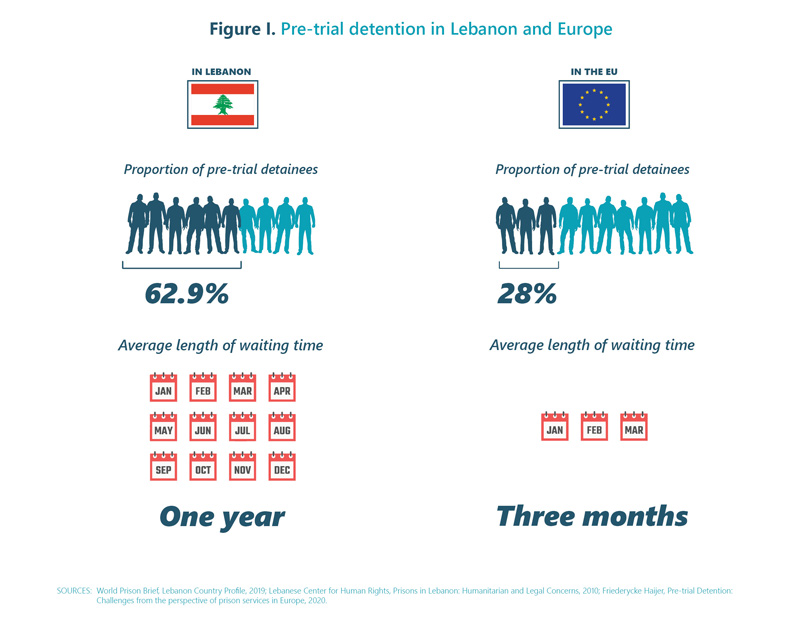
Throughout Lebanon’s history, laws that permit indefinite pre-trial detention combined with a slow and malfunctioning judiciary has created a glut of pre-trial detainees – prisoners who have not yet been convicted of any crime. Of Lebanon’s 10,032 inmates, 6,307 are currently awaiting trial, creating a pre-trial detention rate of 62.9%, over double the average in Europe (25-28%).31World Prison Brief, Lebanon Country Profile, 2019, https://www.prisonstudies.org/country/lebanon.↓ 32Friederycke Haijer, Pre-trial Detention: Challenges from the perspective of prison services in Europe, 2020, https://www.researchgate.net/publication/341407826_Pre-trial_detention_Challenges_from_the_perspective_of_prison_services_in_Europe.↓
In some cases, interminable pre-trial detention is not only inhumane – it is illegal too. Article 108 of the Code of Criminal Procedure provides maximum pre-trial detention lengths according to the nature of the crime. The period of pre-trial detention for a misdemeanour – legally defined as a crime with a penalty ranging from 10 days to 3 years – cannot exceed two months. 33Interview with Anonymous Criminal Judge, January 23, 2021.↓ 34The Lebanese Republic, Code of Criminal Procedure, Act No. 328 of 7 August 2001, http://ilo.org/dyn/natlex/docs/ELECTRONIC/89874/103351/F-330451556/LBN89874%20Eng.pdf.↓ Those accused of felonies – crimes with a penalty ranging from three years of hard labour and a death sentence35Interview with Anonymous Criminal Judge, January 23, 2021.↓ – should only wait six months before their trial.36The Lebanese Republic, Code of Criminal Procedure, Act No. 328 of 7 August 2001, http://ilo.org/dyn/natlex/docs/ELECTRONIC/89874/103351/F-330451556/LBN89874%20Eng.pdf.↓
However, these safeguards are far from comprehensive. Firstly, the maximum six month rule does not apply to certain felonies, some of which are loosely defined and open to a judge’s interpretation. This list includes crimes involving “homicide, drugs, the endangerment of state security, and felonies entailing extreme danger and crimes of terrorism.”37The Lebanese Republic, Code of Criminal Procedure, Act No. 328 of 7 August 2001, http://ilo.org/dyn/natlex/docs/ELECTRONIC/89874/103351/F-330451556/LBN89874%20Eng.pdf.↓ Without a maximum pre-trial detention length, prisoners accused of these acts may be held in pre-trial detention indefinitely. Moreover, the complete lack of punishments and an enforcement mechanism undermines the few legal protections of Article 108.
Lebanese law does include a number of alternative actions to detention such as travel restrictions, reporting regularly to the supervisory office, having to undergo regular examinations by physicians, or depositing a specified amount of money. However, investigative judges rarely apply these measures. Where this principle, enshrined in Article 111 of the Code of Criminal Procedure, could alleviate some of the endemic overcrowding of Lebanese prisons, the law cannot be applied fully as Lebanon lacks both the technology, such as ankle monitors, to monitor an individual’s whereabouts and a supervisory office with the mandate to receive reports from accused individual.38Centre for Civil and Political Rights, Civil society report on the implementation of the International Covenant on Civil and Political Rights in Lebanon, 2018, https://tbinternet.ohchr.org/Treaties/CCPR/Shared%20Documents/LBN/INT_CCPR_CSS_LBN_30241_E.pdf.↓ Lacking other options, judges continue to opt for immediate detention.39↓Centre for Civil and Political Rights, Civil society report on the implementation of the International Covenant on Civil and Political Rights in Lebanon, 2018, https://tbinternet.ohchr.org/Treaties/CCPR/Shared%20Documents/LBN/INT_CCPR_CSS_LBN_30241_E.pdf.40↓
Another important cause of the judicial lag is an insufficient number of judges. As of 2017, Lebanon was home to only 317 criminal judges and 286 civil judges, leaving one criminal judge for every 31 prisoners and one civil judge for every 35 prisoners, who refer cases to the criminal judges.41Rola Assi, UN ESCWA, Women in the Judiciary in Lebanon, 2018, https://www.unescwa.org/sites/www.unescwa.org/files/events/files/presentation_lebanon.pdf.↓ A lack of lack transportation to court hearings is another cause for judicial delays.4270% of a sample of 1,000 detainees in 2013 listed this as a reason for delays in their court hearings↓ For these reasons, detainees face an average waiting time of a year to receive their sentence.43Lebanese Center for Human Rights, Prisons in Lebanon: Humanitarian and Legal Concerns, 2010, https://www.europarl.europa.eu/meetdocs/2009_2014/documents/droi/dv/201/201010/20101025_4-6cldh_en.pdf.↓ In Europe, the average length of pre-trial detention in the European union is three months.44Friederycke Haijer, Pre-trial Detention: Challenges from the perspective of prison services in Europe, 2020, https://www.researchgate.net/publication/341407826_Pre-trial_detention_Challenges_from_the_perspective_of_prison_services_in_Europe.↓
Pre-trial detention lengths vary greatly according to the nature of the crime. Those accused of murder spend an average of three and a half years in pre-trial detention, crimes relating to drugs one and a half years, and robbery less than a year, while those detained on terrorism charges can wait for even longer.45Lebanese Center for Human Rights, Prisons in Lebanon: Humanitarian and Legal Concerns, 2010, https://www.europarl.europa.eu/meetdocs/2009_2014/documents/droi/dv/201/201010/20101025_4-6cldh_en.pdf↓ 46United States Department of State, Lebanon 2019 Human Rights Report, 2019, https://www.state.gov/wp-content/uploads/2020/02/LEBANON-2019-HUMAN-RIGHTS-REPORT.pdf.↓ Following the Nahr el-Bared conflict in 2008, some 425 people were arrested for allegedly having connections to Fatah al-Islam.47Camille Lons, Is justice for everyone? Arbitrary detention and torture of Islamists in Lebanon, 2019, https://civilsociety-centre.org/content/justice-everyone-arbitrary-detention-and-torture-islamists-lebanon.↓ Most remained in pre-trial detention for seven years, even though 50 people were eventually found innocent.48Camille Lons, Is justice for everyone? Arbitrary detention and torture of Islamists in Lebanon, 2019, https://civilsociety-centre.org/content/justice-everyone-arbitrary-detention-and-torture-islamists-lebanon.↓ More recently, jihadist fighters returning to Lebanon from Syria have been known to spend a whole decade in pre-trial detention, only to receive a three year sentence.49Interview with Jad Tohme and Nermine Sibai, Human Rights Lawyers, January 15, 2021.↓
A SCHOOL OF CRIME
While the Internal Security Forces (ISF) lacks exact statistics on recidivism, multiple experts agreed that repeat offenses are very common. In fact, prisoners often learn new and more serious criminal behaviour while behind bars, making them more likely to commit a more serious crime in the future.50 United States Department of State, Lebanon 2016 Human Rights Report, 2016, https://www.state.gov/wp-content/uploads/2019/01/Lebanon-1.pdf.↓
Deliberate state neglect is directly to blame for this vicious cycle. Overcrowding means that prisoners are separated more by sect than by nature of crime, and so each block within a prison typically contains a dominant group which imposes its authority on other prisoners.51Interview with Jad Tohme and Nermine Sibai, Human Rights Lawyers, January 15, 2021.↓ 52Michal Kranz, Lebanon’s Interior Minister Pushes for Prison Reform Amid Calls for Radical Change, 2019, https://www.al-monitor.com/originals/2019/05/lebanon-interior-minister-prison-reforms-penal-system.html.↓ In order to survive, detainees are often forced to adapt to their immediate environment. Rather than leaving prison reformed, these individuals leave prison with a new artillery of criminal knowledge.53Interview with Jad Tohme and Nermine Sibai, Human Rights Lawyers, January 15, 2021.↓ 54Lebanese Center for Human Rights, Prisons in Lebanon: Humanitarian and Legal Concerns, 2010, https://www.europarl.europa.eu/meetdocs/2009_2014/documents/droi/dv/201/201010/20101025_4-6cldh_en.pdf.↓ An inmate entering Block B of Roumieh, for example, must coexist with a majority of extremist prisoners.55EER, Philips, Indi, Prison Radicalization: Indirect Processes of Radicalization at Lebanon’s Roumieh, 2019, Prison Radicalization: Indirect Processes of Radicalization at Lebanon’s Roumieh – European Eye on Radicalization (eeradicalization.com)↓ Similarly, Shia prisoners who enter for minor drug-related offenses are likely to return to society with a deeper knowledge of drug trafficking.
Meanwhile, insufficient numbers of prison guards also increase the likelihood of transmission of criminal behaviour and radicalisation. A mere six guards are allocated for Block B’s three floors, home to approximately 850 inmates. This means that there are around 125 inmates for every prison guard, compared the European Union, where there are on average 2.7 inmates per prison guard.56European Prison Observatory, Prisons in Europe: 2019 report on European prisons and penitentiary systems, 2019, Prisonsineurope2019.pdf (antigone.it)↓
STARVING JUSTICE
The Lebanese government has remained impervious to calls to reform, despite decades of lobbying from rights groups and civil society actors. In 1949, Decree 14310 gave the Ministry of Interior and Municipalities control over the management of Lebanese prisons system.57The Lebanese Republic, Article 1 of Decree 14310: Organisation of Prisons, Places of Detention, and Juvenile Reform Institutions, 1949, http://77.42.251.205/LawView.aspx?opt=view&LawID=204130.↓ Subsequent legislation, such as Decree 17315 from 1964 and Decree 151 from 1983, has aimed to transfer prison control to the Ministry of Justice. In theory the ministry would be better suited because it would guarantee more efficient management and better trained guards that serve to rehabilitate rather than punish the prisoners.58Interview with Jad Tohme and Nermine Sibai, Human Rights Lawyers, January 15, 2021.↓ However, over half a century since legislative reforms began, no handover of power has taken place.
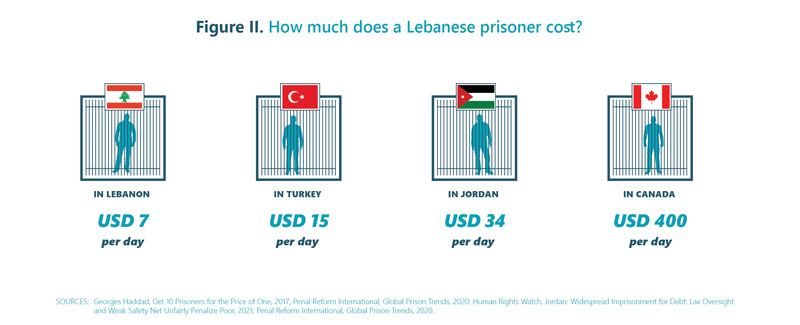
Even if prison management were handed to the Ministry of Justice, there would still be little guarantee of reform. The Ministry of Justice ‘s budget is even smaller than the Ministry of Interior’s, raising questions about its capacity to govern Lebanon’s prisons, should it assume control. The Ministry of Justice is allotted a mere 0.45 percent of the public budget, a tenth of the international standard which stands at around 4-5 percent.59Gherbal Initiative, State Budget, 2019, https://elgherbal.org/state-budget.↓ 60Interview with Anonymous Criminal Judge, January 23, 2021.↓ Meanwhile, the Ministry of Interior’s budgetary share is considerably higher at 6.42 percent of the public budget.61Gherbal Initiative, State Budget, 2019, https://elgherbal.org/state-budget.↓ It is little wonder then that the Lebanese government’s treasury currently spends a meagre 7 dollars per prisoner62Georges Haddad, Get 10 Prisoners for the Price of One, 2017, https://www.pressreader.com/lebanon/the-daily-star-lebanon/20171014/281676845136268.↓ – half that of nearby Turkey ($15) and around 60 times less than Canada ($400).63Penal Reform International, Global Prison Trends, 2020, https://cdn.penalreform.org/wp-content/uploads/2020/05/Global-Prison-Trends-2020-Penal-Reform-International-Second-Edition.pdf.↓ Sufficient prison budgets are necessary to ensure a sufficient supply of healthy food, medical care, clothing, and a hygienic environment, not to mention rehabilitation.64Penal Reform International, Global Prison Trends, 2020, https://cdn.penalreform.org/wp-content/uploads/2020/05/Global-Prison-Trends-2020-Penal-Reform-International-Second-Edition.pdf.↓
Funds are only one part of the issue; current prison management also lacks proper training.65Michal Kranz, Lebanon’s interior minister pushes for prison reform amid calls for radical change, 2019, https://www.al-monitor.com/originals/2019/05/lebanon-interior-minister-prison-reforms-penal-system.html↓ Many ISF members consider serving as a prison guard to be a punishment, and those with wasta – influence peddling – are able to be placed in higher positions, far away from the dreaded prison system.66Interview with Omar Nashabe, Prisons Expert, January 26, 2021.↓ The result is that most prison guards are merely untrained ISF officers with little awareness of minimum human rights and treatment standards. Their lack of training increases the likelihood that prisoners are subject to various forms of abuse and torture.67Omar Nashabe, Security Sector Reform in Lebanon: Internal Security Forces and General Security, 2009, https://gsdrc.org/document-library/security-sector-reform-in-lebanon-internal-security-forces-and-general-security/.↓
CLIENTELISM AND AMNESTY
Clientelist networks play a large role in the state’s public sector, and prisons are no exception. Politicians are allegedly able to use their influence to grant prisoners protection from abuse and harassment or provide them with comparative luxuries, such as mattresses.68Interview with Omar Nashabe, Prisons Expert, January 26, 2021.↓ If the politician does not collect a sum of money for this service, they are likely to expect political loyalty in the future.
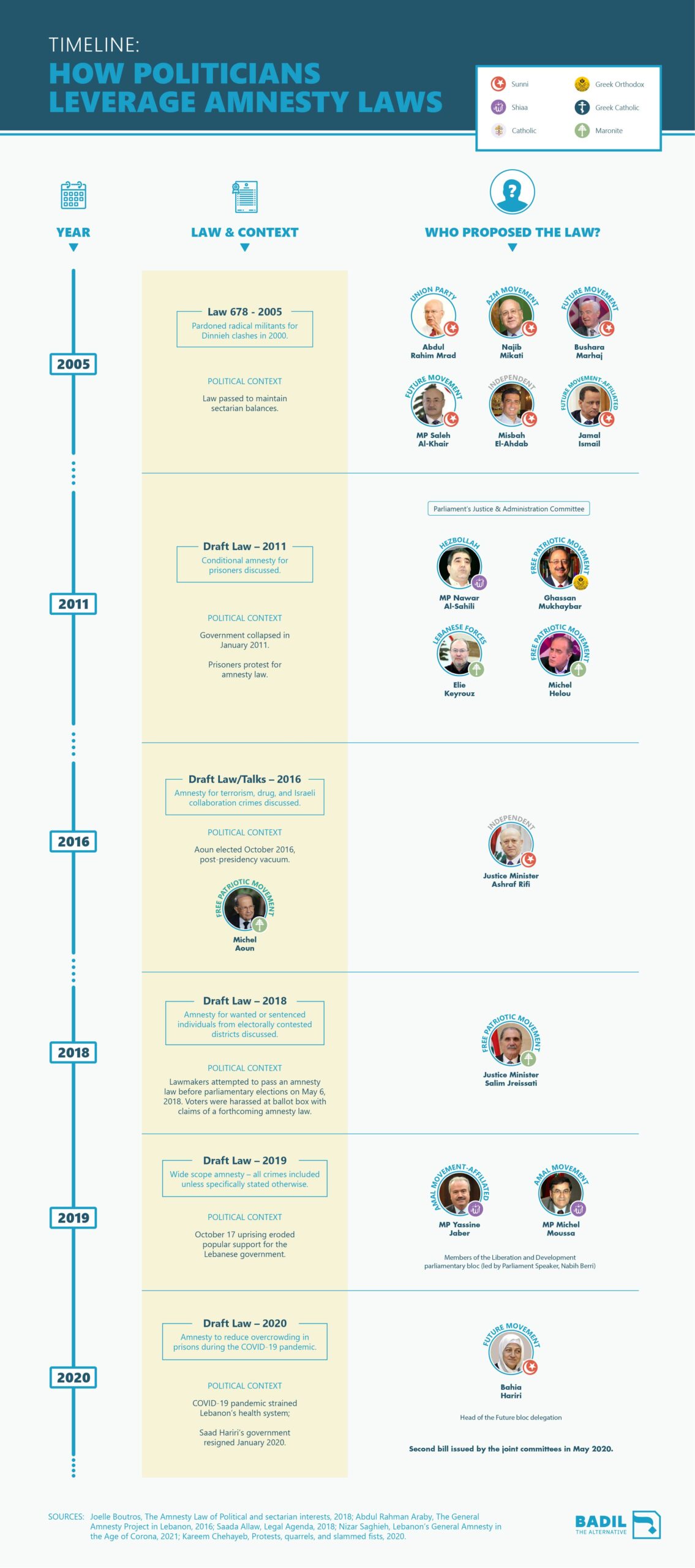
However, political figures have an even more powerful tool to leverage Lebanon’s unjust prison system in the form of amnesty laws. Since the civil war, politicians and parliamentary alliances have repeatedly used amnesty laws to serve their own political goals. By proposing amnesty laws at critical junctures, politicians have been able to ensure continued support from their electoral bases or even the Lebanese public at large.
The 2018 parliamentary elections were the most recent example of amnesty used as electoral propaganda. In the build up to the elections on May 6, 2018, lawmakers scrambled to pass an amnesty law which would have pardoned all misdemeanours with a few exceptions including building violations and consumer protection crimes.69Saada Allaw, المفكرة تتفرد بنشر مضمون المسودة الأخيرة لقانون العفو 2018: علام ترسو حسابات القوى الطائفية المتناقضة؟, 2018, https://legal-agenda.com/%d8%a7%d9%84%d9%85%d9%81%d9%83%d8%b1%d8%a9-%d8%aa%d8%aa%d9%81%d8%b1%d8%af-%d8%a8%d9%86%d8%b4%d8%b1-%d9%85%d8%b6%d9%85%d9%88%d9%86-%d8%a7%d9%84%d9%85%d8%b3%d9%88%d8%af%d8%a9-%d8%a7%d9%84%d8%a3%d8%ae/.↓ At the ballot boxes, party members harassed voters, reminding them that the amnesty law was being discussed.70Saada Allaw, المفكرة تتفرد بنشر مضمون المسودة الأخيرة لقانون العفو 2018: علام ترسو حسابات القوى الطائفية المتناقضة؟, 2018, https://legal-agenda.com/%d8%a7%d9%84%d9%85%d9%81%d9%83%d8%b1%d8%a9-%d8%aa%d8%aa%d9%81%d8%b1%d8%af-%d8%a8%d9%86%d8%b4%d8%b1-%d9%85%d8%b6%d9%85%d9%88%d9%86-%d8%a7%d9%84%d9%85%d8%b3%d9%88%d8%af%d8%a9-%d8%a7%d9%84%d8%a3%d8%ae/.↓ In 2005, a group of Sunni politicians including Abdul Rahim Mrad and Najib Mikati successfully pushed another amnesty law through parliament which specifically pardoned radical Islamists involved in the Dinnieh clashes of 2000.71Joelle Boutros, قانون العفو عام 2005: المصالح السياسية والطائفية على حساب المصالحة الحقيقية, 2018, https://legal-agenda.com/%D9%82%D8%A7%D9%86%D9%88%D9%86-%D8%A7%D9%84%D8%B9%D9%81%D9%88-%D8%B9%D8%A7%D9%85-2005-%D8%A7%D9%84%D9%85%D8%B5%D8%A7%D9%84%D8%AD-%D8%A7%D9%84%D8%B3%D9%8A%D8%A7%D8%B3%D9%8A%D8%A9-%D9%88%D8%A7%D9%84/.↓ It is little coincidence that this law was passed just one month after the 2005 parliamentary elections.
But recent years have also shown how amnesty laws can draw cross-party support, when the entire political establishment is threatened. The 2019 October revolution, for example, prompted renewed parliamentary discussion of the 2018 draft amnesty law. The new draft law sought to pardon a wide variety of crimes, in an effort to appeal to Sunni, Shiite, and Christian communities. The law would have cancelled 48,000 arrest warrants for drug trafficking crimes (the majority of which were in the Shia-dominated Baalbek-Hermel region), 6,000 warrants for dealing with Israel (in which Christians are well represented) and pardoning around 1,200 detainees arrested on terrorism charges (the majority of whom are from the Sunni sect).72Bachir Mostafa, إرادة من تنتصر في قانون العفو في لبنان؟, 2020, https://www.independentarabia.com/node/113571/%D8%B3%D9%8A%D8%A7%D8%B3%D8%A9/%D8%AA%D9%82%D8%A7%D8%B1%D9%8A%D8%B1/%D8%A5%D8%B1%D8%A7%D8%AF%D8%A9-%D9%85%D9%86-%D8%AA%D9%86%D8%AA%D8%B5%D8%B1-%D9%81%D9%8A-%D9%82%D8%A7%D9%86%D9%88%D9%86-%D8%A7%D9%84%D8%B9%D9%81%D9%88-%D9%81%D9%8A-%D9%84%D8%A8%D9%86%D8%A7%D9%86%D8%9F↓ Through proposing this law, political figures sought to regain cross-party support after the protest movement.73Makram Rabah, Lebanon’s amnesty law is the government’s last bid to save itself, 2019, https://english.alarabiya.net/views/news/middle-east/2019/11/24/Lebanon-s-amnesty-law-is-the-government-s-last-bid-to-save-itself.↓ 74Rayan Fakhoury, بم يناقض اقتراح قانون العفو العام التزامات لبنان الدولية؟ الإفلات من العقاب بغطاء تشريعي, 2019, https://legal-agenda.com/%D8%A8%D9%85-%D9%8A%D9%86%D8%A7%D9%82%D8%B6-%D8%A7%D9%82%D8%AA%D8%B1%D8%A7%D8%AD-%D9%82%D8%A7%D9%86%D9%88%D9%86-%D8%A7%D9%84%D8%B9%D9%81%D9%88-%D8%A7%D9%84%D8%B9%D8%A7%D9%85-%D8%A7%D9%84%D8%AA%D8%B2/.↓ However, sectarian disputes and widespread popular opposition derailed discussion of the draft law which remains unpassed.
The ongoing COVID-19 pandemic also drew cross-party support for amnesty laws, allegedly to alleviate pressures on the overcrowded prison system. Rather than addressing infrastructural issues and the judiciary’s backlog of cases, the parliament instead responded by reviving discussion of the draft amnesty law, which was submitted by head of the Future Movement bloc Bahia Hariri.75Nizar Saghieh, “العفو العامّ” واكتظاظ السّجون في زمن كورونا: الحقّ في الصحّة ذريعة لغايات سياسية وليس هدفاً, 2020, https://legal-agenda.com/%D8%A7%D9%84%D8%B9%D9%81%D9%88-%D8%A7%D9%84%D8%B9%D8%A7%D9%85-%D9%83%D9%85%D8%AF%D8%AE%D9%84-%D9%88%D8%A7%D9%83%D8%AA%D8%B8%D8%A7%D8%B8-%D8%A7%D9%84%D8%B3%D8%AC%D9%88%D9%86-%D9%81%D9%8A-%D8%B2/.↓ 76Kareem Chehayeb, Protests, quarrels, and slammed fists: Lebanon’s amnesty bill row rumbles on, 2020, https://www.middleeasteye.net/news/lebanons-parliament-delays-vote-controversial-amnesty-bill.↓ In the amended law, caretaker Justice Minister Marie-Claude Najm proposed the release of convicted prisoners who have less than six months left to serve.77Emily Lewis, Coronavirus: Lebanon moves to release inmates from overcrowded prisons, 2020, https://english.alarabiya.net/features/2020/04/03/Coronavirus-Lebanon-moves-to-release-inmates-from-overcrowded-prisons.↓ Parliament pushed for an urgent draft law approved by the cabinet that would pardon prisoners that have served their sentence but are still imprisoned on the account of failing to pay their fines.78Emily Lewis, Coronavirus: Lebanon moves to release inmates from overcrowded prisons, 2020, https://english.alarabiya.net/features/2020/04/03/Coronavirus-Lebanon-moves-to-release-inmates-from-overcrowded-prisons.↓
RECOMMENDATIONS
With a growing proportion of Lebanese living under the poverty line, desperate individuals are increasingly likely to resort to crime. However, punishment alone will not serve them and their marginalised communities; only true rehabilitation can end the vicious cycle which is perpetuated by politicians with narrow sectarian goals.
A number of concrete steps could soon bring about much-needed respite for those suffering under Lebanon’s shambolic detention regime. Holistic legal reform must arrive first, starting with eliminating arbitrary detention periods under Article 108 of the Code of Criminal Procedure. A legal amendment should eliminate arbitrary detention periods for the four currently excluded crimes, providing a legal basis for receiving a timely conviction, regardless of the crime. Simultaneously, sincere efforts should be made to finally transfer prison authority away from the Ministry of Interior to the Ministry of Justice, which is a more appropriate institution for the task. This long overdue transition process must also guarantee sufficient budgetary resources for the new ministry.
Once the handover is complete, the Ministry of Justice should focus on strengthening its human capital to ensure the smooth running of the justice system. This must include both increasing the number of judges and training them to understand the benefits of providing alternative sentences to imprisonment. Simultaneously, prisons must digitise their records; the current system functions on pen and paper, making collecting, storing, and retrieving information and evidence for a case a lengthy process which can cause delays in the courts.
In the more immediate future, much can be done to improve the inhuman conditions suffered by Lebanese prisoners. The Ministry of Interior should impose an obligatory training programme for ISF members who work as prison wardens. Bringing professionalism and dignity to this task should destigmatise the position in the eyes of ISF staff, whilst also benefiting prisoners. The ministry should also invest more resources in enforcing Lebanese Law’s minimum requirements for prison conditions. A powerful regulatory body should be established immediately to punish all instances where the minimum standards are violated.
However, overcrowding is an intractable issue which regulation alone cannot solve. For this reason, lowering the occupancy rates of Lebanon’s prison cells should also be an immediate priority for reform. A successful policy would take away pressure on the state’s inadequate detention infrastructure, and, theoretically at least, allow prison management to separate prisoners according to international best practices.
Lebanese law already sanctions a number of alternatives to imprisonment for prisoners who have not seen trial which, if implemented, would reduce the country’s ludicrously high pre-trial detention rates. However, many of these alternative measures – for example, geographical confinement and reporting to a supervisory office – cannot be implemented due to an absence of technology or administrative capability. In order to correct this, the Ministry of Justice should invest in basic technologies such as ankle tags, which would immediately alleviate pressure on the prison system. An even cheaper solution would be to provide a supervisory office with the mandate to receive and file prisoners’ reports, as laid out in Article 111 of the Code of Criminal Procedure.79The Lebanese Republic, Code of Criminal Procedure, Act No. 328 of 7 August 2001, http://ilo.org/dyn/natlex/docs/ELECTRONIC/89874/103351/F-330451556/LBN89874%20Eng.pdf↓
Another way of diminishing strain on Lebanon’s bursting prisons would be to introduce community service and parole systems for non-violent crimes. Prisoners convicted of minor misdemeanours may only receive a sentence as short as ten days, but even this can do irreparable damage to an individual’s reputation. A community service system would remove the stigma surrounding imprisonment for petty criminals, allowing them more easily to transition back into normal life.80Interview with Anonymous Criminal Judge, January 23, 2021.↓ Similarly, a well-managed parole system would allow prisoners to serve their sentence outside of jail, reward good behaviour and alleviating overcrowding.
When the policies, funding, and infrastructure are in place, the state must turn its attention to addressing the root causes of crime. Marginalisation in low income communities is likely to increase in the coming period, and a heavy handed approach to crime and punishment will only accelerate the vicious cycle of prison conditions, radicalisation, recidivism, and clientelism.
For these reasons, any future prison reforms must also be linked to government budgets and aid transforming policing to community support and rehabilitation of social infrastructure including education, jobs, healthcare, and housing. Only these important social investments can hope to truly break this vicious cycle and plot a course towards rehabilitation of communities alongside correction facilities.
EDITOR’S NOTE
Triangle would like to express its heartfelt gratitude to all the activists, researchers, journalists, and academics who anonymously contributed to this policy paper.
Triangle made multiple requests for comment from the Internal Security Forces (ISF), with no response.
This paper was compiled with the support of International Media Support (IMS).
Footnotesالهوامش
- 1World Prison Brief, Lebanon Country Profile, 2019, https://www.prisonstudies.org/country/lebanon. ↩︎
- 2World Prison Brief, Highest to Lowest – Occupancy Level (based on official capacity), 2019, https://www.prisonstudies.org/highest-to-lowest/occupancy-level?field_region_taxonomy_tid=21. ↩︎
- 3The most recent public data on prison capacity from the UAE is from 2014. ↩︎
- 4Penal Reform International, UN Nelson Mandela Rules, https://www.penalreform.org/issues/prison-conditions/standard-minimum-rules/.] ↩︎
- 5Andrew Gilmour, The Nelson Mandela Rules: Protecting the Rights of Persons Deprived of Liberty, https://www.un.org/en/un-chronicle/nelson-mandela-rules-protecting-rights-persons-deprived-liberty#:~:text=to%20sentenced%20prisoners.-,The%20Rules%20are%20based%20on%20an%20obligation%20to%20treat%20all,disciplinary%20measures%20to%20medical%20services. ↩︎
- 6United Nations Office on Drugs and Crime, The United Nations Standard Minimum Rules for the Treatment of Prisoners (the Nelson Mandela Rules), 2015, https://www.unodc.org/documents/justice-and-prison-reform/Nelson_Mandela_Rules-E-ebook.pdf. ↩︎
- 7Committee Against Torture, Annex III: The National mechanisms and institutions that supervise the protection and promotion of human rights in Lebanon, https://tbinternet.ohchr.org/Treaties/CAT/Shared%20Documents/LBN/INT_CAT_ADR_LBN_23259_E.docx. ↩︎
- 8Lebanese Center for Human Rights, Prisons in Lebanon: Humanitarian and Legal Concerns, 2010, https://www.europarl.europa.eu/meetdocs/2009_2014/documents/droi/dv/201/201010/20101025_4-6cldh_en.pdf. ↩︎
- 9WASH in South Lebanon Prisons and Detention Centers, SHEILD, 2015. ↩︎
- 10The Parliamentary Human Rights Committee, UNDP and the High Commissioner for Human Rights Regional Office for the Middle East, The National Action Plan for Human Rights in Lebanon 2014 – 2019, https://www.ohchr.org/Documents/Issues/NHRA/Lebanon_en.pdf. ↩︎
- 11
- 12United Nations Office for Project Services, Technical Guidance for Building Prisons, 2016, https://content.unops.org/publications/Technical-guidance-Prison-Planning-2016_EN.pdf?mtime=20171215190045. ↩︎
- 13The document states that “prisons should be designed to take into account the provision of basic living conditions, such as light, water, sanitation, and adequate space for the number of prisoners intended to occupy the space, in addition to creating a space that allows for the control of prisoners’ movement and the separation of prisoners according to crime, sex, age, and conviction status.” ↩︎
- 14uan Ward, ‘The Whole System is Broken’: Lebanon’s prison riots stretch deeper than coronavirus fears, 2020, http://www.dailystar.com.lb/GetArticleBody.aspx?id=503615&fromgoogle=1. ↩︎
- 15Interview with Omar Nashabe, Prisons Expert, January 26, 2021. ↩︎
- 16United Nations, OHCHR, Joint Submission in View of Lebanon’s Second Periodic Review by the Human Rights Council: Torture, Detention, and Unfair Trials, 2015, https://uprdoc.ohchr.org/uprweb/downloadfile.aspx?filename=2091&file=EnglishTranslation. ↩︎
- 17United Nations Office on Drugs and Crime, The United Nations Standard Minimum Rules for the Treatment of Prisoners (the Nelson Mandela Rules), Rule 11, page 5, 2015, https://www.unodc.org/documents/justice-and-prison-reform/Nelson_Mandela_Rules-E-ebook.pdf. ↩︎
- 18The Lebanese Republic, Decree 1157: The Structural Organisation of the Internal Security Forces, 1991, https://isf.gov.lb/files/1157.pdf. ↩︎
- 19Samya Kullab, Inside Roumieh’s Walls, Prisoners Run the Show, 2013, http://www.rightsobserver.org/blog/_Inside_Roumieh%E2%80%99s_walls_prisoners_run_the_show. ↩︎
- 20Interview with Jad Tohme and Nermine Sibai, Human Rights Lawyers, January 15, 2021. ↩︎
- 21Alef, The Painful Whereabouts of Detention, 2008, Alef report english/carine.indd (alefliban.org) ↩︎
- 22The Lebanese Republic, Decree 1157: The Structural Organisation of the Internal Security Forces, 1991, https://isf.gov.lb/files/1157.pdf. ↩︎
- 23Interview with Jad Tohme and Nermine Sibai, Human Rights Lawyers, January 15, 2021. ↩︎
- 24Indi Phillips, Prison Radicalization: Indirect Processes of Radicalization at Lebanon’s Roumieh, 2019, https://eeradicalization.com/prison-radicalization-indirect-processes-of-radicalization-at-lebanons-roumieh/. ↩︎
- 25Interview with Jad Tohme and Nermine Sibai, Human Rights Lawyers, January 15, 2021. ↩︎
- 26Interview with Jad Tohme and Nermine Sibai, Human Rights Lawyers, January 15, 2021. ↩︎
- 27Interview with Omar Nashabe, Prisons Expert, January 26, 2021. ↩︎
- 28The Lebanese Republic, Article 9 of Decree 14310: Organisation of Prisons, Places of Detention, and Juvenile Reform Institutions, 1949, http://77.42.251.205/LawView.aspx?opt=view&LawID=204130. ↩︎
- 29Interview with Jad Tohme and Nermine Sibai, Human Rights Lawyers, January 15, 2021. ↩︎
- 30United Nations Office on Drugs and Crime, The United Nations Standard Minimum Rules for the Treatment of Prisoners (the Nelson Mandela Rules), Rule 7, page 4, 2015, https://www.unodc.org/documents/justice-and-prison-reform/Nelson_Mandela_Rules-E-ebook.pdf. ↩︎
- 31World Prison Brief, Lebanon Country Profile, 2019, https://www.prisonstudies.org/country/lebanon. ↩︎
- 32Friederycke Haijer, Pre-trial Detention: Challenges from the perspective of prison services in Europe, 2020, https://www.researchgate.net/publication/341407826_Pre-trial_detention_Challenges_from_the_perspective_of_prison_services_in_Europe. ↩︎
- 33Interview with Anonymous Criminal Judge, January 23, 2021. ↩︎
- 34The Lebanese Republic, Code of Criminal Procedure, Act No. 328 of 7 August 2001, http://ilo.org/dyn/natlex/docs/ELECTRONIC/89874/103351/F-330451556/LBN89874%20Eng.pdf. ↩︎
- 35Interview with Anonymous Criminal Judge, January 23, 2021. ↩︎
- 36The Lebanese Republic, Code of Criminal Procedure, Act No. 328 of 7 August 2001, http://ilo.org/dyn/natlex/docs/ELECTRONIC/89874/103351/F-330451556/LBN89874%20Eng.pdf. ↩︎
- 37The Lebanese Republic, Code of Criminal Procedure, Act No. 328 of 7 August 2001, http://ilo.org/dyn/natlex/docs/ELECTRONIC/89874/103351/F-330451556/LBN89874%20Eng.pdf. ↩︎
- 38Centre for Civil and Political Rights, Civil society report on the implementation of the International Covenant on Civil and Political Rights in Lebanon, 2018, https://tbinternet.ohchr.org/Treaties/CCPR/Shared%20Documents/LBN/INT_CCPR_CSS_LBN_30241_E.pdf. ↩︎
- 39
- 40
- 41Rola Assi, UN ESCWA, Women in the Judiciary in Lebanon, 2018, https://www.unescwa.org/sites/www.unescwa.org/files/events/files/presentation_lebanon.pdf. ↩︎
- 4270% of a sample of 1,000 detainees in 2013 listed this as a reason for delays in their court hearings ↩︎
- 43Lebanese Center for Human Rights, Prisons in Lebanon: Humanitarian and Legal Concerns, 2010, https://www.europarl.europa.eu/meetdocs/2009_2014/documents/droi/dv/201/201010/20101025_4-6cldh_en.pdf. ↩︎
- 44Friederycke Haijer, Pre-trial Detention: Challenges from the perspective of prison services in Europe, 2020, https://www.researchgate.net/publication/341407826_Pre-trial_detention_Challenges_from_the_perspective_of_prison_services_in_Europe. ↩︎
- 45Lebanese Center for Human Rights, Prisons in Lebanon: Humanitarian and Legal Concerns, 2010, https://www.europarl.europa.eu/meetdocs/2009_2014/documents/droi/dv/201/201010/20101025_4-6cldh_en.pdf ↩︎
- 46
- 47Camille Lons, Is justice for everyone? Arbitrary detention and torture of Islamists in Lebanon, 2019, https://civilsociety-centre.org/content/justice-everyone-arbitrary-detention-and-torture-islamists-lebanon. ↩︎
- 48Camille Lons, Is justice for everyone? Arbitrary detention and torture of Islamists in Lebanon, 2019, https://civilsociety-centre.org/content/justice-everyone-arbitrary-detention-and-torture-islamists-lebanon. ↩︎
- 49Interview with Jad Tohme and Nermine Sibai, Human Rights Lawyers, January 15, 2021. ↩︎
- 50United States Department of State, Lebanon 2016 Human Rights Report, 2016, https://www.state.gov/wp-content/uploads/2019/01/Lebanon-1.pdf. ↩︎
- 51Interview with Jad Tohme and Nermine Sibai, Human Rights Lawyers, January 15, 2021. ↩︎
- 52Michal Kranz, Lebanon’s Interior Minister Pushes for Prison Reform Amid Calls for Radical Change, 2019, https://www.al-monitor.com/originals/2019/05/lebanon-interior-minister-prison-reforms-penal-system.html. ↩︎
- 53Interview with Jad Tohme and Nermine Sibai, Human Rights Lawyers, January 15, 2021. ↩︎
- 54Lebanese Center for Human Rights, Prisons in Lebanon: Humanitarian and Legal Concerns, 2010, https://www.europarl.europa.eu/meetdocs/2009_2014/documents/droi/dv/201/201010/20101025_4-6cldh_en.pdf. ↩︎
- 55EER, Philips, Indi, Prison Radicalization: Indirect Processes of Radicalization at Lebanon’s Roumieh, 2019, Prison Radicalization: Indirect Processes of Radicalization at Lebanon’s Roumieh – European Eye on Radicalization (eeradicalization.com) ↩︎
- 56European Prison Observatory, Prisons in Europe: 2019 report on European prisons and penitentiary systems, 2019, Prisonsineurope2019.pdf (antigone.it) ↩︎
- 57The Lebanese Republic, Article 1 of Decree 14310: Organisation of Prisons, Places of Detention, and Juvenile Reform Institutions, 1949, http://77.42.251.205/LawView.aspx?opt=view&LawID=204130. ↩︎
- 58Interview with Jad Tohme and Nermine Sibai, Human Rights Lawyers, January 15, 2021. ↩︎
- 59Gherbal Initiative, State Budget, 2019, https://elgherbal.org/state-budget. ↩︎
- 60Interview with Anonymous Criminal Judge, January 23, 2021. ↩︎
- 61Gherbal Initiative, State Budget, 2019, https://elgherbal.org/state-budget. ↩︎
- 62Georges Haddad, Get 10 Prisoners for the Price of One, 2017, https://www.pressreader.com/lebanon/the-daily-star-lebanon/20171014/281676845136268. ↩︎
- 63Penal Reform International, Global Prison Trends, 2020, https://cdn.penalreform.org/wp-content/uploads/2020/05/Global-Prison-Trends-2020-Penal-Reform-International-Second-Edition.pdf. ↩︎
- 64Penal Reform International, Global Prison Trends, 2020, https://cdn.penalreform.org/wp-content/uploads/2020/05/Global-Prison-Trends-2020-Penal-Reform-International-Second-Edition.pdf. ↩︎
- 65Michal Kranz, Lebanon’s interior minister pushes for prison reform amid calls for radical change, 2019, https://www.al-monitor.com/originals/2019/05/lebanon-interior-minister-prison-reforms-penal-system.html ↩︎
- 66Interview with Omar Nashabe, Prisons Expert, January 26, 2021. ↩︎
- 67Omar Nashabe, Security Sector Reform in Lebanon: Internal Security Forces and General Security, 2009, https://gsdrc.org/document-library/security-sector-reform-in-lebanon-internal-security-forces-and-general-security/. ↩︎
- 68Interview with Omar Nashabe, Prisons Expert, January 26, 2021. ↩︎
- 69Saada Allaw, المفكرة تتفرد بنشر مضمون المسودة الأخيرة لقانون العفو 2018: علام ترسو حسابات القوى الطائفية المتناقضة؟, 2018, https://legal-agenda.com/%d8%a7%d9%84%d9%85%d9%81%d9%83%d8%b1%d8%a9-%d8%aa%d8%aa%d9%81%d8%b1%d8%af-%d8%a8%d9%86%d8%b4%d8%b1-%d9%85%d8%b6%d9%85%d9%88%d9%86-%d8%a7%d9%84%d9%85%d8%b3%d9%88%d8%af%d8%a9-%d8%a7%d9%84%d8%a3%d8%ae/. ↩︎
- 70Saada Allaw, المفكرة تتفرد بنشر مضمون المسودة الأخيرة لقانون العفو 2018: علام ترسو حسابات القوى الطائفية المتناقضة؟, 2018, https://legal-agenda.com/%d8%a7%d9%84%d9%85%d9%81%d9%83%d8%b1%d8%a9-%d8%aa%d8%aa%d9%81%d8%b1%d8%af-%d8%a8%d9%86%d8%b4%d8%b1-%d9%85%d8%b6%d9%85%d9%88%d9%86-%d8%a7%d9%84%d9%85%d8%b3%d9%88%d8%af%d8%a9-%d8%a7%d9%84%d8%a3%d8%ae/. ↩︎
- 71Joelle Boutros, قانون العفو عام 2005: المصالح السياسية والطائفية على حساب المصالحة الحقيقية, 2018, https://legal-agenda.com/%D9%82%D8%A7%D9%86%D9%88%D9%86-%D8%A7%D9%84%D8%B9%D9%81%D9%88-%D8%B9%D8%A7%D9%85-2005-%D8%A7%D9%84%D9%85%D8%B5%D8%A7%D9%84%D8%AD-%D8%A7%D9%84%D8%B3%D9%8A%D8%A7%D8%B3%D9%8A%D8%A9-%D9%88%D8%A7%D9%84/. ↩︎
- 72Bachir Mostafa, إرادة من تنتصر في قانون العفو في لبنان؟, 2020, https://www.independentarabia.com/node/113571/%D8%B3%D9%8A%D8%A7%D8%B3%D8%A9/%D8%AA%D9%82%D8%A7%D8%B1%D9%8A%D8%B1/%D8%A5%D8%B1%D8%A7%D8%AF%D8%A9-%D9%85%D9%86-%D8%AA%D9%86%D8%AA%D8%B5%D8%B1-%D9%81%D9%8A-%D9%82%D8%A7%D9%86%D9%88%D9%86-%D8%A7%D9%84%D8%B9%D9%81%D9%88-%D9%81%D9%8A-%D9%84%D8%A8%D9%86%D8%A7%D9%86%D8%9F ↩︎
- 73Makram Rabah, Lebanon’s amnesty law is the government’s last bid to save itself, 2019, https://english.alarabiya.net/views/news/middle-east/2019/11/24/Lebanon-s-amnesty-law-is-the-government-s-last-bid-to-save-itself. ↩︎
- 74Rayan Fakhoury, بم يناقض اقتراح قانون العفو العام التزامات لبنان الدولية؟ الإفلات من العقاب بغطاء تشريعي, 2019, https://legal-agenda.com/%D8%A8%D9%85-%D9%8A%D9%86%D8%A7%D9%82%D8%B6-%D8%A7%D9%82%D8%AA%D8%B1%D8%A7%D8%AD-%D9%82%D8%A7%D9%86%D9%88%D9%86-%D8%A7%D9%84%D8%B9%D9%81%D9%88-%D8%A7%D9%84%D8%B9%D8%A7%D9%85-%D8%A7%D9%84%D8%AA%D8%B2/. ↩︎
- 75Nizar Saghieh, “العفو العامّ” واكتظاظ السّجون في زمن كورونا: الحقّ في الصحّة ذريعة لغايات سياسية وليس هدفاً, 2020, https://legal-agenda.com/%D8%A7%D9%84%D8%B9%D9%81%D9%88-%D8%A7%D9%84%D8%B9%D8%A7%D9%85-%D9%83%D9%85%D8%AF%D8%AE%D9%84-%D9%88%D8%A7%D9%83%D8%AA%D8%B8%D8%A7%D8%B8-%D8%A7%D9%84%D8%B3%D8%AC%D9%88%D9%86-%D9%81%D9%8A-%D8%B2/. ↩︎
- 76Kareem Chehayeb, Protests, quarrels, and slammed fists: Lebanon’s amnesty bill row rumbles on, 2020, https://www.middleeasteye.net/news/lebanons-parliament-delays-vote-controversial-amnesty-bill. ↩︎
- 77Emily Lewis, Coronavirus: Lebanon moves to release inmates from overcrowded prisons, 2020, https://english.alarabiya.net/features/2020/04/03/Coronavirus-Lebanon-moves-to-release-inmates-from-overcrowded-prisons. ↩︎
- 78Emily Lewis, Coronavirus: Lebanon moves to release inmates from overcrowded prisons, 2020, https://english.alarabiya.net/features/2020/04/03/Coronavirus-Lebanon-moves-to-release-inmates-from-overcrowded-prisons. ↩︎
- 79The Lebanese Republic, Code of Criminal Procedure, Act No. 328 of 7 August 2001, http://ilo.org/dyn/natlex/docs/ELECTRONIC/89874/103351/F-330451556/LBN89874%20Eng.pdf ↩︎
- 80Interview with Anonymous Criminal Judge, January 23, 2021. ↩︎