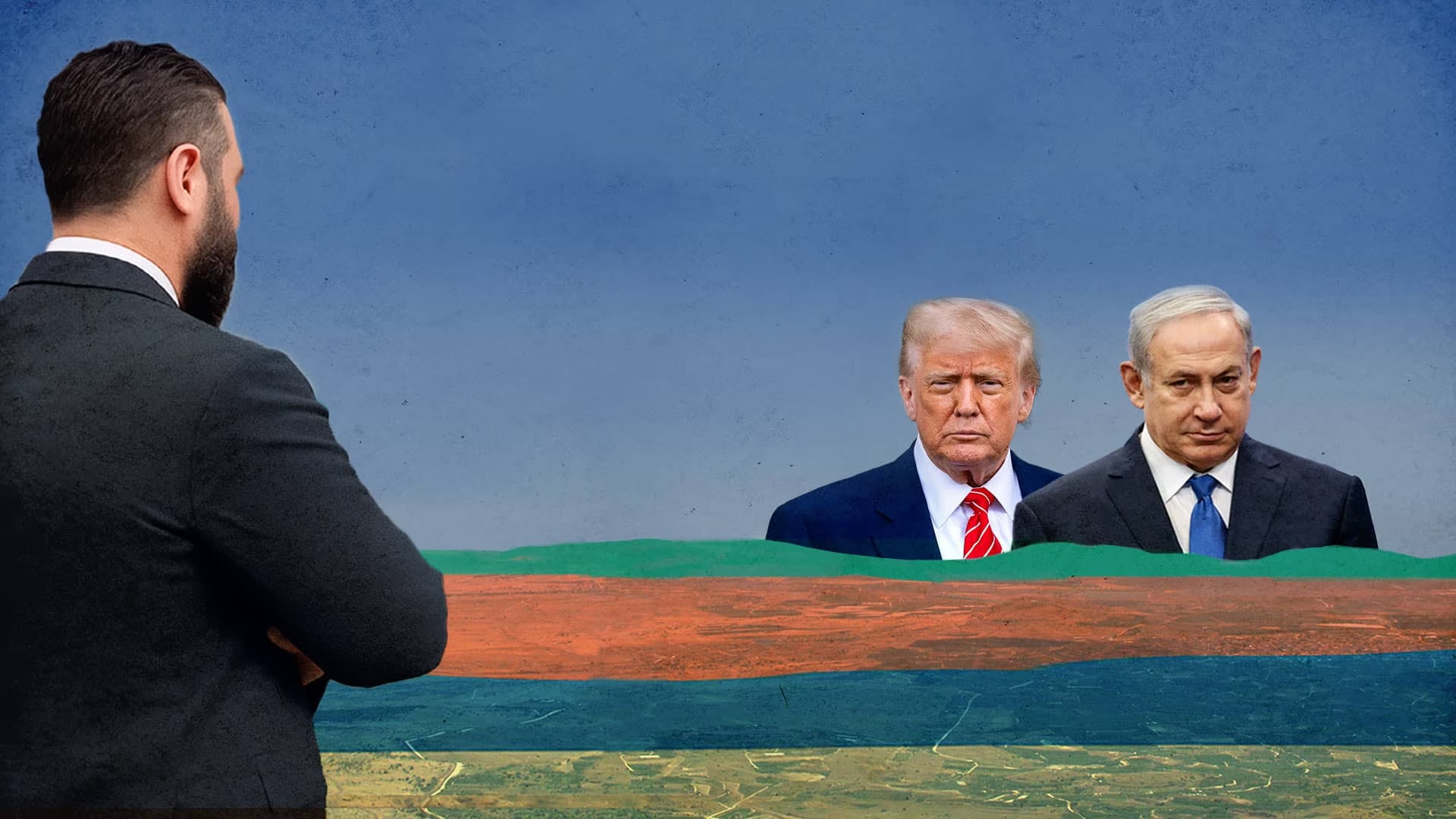

Syria is confronting perhaps its most critical test since the collapse of the Assad regime. Months of security negotiations with Israel have recently stalled, leading Israel to abruptly shift from diplomacy to coercion, threatening both Syria’s sovereignty and stability.
On November 19, Prime Minister Benjamin Netanyahu arrived unannounced in Israeli-occupied southern Syria, accompanied by his defense minister, senior security officials, and the army chief of staff. Touring Israeli positions near the Druze village of Hader, the visit was designed to convey dominance. Syrian officials condemned the move as a “grave violation” of sovereignty but could do little else. Hammering home the message the next day, Israeli jets flew deep and unchallenged across Syrian airspace, looping over Damascus and reaching as far as Latakia. For Syrians, the signal was clear: whether by negotiation or by force, Israel intends to craft the post-Assad security architecture to its liking.
As part of the United States-brokered negotiations, Israel has leveraged its military supremacy to push maximalist demands: a comprehensive peace deal that enshrines its military dominion over swathes of southern Syria for the sake of Israeli security. Syrian President Ahmed al-Sharaa and his negotiating team, with few cards to play, are seeking interim security arrangements and an Israeli withdrawal from territories it has seized since December 2024. Washington, meanwhile, is playing the carrot to Israel’s stick, offering al-Sharaa’s new government recognition and desperately needed economic relief in return for falling in line with the US’ grand new security architecture for the region. The outcome will set Syria’s course for years to come.
The following analysis examines how southern Syria became the center of competing regional strategies; the mechanisms through which the US and Israel have sought to recast Syria’s security environment; the pressures facing the new Syrian leadership as it confronts both external demands and internal constraints; and the implications of proposed buffer arrangements for sovereignty, territorial cohesion, and long-term stability. Together, these dynamics reveal the stakes of the current confrontation: whether Syria can navigate the narrow space between near-term stability and the enduring struggle to reclaim sovereignty over its land, its borders, and its political future.
The American Shepherd of a New Regional Security Order
Until late last year, the Israel-Syria border area had been governed by the 1974 Disengagement Agreement, which established a ceasefire and separation of forces following the 1973 Yom Kippur War. Fifty years later, in December 2024, al-Sharaa and his rebel group Hayat Tahrir al-Sham (HTS) toppled the Assad regime, following which Netanyahu declared the 1974 agreement null and void, claiming there was no party on the Syrian side to implement it.
A massive Israeli bombing campaign ensued, decimating Syria’s army, air force, and naval capacities, destroying bases and weapon depots across the country. Israeli troops also swiftly seized the roughly 240-square-kilometer (sq km) buffer zone between the countries, taking control of the Syrian side of the border from Quneitra to Mount Hermon. Amid these actions, Netanyahu pointedly said Israel was extending a “hand of peace” to Syrian Druze, a minority community primarily based in the country’s southern province of Sweida.
Claiming the need to prevent arms smuggling and fill the security gap left by the Syrian army’s collapse, Israeli forces subsequently extended their zone of control deeper into Syrian territory, covering nearly 700 sq km and reaching to within 20 km of Damascus. In July 2025, following clashes in Sweida involving government security forces and locals, the Israeli air force also bombed near the presidential palace in Damascus. Syria, devastated by a nearly 15-year civil war and a new government trying to preside over gargantuan recovery needs, was in no position to respond militarily. As such, Israel established a new deterrence dynamic and effective control over southern Syria’s airspace and ground.
Washington policymakers, witnessing the turmoil post-Assad, saw security vacuums across much of Syria and feared that instability could spill over its borders. As part of its response, the Trump administration backed a series of unprecedented security and political meetings between Syrian and Israeli officials, aiming to reshape the Levant’s security order.
The process began in Paris in early February 2025, according to a Syrian official who spoke on the condition of anonymity. This involved Syrian Foreign Minister Asaad al-Shaibani meeting Israeli Minister of Strategic Affairs Ron Dermer under joint French-American sponsorship, with coordination from US Special Envoy for Syria Tom Barrack. This round of direct talks, the first in decades between the neighboring states, focused on stabilizing southern Syria, preventing escalation in the Golan Heights, and regulating the Syrian-Jordanian border.
A second round in Baku later that spring concentrated on intelligence issues tied to arms smuggling in the south and on defining the informal boundary between Israeli influence and that of the new Syrian authorities. Although described as security consultations, these talks were fundamentally political, serving Washington’s aim of disciplining the new Syrian regime and pulling it into the regional stability framework built around the Abraham Accords.
Washington speaks in incentives, Israel in security terms, and Damascus negotiates from weakness, torn between its need for stability and its fear of surrendering sovereignty.
Within this context, President Ahmed al-Sharaa met US President Donald Trump in Riyadh on May 14, in what amounted to a formal political declaration of the new relationship. Trump pressed Damascus to join a regional “peace process” in return for phased sanctions relief, international recognition of the new Syrian government, and an economic assistance package via the World Bank and Gulf funds. From then on, Washington’s approach to Syria rested on a clear formula: security cooperation for economic relief, and de-escalation for legitimacy.
Al-Shaibani’s follow-on diplomacy reinforced this trajectory. He travelled to Washington in June to discuss sanctions; held talks in London on Israel’s draft security agreement; and joined a Paris meeting on consolidating the Sweida ceasefire and revising parts of the 1974 Disengagement Agreement. These rounds laid the first bricks of a multi-layered negotiation track, where military, economic, and political files intersected under a single US-led strategy.
These meetings were far more than technical border talks. They opened the way to redefine Syria’s place in the emerging regional order, with the security track serving as the public face of a deeper project to integrate Syria into a network of US-Israeli interests through gradual steps, from border arrangements to tacit normalization. Security negotiations between Syria and Israel have thus become a microcosm of the new balance of power in the region: Washington speaks in incentives, Israel in security terms, and Damascus negotiates from weakness, torn between its need for stability and its fear of surrendering sovereignty.
The Proposed Syria-Israel Security Arrangement
During the mid-September meeting between al-Shaibani and Ron Dermer, the outlines of Israel’s security proposal came into focus. Israel presented a detailed plan for a new security arrangement in southern Syria that revises the 1974 Disengagement Agreement, extending it beyond the Golan ceasefire line deeper into Syrian territory under the banners of “field guarantees” and “preventing future threats.”

Importantly, Israel’s aggressive military actions since December 2024 had given it all the leverage, leaving Syria’s military fragmenting and Damascus unable to secure its borders. The Israelis thus advanced a formula that not only secures their gains in the Golan, but also extends their reach far beyond through four graduated security zones that increasingly curb Syrian sovereignty closer to the border:
- The Yellow Zone (effectively occupied): runs along the border strip, including observation posts on Mount Hermon and parts of Quneitra, under direct Israeli security control with permanent reconnaissance units and early warning systems.
- The Blue Zone (separation of forces): corresponds to the 1974 disengagement strip but with stronger international monitoring involving US-UK participation and a strict ban on heavy military forces on both sides.
- The Red Zone (demilitarized): extends up to 25 km into Syria, barring Syrian combat units and medium or heavy weapons, while imposing no parallel limits on Israel, turning it into buffer tailored to Israeli security needs.
- The Green Zone (no-fly): covers most of Daraa and Sweida and reaches the outskirts of rural Damascus, banning Syrian military aircraft and placing the area under joint US-Israeli intelligence oversight.
Israel presented this structure as a way to prevent any renewed “cross-border threat.” In practice, it mirrors the Sinai model of the Camp David Accords with a crucial difference: Syria regains none of its occupied land yet is asked to accept arrangements that narrow its sovereign depth in return for limited economic and political concessions.
Controversy has grown around a clause on mutual “political recognition,” under which Israel would formally recognize Ahmed al-Sharaa’s government as Syria’s sole legitimate authority. Many in Damascus see this as unprecedented: a foreign power bestowing legitimacy on a government whose territory it holds under military occupation.
For Damascus, accepting such terms would amount to signing a new version of the 1974 agreement without victory and without recovering land.
Taken together, the proposal signaled a clear intent to lock in the post-war order, not through a political settlement but via long-term security arrangements that turned southern Syria into a “grey zone”, stripping Damascus’ sovereignty. Framed as stabilizing measures, these steps would function to redraw Syria’s internal borders and turn the south into a security sphere indirectly run by Washington and Tel Aviv.
For Damascus, accepting such terms would amount to signing a new version of the 1974 agreement without victory and without recovering land. This proposed “security peace” was an implicit surrender.
Al-Sharaa’s Washington Welcome
President al-Sharaa’s visit to Washington earlier this month marked a geopolitical turning point. Previously, US-Syria relations had been an antagonistic affair defined by the Assad regime and its regional alliances. By contrast, when al-Sharaa met with President Trump, he became the first Syrian head of state to be invited to the White House. The leaders’ meeting both cemented direct lines of communication between Damascus and Washington and revealed a shared willingness to adopt a more pragmatic approach across a broad spectrum of issues. These ranged from counterterrorism to economic development and reconstruction, and crucially, the status of southern Syria and the Israeli-occupied Golan Heights.
Regarding the latter, al-Sharaa told The Washington Post after his meeting with Trump that he would not accept a “comprehensive peace agreement with Israel.” Instead, he raised the option of “interim security arrangements” on border control and managing southern Syria. The distinction between a permanent peace deal and temporary security measures was a deliberate attempt to thread the needle between opposing political pressures: on the one hand, al-Sharaa needed to show Washington he was willing to play ball; on the other, he could not be seen as bowing to Israel’s maximalist demands, lest he face repercussions at home, particularly from more radical factions within his HTS support base.
Following the Washington meeting, Syria–Israel talks continued, with US Special Envoy for Syria Tom Barrack pressuring for progress. Al-Sharaa insisted that any deal would resemble the 1974 Disengagement Agreement and would not mean normalization with Israel or Syria joining the Abraham Accords. However, the Syrian Ministry of Foreign Affairs indicated that the draft under preparation was part of “a series of agreements that will be concluded with the Israeli side.”
The Wedge Between Sweida and Syria
Sweida is one of the most sensitive areas in southern Syria, not only because it falls within the proposed four security zones, but because local, social, and geopolitical dynamics all shape debates over future security and governance there. While the province’s Druze leaders had long exercised a degree of autonomy from the central government, before the major upheaval of July 2025, the dominant mood in the governorate was not oriented toward secession or the creation of an autonomous region. Local ties to the state held, even as many felt the state had failed to protect them. This perception was reinforced by security services’ failure to prevent kidnappings and highway robberies on the Sweida–Damascus road.
The violence escalated dramatically in July, with widespread clashes between Bedouin tribes backed by government security forces and local Druze militias, with many Druze villages sacked, as well as a smaller number of Bedouin neighbourhoods. Hundreds were killed, thousands wounded, and tens of thousands displaced. In response, many residents armed themselves for self-defence, desperate for protection, with their faith in the central state shattered. In the months since, a fragile and oft-violated US- and Jordanian-brokered ceasefire has curbed major outbreaks of renewed violence, though many Druze villages around the provincial capital remain occupied by government forces.
The July clashes brought a variety of responses from Israel. In the immediate aftermath, Israeli Druze rallied to support their Syrian brethren, using informal networks to send money and relief supplies into Sweida, while the Israeli government sent official aid convoys. During the hostilities, the Israeli air force also bombed a Syrian army convoy headed towards Sweida. A more enduring shift, according to local sources, has been substantial Israeli financial and material support for Sweida’s largest two Druze militia’s, the National Guard and the Eagle Eye Network.
While locals in Sweida still hold widely varying opinions of what the future of their province should look like, events since the summer have created a multi-layered and complex picture. Among other things, Sweida has become a barometer of the state’s capacity to manage its relationship with local communities and reinforce its security presence in the south. The governorate is now central to any future security approach. Israel views it through the prism of protecting the Golan Heights; the United States treats it as a test of Damascus’s ability to govern southern Syria; and the Syrian state sees it as part of recalibrating its relationship with local structures.
The Druze question has thus become a measure of the state’s ability to manage local identities within emerging postwar arrangements
Within this context, the United States and Jordan worked to draft a joint roadmap for de-escalation in Sweida, including integrating some local groups into internal security institutions and regulating the presence of unlicensed arms. However, the latest Israeli proposal reshuffled the deck, appearing to shift the file from a Syrian-American-Jordanian track to a broader regional one shaped largely from outside Syria.
The Druze question has thus become a measure of the state’s ability to manage local identities within emerging postwar arrangements, while Israel uses it as a lever to create a grey zone that is neither fully under Damascus’s authority nor on a front line of confrontation, making Sweida a key arena of future Syrian–Israeli interaction.
Al-Sharaa’s Limited Room to Maneuver
The new Syrian President Ahmed al-Sharaa faces a difficult balancing act. He knows that any negotiations with Israel, even those limited to security issues, is seen domestically as violating Syria’s long-held policy centered on territorial sovereignty and resistance to Zionist colonialism. However, he also sees such negotiations as a chance to gain international recognition for his government and relieve the political and economic isolation that has continued since the Assad regime fell in December 2024.
Al-Sharaa is caught between rising American pressure, which links financial aid and sanctions relief to concrete security progress in southern Syria, and strong internal opposition – both popular and bureaucratic – against any moves that could be seen as normalizing relations with an occupying power.
To navigate this, al-Sharaa has adopted a form of “defensive realism”: accepting temporary security arrangements that stabilize the situation and buy time for rebuilding state institutions, without making permanent or irreversible political concessions. Yet this approach carries risks, as any actions on the ground could eventually become binding political commitments, especially given the lack of an elected parliament or clear constitutional authority over sovereignty.
Legally, the draft agreement raises serious questions about whether a transitional government has the power to make decisions affecting Syria’s territorial integrity. The interim constitution does not authorize al-Sharaa or his cabinet to negotiate border or defense issues. Signing a demilitarization deal without popular or parliamentary approval could be unconstitutional and risk deep political and social divisions.
More worrying is that accepting buffer zones and a no-fly zone would gradually redraw de facto boundaries and grant Israel freedom of operation deep inside Syrian territory under the pretext of monitoring compliance. Historical analogies, from Sinai to southern Lebanon, show that such security arrangements tend to reinforce the military dominance of the stronger party rather than reduce it.
Thus, the proposed “1974-Plus” formula is perilous: it risks stripping Syria of its legitimate right to self defense under the guise of managing a fragile post-war transition. Al-Sharaa must carefully weigh short-term stabilization against the long-term consequences for Syria’s sovereignty and territorial integrity.
Balancing Sovereignty with Stability
The current path toward a security arrangement between Syria and Israel critically tests the nature of the new Syrian state and its political autonomy. Al-Sharaa must balance American pressure to integrate Syria into a regional stability framework with Israeli aims to establish strategic depth inside Syrian territory. His challenge: safeguarding Syria’s sovereignty without pushing the country into isolation.
Accepting the proposed security arrangements may bring short-term stability but risks long-term erosion of sovereignty and a model of restricted zones. Rejecting them outright without alternatives risks confrontation with Israel and the US during a fragile internal period, potentially isolating the new regime.
Ultimately, no transitional government can legitimize agreements affecting Syria’s territorial unity without a clear popular mandate and referendum. History shows that security concessions to Israel have never ended aggression or brought lasting peace, only cycles of domination.
Therefore, the safest course for Damascus is to hold to the 1974 Disengagement Agreement as the sole legal framework while remaining open to temporary monitoring that does not threaten core sovereignty. In this light, the future of southern Syria hinges on Damascus’ ability to balance internal diversity with territorial unity, without becoming subordinate in a security structure designed beyond its borders.