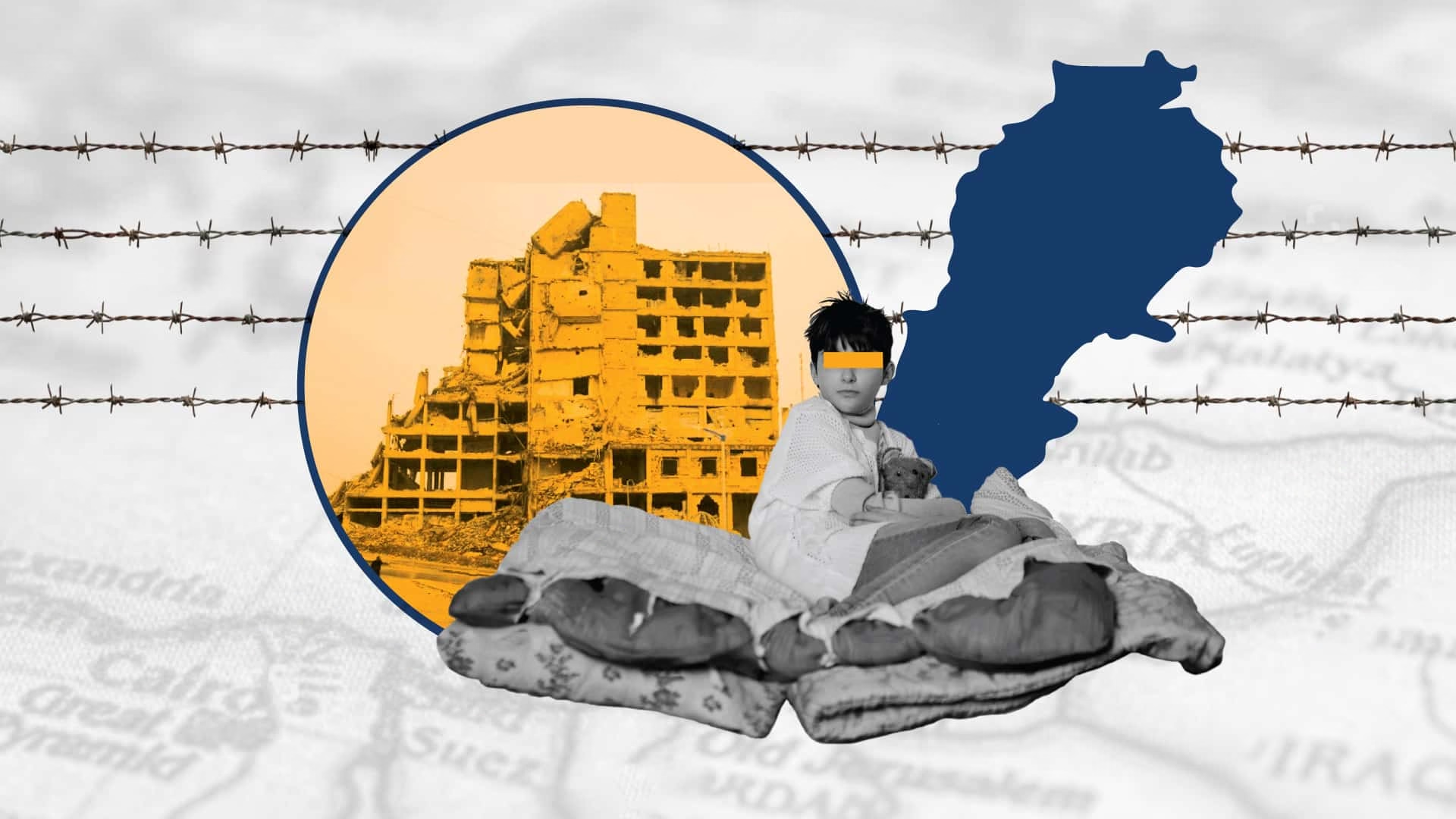

The Lebanese government’s plan to bring all arms in the country under state control faces a critical sovereignty test: asserting authority within the country’s 12 Palestinian refugee camps. So far, it’s failing.
The camps, and the many armed Palestinian factions within them, have for decades operated beyond the reach of Lebanese law and security services. The recently renewed effort to disarm these groups comes amid growing international pressure on Lebanon to disarm Hezbollah following the recent war with Israel. Indeed, the prospective disarmament of armed Palestinian factions in Lebanon could be seen as a litmus test, a technical-political entry point to gauge the possibility of a more comprehensive approach to arms outside state control.
The effort to disarm the camps is, however, inseparable from broader dynamics within Lebanon’s political-sectarian power balance, as well as regional and Western stakeholders’ attempts to redefine Lebanese state sovereignty through “implementable” localized steps. Despite the apparent pragmatism of some senior Lebanese figures, the prospect of Palestinian disarmament has raised major challenges concerning trust between this disenfranchised refugee population and the Lebanese state. Especially in the absence of a just solution to the refugee issue, many Palestinian groups remain deeply skeptical about surrendering arms they view as part of their identity and a means of self-defense in a historically hostile environment.
Today, it is apparent that the international community will no longer accept the “Palestinian exception” in Lebanon that has allowed unregulated arms to persist in its refugee camps.
The presence of Palestinian refugees in Lebanon dates to the 1948 Nakba, when hundreds of thousands fled their homeland amid the violence accompanying the creation of Israel. Lebanon’s refugee camps gained the status of autonomous enclaves in the 1969 Cairo Agreement between the Lebanese government and the Palestinian Liberation Organization. While Lebanon officially annulled the agreement in the late 1980s, the government never regained effective control over the camps.
The recent Israel-Lebanon war then revealed the extent of entanglement between Palestinian military wings in the country and the regional conflict with Israel, now extending from Gaza to South Lebanon, and Iran to Yemen. Alongside Hezbollah, Palestinian factions in Lebanon, foremost among them Hamas and Islamic Jihad, directly participated in launching rockets at Israel as part of a so-called “support war” for Palestinian groups fighting Israel in Gaza. This embarrassed the Lebanese state and, as the sole authority sanctioned to bear arms under the terms of the ceasefire, obliged it to commit to measures preventing a recurrence of such incidents.
Today, it is apparent that the international community will no longer accept the “Palestinian exception” in Lebanon that has allowed unregulated arms to persist in its refugee camps. Instead, Western countries are viewing Palestinian groups’ disarmament as an adjunct to the ongoing campaign to disarm Hezbollah and are pressuring the Lebanese government to this end. This approach, however, has quickly encountered political and practical challenges.
Abbas’ Maneuvering in Lebanon
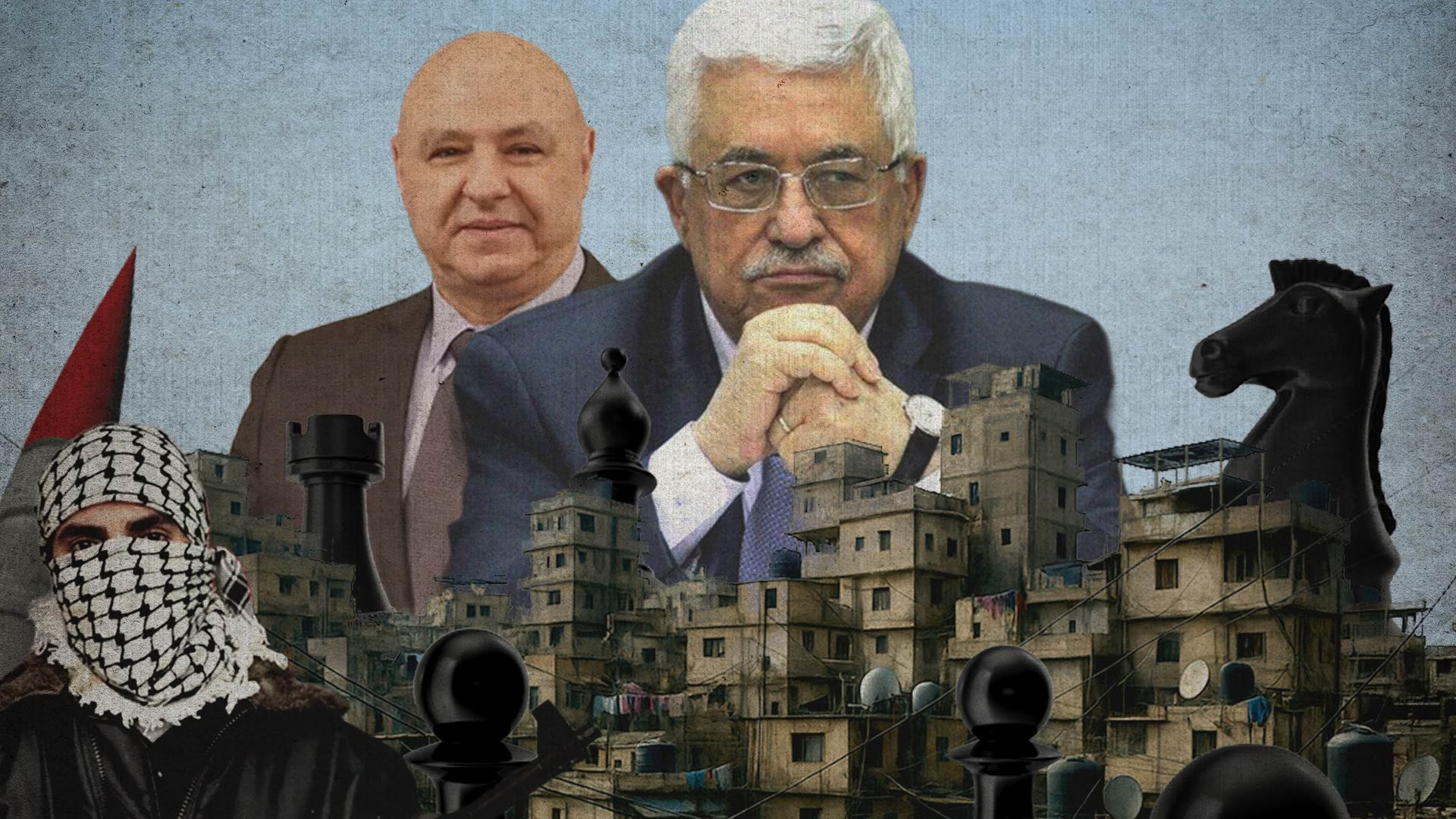
Palestinian Authority (PA) President Mahmoud Abbas’s May 21 trip to Beirut was not a mere protocol visit. His meetings with Lebanese President Joseph Aoun, Prime Minister Nawaf Salam, and Parliamentary Speaker Nabih Berri came at a critical political moment, amid unprecedented regional and international pressures on Lebanon. Abbas’s visit reflected the PA’s desire to align with this emerging context, through agreeing with Lebanon on a mechanism to gradually hand over Palestinian arms in exchange for improving refugees’ social and economic conditions.
Official statements about the arrangement that was reached frame it as inaugurating a new phase in Palestinian–Lebanese relations, based on the principle of Lebanon extending state sovereignty throughout the country, including the Palestinian camps. Notably, both Abbas and the Lebanese officials continue to reject refugee resettlement in Lebanon.
Abbas also had other, less public, objectives, according to sources close to the talks. First among these was to appear before the Arab and international communities as a partner in the Lebanese state project and as a party opposed to illegal arms in Lebanon’s Palestinian camps. Second, Abbas’s visit was an attempt to regain the initiative against Hamas and other Palestinian rivals in the Lebanese arena, with Hamas enjoying growing influence in many camps, especially in South Lebanon.
Power in the Camps: Weak Authority and Fragmented Leadership
The reality of Lebanon’s camps, however, belies Abbas’s ambitions. Fatah, representing the PA’s political and military face, is among the various Palestinian factions vying for control. While the PA’s “Palestinian National Security Forces” are theoretically responsible for camp security, experience has shown their complete inability to control arms, prevent rocket launches, or enforce any other security measures on Hamas or other factions.
Although some Palestinian factions cautiously welcomed Abbas’s visit, Hamas in particular was more reserved, neither directly confronting the PA nor committing to implementing the agreements Abbas reached. Instead, it engaged in limited preemptive steps, such as cooperating with Lebanese security by handing over suspects involved in rocket launches against Israel. Rather than showing a genuine commitment to the deal, however, this step aimed to avert the potentially explosive situation of Lebanese security forces attempting to enter the camps.
The Lebanese View: Palestinian Arms in Hezbollah’s Shadow
On the Lebanese side, there is agreement across the political spectrum on the principle of asserting state sovereignty nationwide and confining arms to the army. However, divergences emerge when the question arises: how?
The fate of Palestinian arms, however, cannot be separated from the broader controversy regarding Hezbollah’s arms. Every step toward disarming Palestinian factions is automatically read as a prelude to similar demands concerning Hezbollah, which explains Hezbollah’s reserved stance.
The party realizes that accepting the confiscation of Palestinian arms could later be used against it, especially in the current Lebanese and international context. Therefore, it appears to be adopting the strategy of neither publicly supporting nor opposing the process. Rather, Hezbollah appears to be attempting to buy time, keeping the matter unresolved and allowing space for negotiation or obstruction, depending on the progress of regional settlements, particularly those involving Iran and the nuclear file.
The Lebanese public is increasingly anathema to all non-state arms and is calling for an end to this abnormal reality that reproduces civil war atmospheres.
However, the problem is that this card has become internally costly. The Lebanese public is increasingly anathema to all non-state arms and is calling for an end to this abnormal reality that reproduces civil war atmospheres. Also, any perceived Hezbollah support for Palestinian factions keeping their arms could translate into political and popular backlash that it cannot afford.
The Disconnect Between Declarations and Implementation
At the end of May, the Lebanese government announced that by mid-June it would begin implementing the plan to disarm Palestinian camps in and around Beirut. This deadline passed without any practical measures being implemented: almost no handover or collection of arms has been recorded, nor have there been any concrete security negotiations with the Palestinian factions inside the camps.
This raises fundamental questions about the state’s seriousness and capacity to execute this sensitive decision. Is the government incapable of imposing its vision? Has it succumbed to internal and external pressures that prevented execution? Perhaps those in charge prefer to avoid potential security threats during a period of intense regional tensions. Another, more likely, cause for the delay is that Palestinian disarmament is not a priority for Lebanese institutional leaders, especially since there is no political consensus on how it should be carried out, nor on the guarantees to be offered to Palestinians in exchange for disarmament.
The fact is that the Lebanese state has not transitioned from political declarations to real implementation, and the camps will likely retain their arms for the foreseeable future.
The danger, however, is that delaying implementation without official clarification reopens the sovereignty vacuum, reinforcing the idea that the Lebanese state’s aspirations for a monopoly over arms remain blocked by other factors and considerations. Indeed, the delay and the lack of an articulated legal and security framework for disarmament have led Palestinian factions to become increasingly suspicious of the Lebanese state’s intentions, especially amid recent Lebanese–Palestinian tensions.
Regardless of the reason, the fact is that the Lebanese state has not transitioned from political declarations to real implementation, and the camps will likely retain their arms for the foreseeable future. Without a change of course, this will remain one of Lebanon’s most significant sovereignty weaknesses and a key manifestation of the official inability to enforce the rule of law.
Justice, Rights and Dignity as a Guarantee for Disarmament
In any serious discussion on disarming Palestinian camps, one cannot ignore the heavy collective memory carried by Palestinian refugees in Lebanon, a memory saturated with the wounds of massacres and violations they have suffered for decades at the hands of Lebanese, Syrian, and Israeli militaries and affiliated armed groups.
From the massacres at Tel al-Zaatar to Sabra and Shatila, to the destruction of Nahr al-Bared, Palestinians have developed a conviction that stripping them of their self-defense tools without real guarantees could once again expose them to liquidation, marginalization, or political and security blackmail.
There must be a national discussion on the civil rights of Palestinians in Lebanon, who remain deprived of the most basic elements of a dignified life—from the right to work and own property to social and legal protection.
Therefore, any serious plan for disarmament cannot rely on theoretical promises alone. It must be accompanied by clear security, political, and legal guarantees. These steps are not a luxury but an inevitable necessity if the Lebanese state genuinely wishes to open a new chapter with the camps based on fair governance under the state, rather than dominance and subjugation.
At the same time, there must be a national discussion on the civil rights of Palestinians in Lebanon, who remain deprived of the most basic elements of a dignified life—from the right to work and own property to social and legal protection. The state cannot ask them to surrender their arms while keeping them outside the legal and social system, treating them as an ever-present risk rather than a vulnerable community deserving justice.
The issue of Palestinian arms in Lebanon cannot be treated as a standalone or isolated issue. Rather, it is part of a broader system linked to the problem of non-state arms in all their forms, including Hezbollah’s arms
Combining disarmament with guarantees of justice and rights constitutes the only equation capable of producing a peaceful and stable transition from the logic of “self-security” within the camps to that of living under the state. Without this link, Palestinian arms, despite the risks they entail, will remain as a reaction to the absence of trust, not an intention to rebel. Camps that have lived for decades under threat cannot genuinely enter a new relationship with the Lebanese state without first obtaining official recognition of their suffering and political and moral redress for decades of marginalization and exclusion.
No Solution Outside a Comprehensive Package
The issue of Palestinian arms in Lebanon cannot be treated as a standalone or isolated issue. Rather, it is part of a broader system linked to the problem of non-state arms in all their forms, including Hezbollah’s arms. This intertwining between the Palestinian and Lebanese tracks necessitates a comprehensive, gradual, and responsible approach.
Such an approach must be grounded in the constants of the Lebanese state: first, confining arms to legitimate institutions; and second, respecting the human dignity and civil rights of Palestinians in Lebanon, while affirming the right of return to Palestine as a cornerstone of any just settlement.
In turn, the success of this path requires careful Arab and international sponsorship that can provide political cover, technical support, and security guarantees, especially given the fragility of Lebanon’s internal balances and the intensity of regional competition.
Between the path of stagnation and that of settlement, the future of the camps and Palestinian arms remains suspended in Lebanese leaders’ ability to transcend their narrow political calculations, and on the willingness of Palestinians – both leadership and factions – to build a new partnership with the state, based not on arms, but on rights, organization, and integration.
Souhayb Jawhar is a Researcher and a Journalist