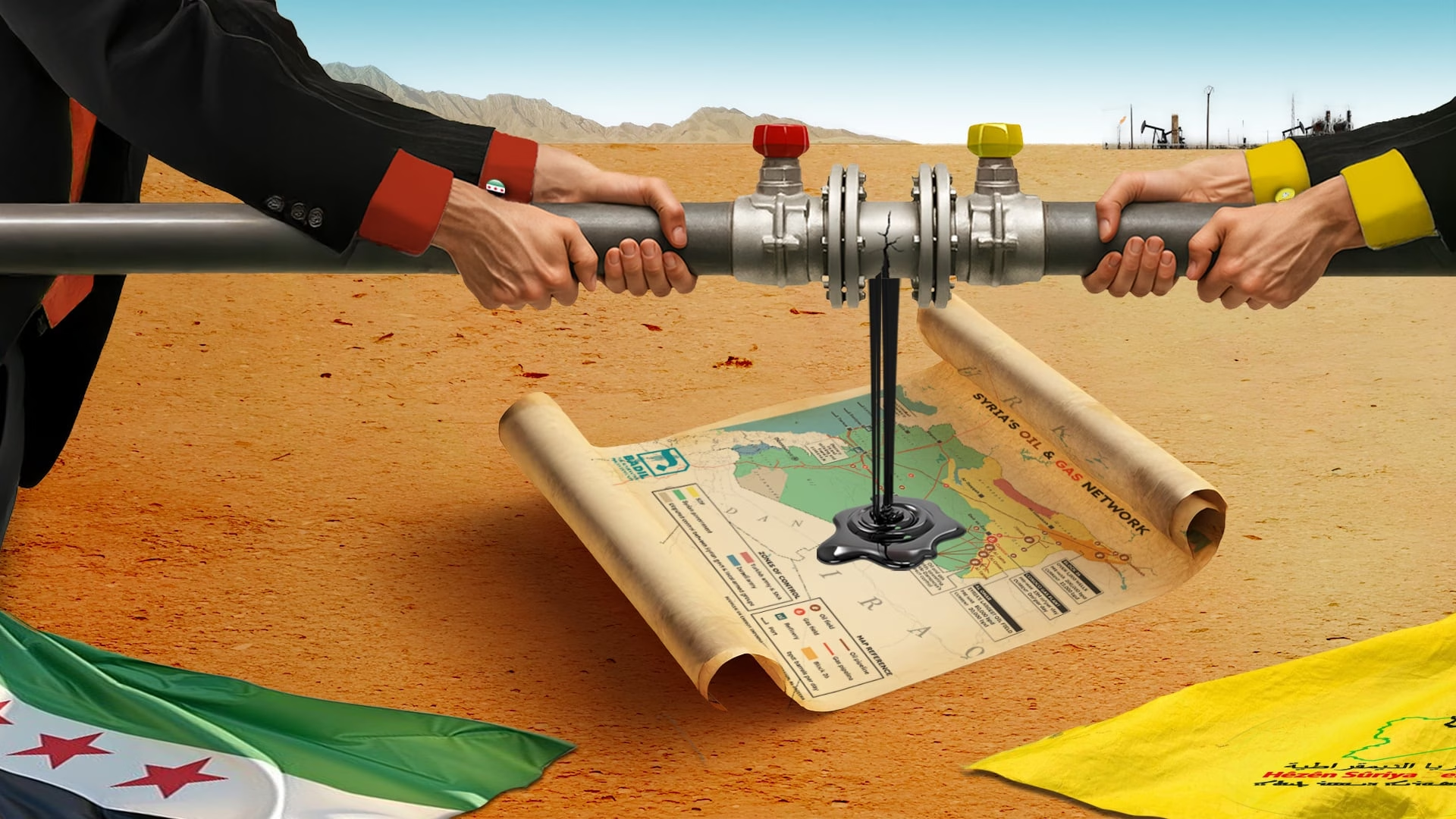
Syria’s oil and gas sector sits at the heart of a standoff that could determine whether the country’s post-war recovery succeeds or collapses into renewed armed conflict.
In the country’s northeast, Kurdish-led Syrian Democratic Forces (SDF) sit atop most of the country’s remaining hydrocarbon wealth. While the civil war reduced production to a fraction of historical output, its revenues have still enabled the Autonomous Administration of North and East Syria (AANES) to finance independent institutions and resist Damascus’ authority.
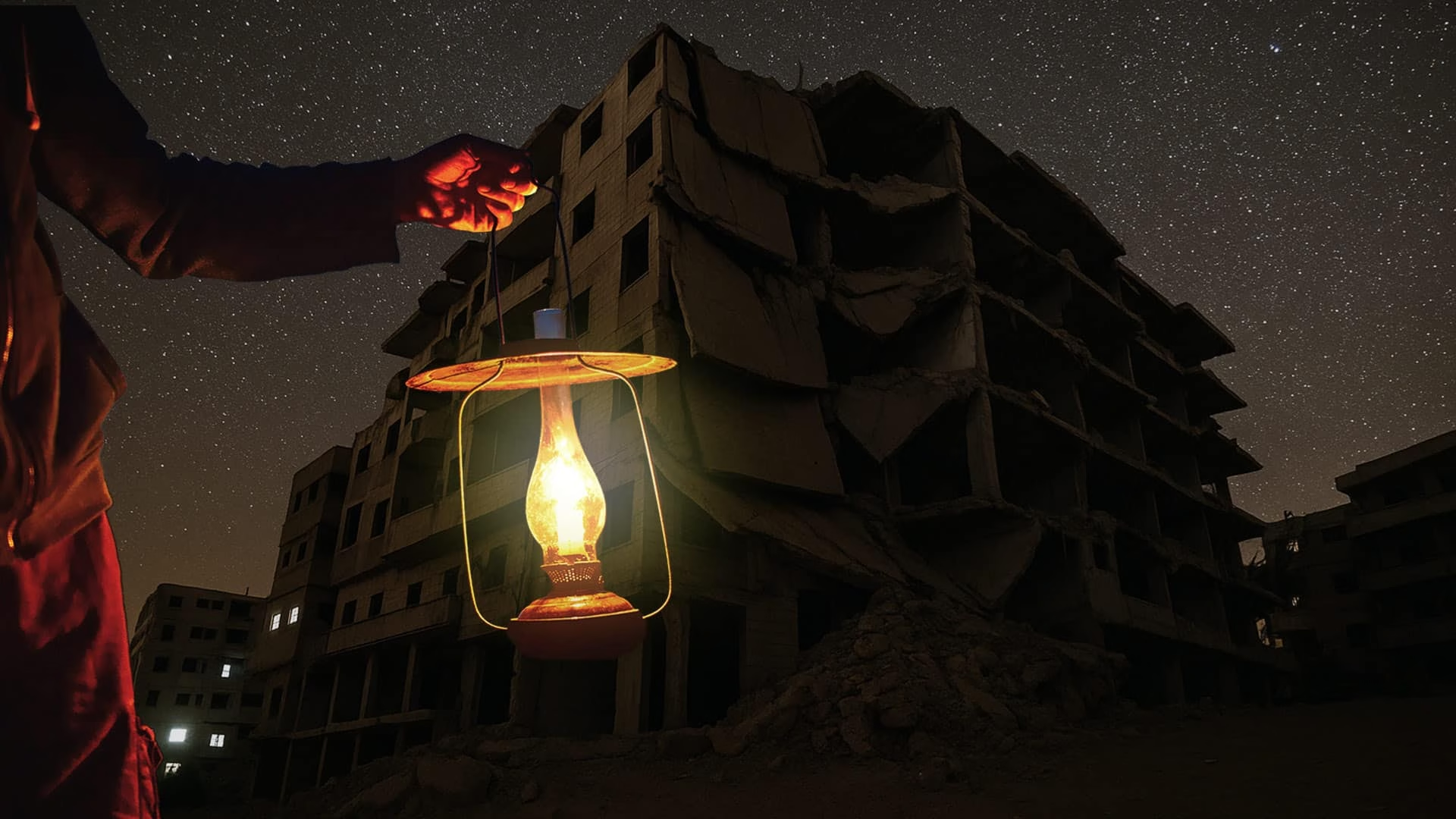
Syrian President Ahmad al-Sharaa, however, sees the country’s oil and gas sector as indispensable to funding national reconstruction and asserting Damascus’ position in the region’s ongoing geopolitical realignment. Notably, Syria’s reconstruction costs are now estimated at $216 billion, roughly 10 times Syria’s projected 2024 GDP. Regaining control over Syria’s northeast is thus a paramount concern for al-Sharaa’s government.
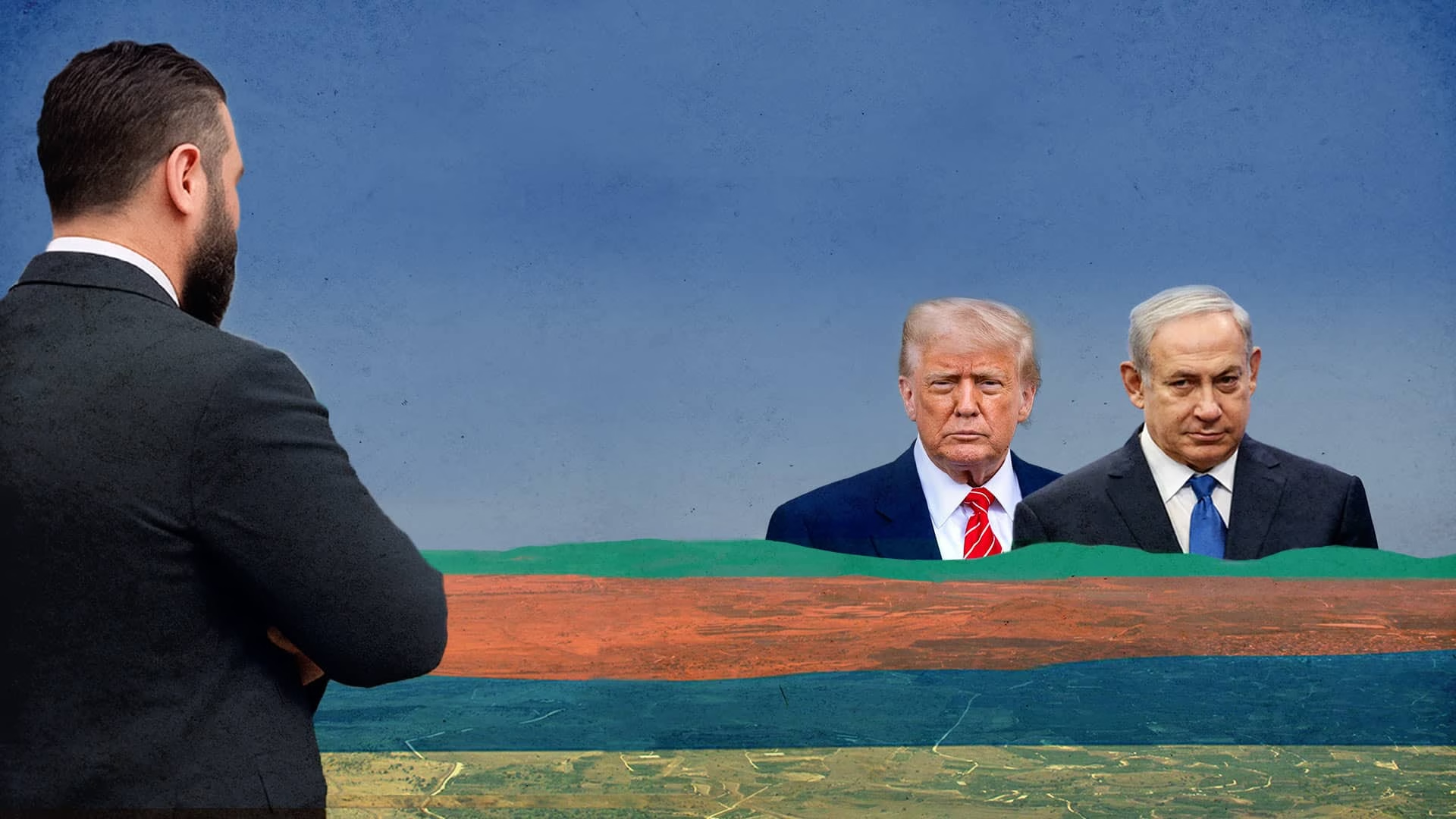
Washington has weighed in, attempting to mediate between the two sides and ensure Syrian state unity in the interest of regional security and stability. Ankara has taken a far more aggressive stance, seeking to block any chance of another autonomous Kurdish region, similar to northern Iraq, emerging along its border.
A failure to resolve the Damacus-SDF standoff would likely deepen Syria’s fiscal and energy crises and invite renewed armed conflict and expanded Turkish military intervention. On the other hand, a blueprint to end the impasse lies in a recent US-backed agreement among Baghdad, Erbil, and Ankara to resolve a dispute over oil exports. Indeed, a “win-win” option for Damascus and the SDF is apparent.
The SDF can extract and sell enough crude to sustain its administration but, as a de facto subnational actor, lacks the capital, technology, and legal standing to rehabilitate fields at scale or sign complex contracts with major international oil companies who can. This leaves most of the region’s potential oil wealth stranded. Damascus, by contrast, can offer those things – formal contracts, security guarantees, and a unified regulatory framework – but needs control on the ground.
The most realistic path out of the deadlock would thus see a negotiated framework in which the Syrian state regains operational and contractual authority over the oilfields, leading to their rehabilitation and increased hydrocarbon revenues. For allowing this, the Kurdish region would receive a defined share of the profits above what the fields are earning at current production levels, and a negotiated status for the SDF and associated structures within a national framework. The crux of such negotiations would, however, be the share of oil revenues and local sovereignty each party would accept for their future relationship.
Wartime Collapse to Kurdish Control
At the beginning of the civil war in 2011, Syria was one of the eastern Mediterranean’s larger hydrocarbon producers: crude oil output stood at roughly 380,000 barrels per day (bpd) and accounted for around 35 percent of export revenues, with the sector attracting the major International Oil Companies (IOCs). As the war escalated, IOCs fled, international sanctions were brought against Damascus, and oil and gas infrastructure was often damaged and neglected as the belligerent parties battled to control it. A report from the Assad-era Ministry of Oil and Natural Resources claimed the first decade of the war had inflicted $100 billion in “direct and indirect” damages to the oil and gas sector. As of 2021, production levels were estimated to have dwindled to 86,000 bpd.
Since September 2017, the US-backed SDF, an alliance of Kurdish and Arab militias and Washington’s main ally in its fight against the Islamic State (ISIS), took control over northern and northeastern governorates of Al-Raqqa, Al-Hasakah, the majority of Der-El Zor, and regions in Northern Aleppo. This enabled their civil administration, AANES, to control most of the oil fields in northeastern areas, where over 70 percent of Syria’s oil and gas resources are concentrated, thereby depriving the Syrian government of such.
For AANES, the northeastern oilfields became the primary financial pillar of its governance project, allowing the SDF to fund security forces and civil administration
Crude from SDF-held areas fed a web of semi-licit and illicit trade. A small portion, some 10,000–15,000 bpd, was sold to refineries in Homs and Banias via intermediaries, in deals widely criticized as breaches of international sanctions against the former Assad regime. Most oil production was smuggled by truck to the Kurdistan Region of Iraq through the Al-Walid border crossing, for sale or refining in Dohuk and Erbil. Often, it was mixed with the Kurdistan Region’s own oil for resale at discounted prices, mainly to Turkey, Iran, and the United Arab Emirates.

For AANES, the northeastern oilfields became the primary financial pillar of its governance project, allowing the SDF to fund security forces and civil administration.[MH1] However, revenue figures, estimated in billions annually, remained opaque and hydrocarbon operations faced accusations of mismanagement, theft, and severe pollution around makeshift refineries.
The SDF’s success also sparked ire in Ankara. The Turkish government sees the YPD, the largest military force within the SDF, as an extension of the PKK, the Kurdish separatist group based in eastern Turkey that Ankara has spent decades attempting to crush. Turkey’s campaign against the SDF has included several invasions of northern Syria, one in 2019 to occupy a 120-kilometer-long strip of land along the border, roughly 30 km wide, which the Turkish army and local proxies still control.
Since the Assad regime fell and Al-Sharaa took power in December 2024, his administration has pursued national rehabilitation on all fronts. This has involved seeking financial and institutional assistance – from Turkey, Gulf states, and others – as well as sanctions relief and diplomatic support – most notably via Washington. Domestically, the government sought to regain control of Syrian territory after years of fragmentation among numerous rebel groups. This effort has been accompanied by multiple outbreaks of violence in areas where sectarian and ethnic minorities are concentrated, notably in Alawite regions of coastal Syria, in Kurdish-controlled northern areas, and the predominantly Druze governorate of Sweida in the south. The latter two instances, in particular, revealed the government’s limited ability to impose its will by force in areas home to autonomous-minded populations with entrenched organizational structures.
In March 2025, after rising tensions with Kurdish forces, al-Sharaa and the SDF leadership agreed, under US mediation, to integrate the SDF into Syrian state institutions, including the transfer of SDF-controlled crossings, airports, and oil and gas assets into new state bodies. Implementation quickly stalled, especially around strategic energy and water infrastructure, with disputes over sites such as the Tishrin Dam freezing handover talks and paralyzing related negotiations over northeastern oilfields.
The Competition of Interests
Washington has made clear that it wants a unified Syrian state that can contain ISIS without a permanent US military presence, while Ankara appears determined to block any Kurdish autonomy on its border, even if that complicates energy deals. For the SDF, continued control of northeastern oilfields is both a fiscal lifeline and its strongest bargaining chip, allowing AANES to fund governance and prevent the SDF’s dissolution into the Syrian army.
For Al-Sharaa, bringing energy infrastructure under state control is nonnegotiable, both as a marker of sovereignty and as a prerequisite for attracting serious investors. Gulf actors have shown interest in rehabilitating refineries at Homs and Banias, while Damascus has courted Emirati firm Dana Gas and US companies such as ConocoPhillips and Novaterra Energy for onshore deals, alongside exploratory talks with Chevron on offshore prospects. None of these investments can be fully realised if key fields, pipelines, and border crossings remain under SDF control and subject to contested legal authority.
US policy sits between these positions. Washington initially justified its presence in the northeast as necessary to prevent oilfields from falling into ISIS hands; now, with Assad gone and ISIS weakened but not eradicated, it is trying to engineer a transition toward “one Syria, one army, one government.” The March 2025 integration deal, which Washington helped broker, is central to this effort: SDF integration into national institutions is framed as key to long-term stability and to enabling a gradual troop drawdown, with US officials rejecting Kurdish federalism outright.
For its part, Turkey refuses any sort of Kurdish autonomy in the northeast and continues to pursue efforts to weaken the SDF and AANES’ influence, depicting this region of Syria as a “terror corridor” tied to the PKK. Despite its welcoming note of the March Agreement, Ankara appears inclined to escalate matters to upend the current status-quo, including expressing a readiness to take the military option to safeguard its interests.
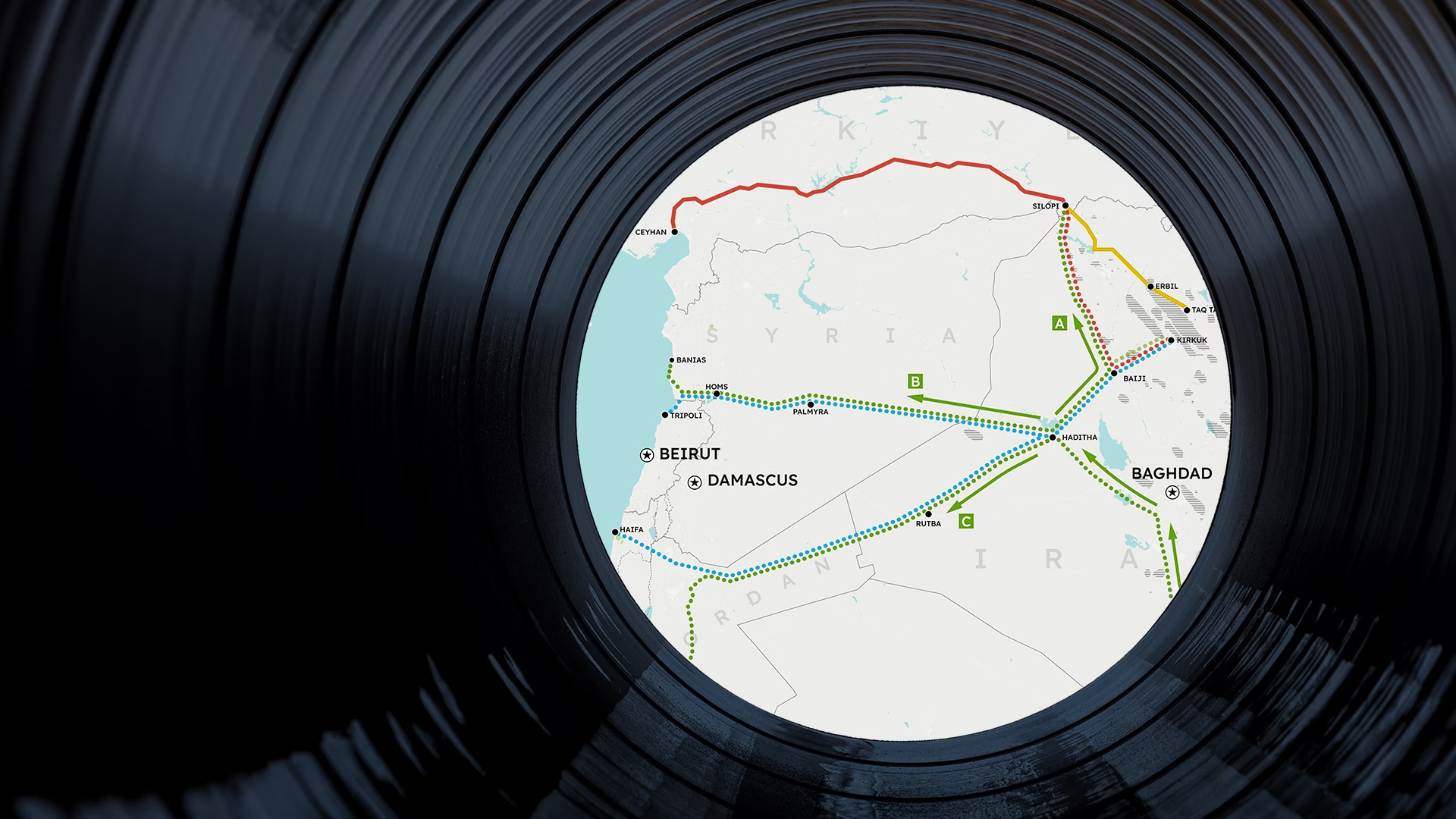
The dynamics in northeastern Syria have echoes of another effort in regional energy diplomacy that were recently concluded. In September 2025, the US mediated an agreement between Ankara, Baghdad and Erbil regarding oil re-export via an existing pipeline from Kirkuk, in northern Iraq, to export facilities in Ceyhan, Turkey. This broke a two-and-a-half-year deadlock in negotiations. According to the agreement, signed with eight oil companies operating in the Kurdistan Region’s fields, 180,000–190,000 bpd will flow under a framework that routes sales through Iraq’s federal marketer SOMO while granting the Kurdistan Regional Government (KRG) about 50,000 bpd for local use and to operate local refineries.
The Kirkuk–Ceyhan deal illustrates a model in which a central government regains formal sovereignty over exports while a subnational region retains a guaranteed share of volumes and revenues through a negotiated mechanism – a template already shaping how US and regional actors think about Syria.
Possible Power-Sharing Scenarios
The core question now is whether Damascus and the SDF can turn a zero-sum struggle over oil into a structured bargain that trades formal sovereignty for predictable local revenues and status. A renewed large-scale confrontation is risky and uncertain for both: the past year has shown Damascus the limits of force in its efforts to assert authority over the country’s peripheries, while the SDF knows that indefinite unilateral control over the fields is hard to maintain under Turkish pressure, technical decline, and investor reluctance.
Politically, Al-Sharaa cannot fully capitalise on emerging Gulf and Western interest without demonstrating clear state authority over major fields and export routes.
Maintaining the current status quo – SDF control backed by semi-licit exports and ad hoc smuggling – is unlikely to be durable. Operationally, the SDF lacks the capital, technology, and legal recognition to rehabilitate damaged infrastructure at scale, and serious investors increasingly insist on a unified national energy framework as a precondition for returning to Syria. Politically, Al-Sharaa cannot fully capitalise on emerging Gulf and Western interest without demonstrating clear state authority over major fields and export routes.
This deadlock creates space for a conditional power-sharing formula that aligns complementary needs. The most plausible arrangement would see the Syrian state assume operational and financial control over northeastern oilfields – inviting IOCs back, overseeing rehabilitation, and handling export contracts – while committing to channel a defined share of revenues to the northeast through an agreed mechanism. In parallel, Kurds would secure improved political guarantees in negotiations over the SDF’s status within national security structures – which the SDF frames as “joining” rather than being dissolved – preserving a measure of distinct identity and influence within a unified army.
The Baghdad–Erbil–Ankara pipeline arrangement offers a concrete analogue. There, the KRG agreed to route exports through Iraq’s federal marketer and accept federal oversight in exchange for defined entitlements, formalizing both federal sovereignty over exports and regional claims to a share of the proceeds. A similar model in Syria could see Damascus reclaim formal control and international legitimacy over oil exports while AANES and SDF-linked structures receive a guaranteed slice of rehabilitated revenues and a recognized role in managing local development. Turkey may be amenable to such a resolution, given its broad influence over the Syrian government. Questions would remain, however, regarding the KRG’s role, given that is has been the primary purchaser of Kurdish Syrian oil in recent years.
Signals from SDF leadership suggest cautious willingness to move in this direction. After Al-Sharaa’s November visit to the White House, SDF commander Mazloum Abdi publicly pledged to accelerate the integration of the SDF into the Syrian state and to work toward a more prosperous, unified Syria. If Damascus and the SDF can lock in a credible agreement on field control and revenue sharing – backed and monitored by external guarantors – it could unlock a wider security compact and give Kurdish actors an institutionalized seat at Syria’s postwar governing table.
The views expressed in this article are solely those of the author and do not necessarily reflect the views of BADIL | The Alternative Policy Institute or its editorial team.