

An ongoing debate over isolationism within the Druze community has evolved beyond a fleeting intellectual disagreement into a defining struggle over identity, history, and the future. At its core is a separatist current that blames Arab nationalism and political Islam for the declining presence of the Druze, while ignoring the colonial context that destroyed their traditional structures and overlooking the religious and political reforms that secured their place in the Levant. In doing so, this current echoes the very takfiri discourse it claims to oppose, while simultaneously underscoring the urgency of confronting this isolationist narrative with a historical and political reckoning that sets the record straight.
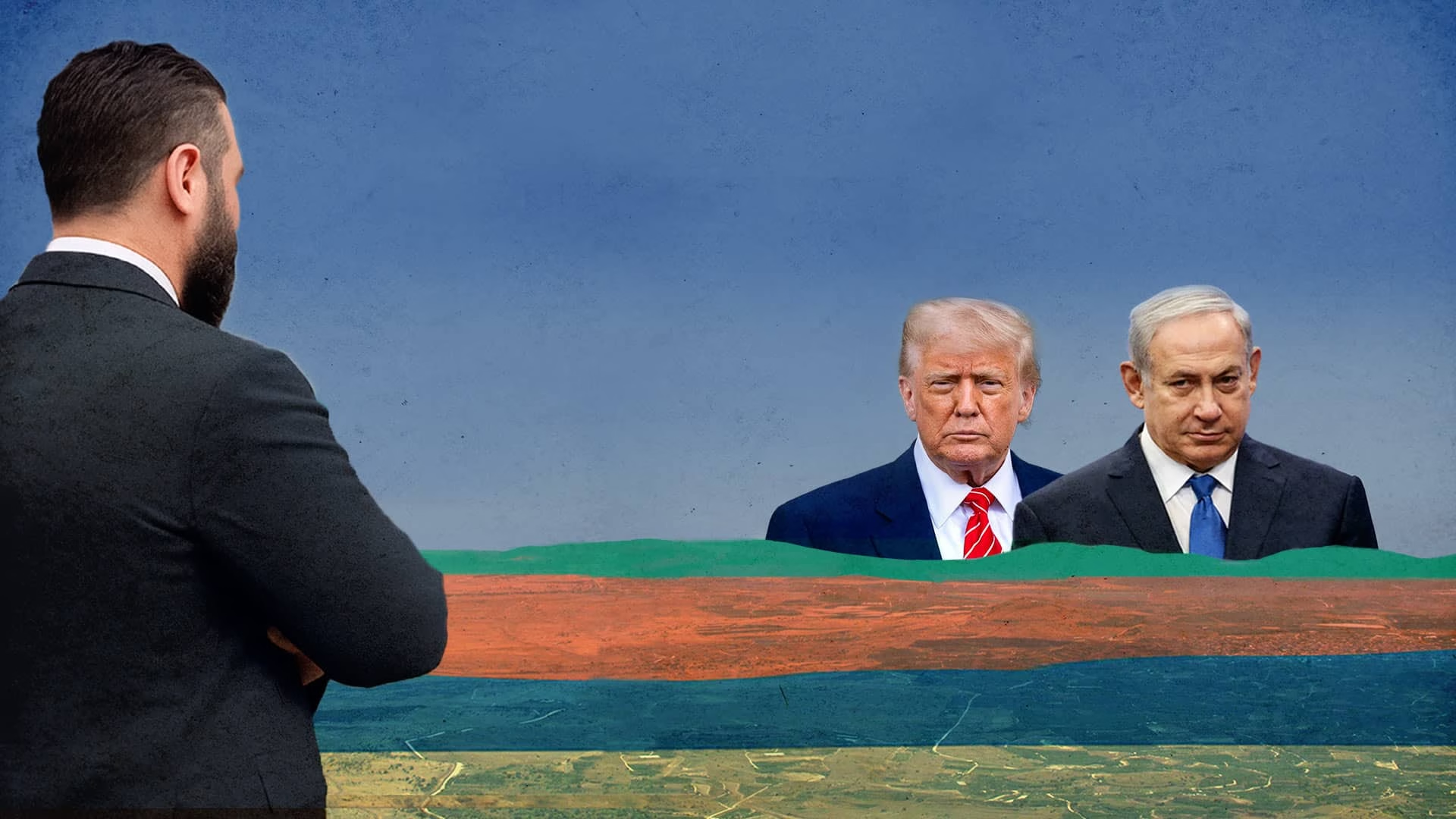
In recent years, what might be termed a “new Druze right” has taken shape, largely through social media – a movement fueled by global right-wing discourse and digital propaganda from Druze influencers in Israel. It seeks to redefine Druze identity in isolationist terms, portraying hostility to Arabism and alliance with Israel as the only means of “protecting” the community, while disregarding its long history of partnership with the Arab Levant. Using short videos and viral posts, these influencers push a distorted message that casts Arab nationalism as a threat and sectarian withdrawal as salvation.
The rise of this current cannot be separated from the actions of Sunni extremist and takfiri groups themselves. Their crimes and massacres against Druze civilians in Sweida, Syria, not only eroded trust in the broader Arab milieu, but also gifted Israel a propaganda boost, allowing it to market itself as the sole “safe haven” and “protector” of minorities in the region. In that light, takfiri groups bear direct responsibility for reinforcing isolationist tendencies among some Druze youth and laying fertile ground for Israel’s broader strategy of fragmenting Levantine societies.
The First Wound: Colonialism, Not Nationalism
The isolationist discourse insists that Arab nationalism led to Druze marginalization, but the historical record tells a different story. It was French and British colonialism that dismantled the historical Druze domain, carving it into four separate states: Lebanon, Syria, Palestine, and Jordan. This partition went beyond drawing new political borders; it ruptured the social and economic fabric that had enabled the Druze to maintain their political and demographic weight for centuries1See Michael Provence, The Last Ottoman Generation and the Making of the Modern Middle East, trans. Osama Esber (Beirut: Arab Center for Research and Policy Studies, 2020).↓.
The 1925 revolt led by Sultan Pasha al-Atrash was not merely an expression of patriotic fervor but a calculated response by the Druze elites, who saw the colonial order as a threat to their feudal authority and economic interests2See Michael Provence, The Great Syrian Revolt and the Rise of Arab Nationalism, trans. Wissam Doudar (Damascus: Qadmus Publishing, 2011).↓. In the same vein, Amir Shakib Arslan played a prominent role at the 1931 World Islamic Congress in Jerusalem, where he called for unity and the defense of Jerusalem as a cause for the entire umma. His participation reflected the Druze elites’ commitment to engaging in the Arab-Islamic movement and confronting the Zionist project – a stance far removed from any isolationist tendencies3An academic study titled “Questioning Imperial Minority Rights: The General Islamic Conference of 1931 in Jerusalem and the Fate of Soviet Muslims” argues that the conference was not merely a religious event, but rather a transnational political forum that brought together thinkers and leaders from across the Muslim world, including Emir Shakib Arslan. The study highlights his role as a prominent anti-colonial voice, articulating a nationalist-Islamist vision that linked the defense of Palestine with the struggles of Muslims in other regions, such as the Soviet Union.↓.
The French and British colonial powers offered the Druze an alternative: retreat into a desert enclave in exchange for limited guarantees of survival. But this option meant isolation and confinement – essentially a “concentration camp” or, at best, a Native American reservation. The Druze refused, paying a steep price for their decision. Yet this choice also preserved their place at the very heart of the Levant.
Al-Tanoukhi’s Legacy: Unity as Shield
The reforms led by Amir al-Sayyid Abdullah al-Tanoukhi in the 15th century marked a pivotal turning point in Druze history. Al-Tanoukhi reshaped Druze jurisprudence to align with Sunni doctrines and solidified its connection with the Ash’ari school of thought. As Wissam Halawi notes in his book Les Druzes en marge de l’islam4Wissam H. Halawi, Les Druzes en marge de l’islam: ésotérisme et normativité en milieu rural (XIVᵉ–XVIᵉ siècle). This French work examines Druze history in the medieval period, reassessing the social and religious role of al-Tanoukhi. It reviews his writings, the institutions he restructured, and his influence on the formation of Druze identity and jurisprudence, with a particular focus on rural Lebanon and its surroundings. The study argues that al-Tanoukhi established a Druze religious tradition rooted in Islamic culture, while at the same time introducing a social distinction within the Druze community between “initiates” and non-initiates—that is, between laypeople and sheikhs. This distinction, based on access to esoteric or mystical religious knowledge, did not reject Sunni Islam but rather drew upon it, incorporating elements of Sunni scholarship into the development of a distinct Druze legal-religious system.↓, al-Tanoukhi’s role went beyond codifying religious practices and reorganizing local institutions: he established a religious tradition deeply rooted in Islamic thought—particularly Sunni Islam—drawing on the knowledge of jurists and Sufi scholars of his era.
This synthesis gave Druze jurisprudence stronger foundations and greater flexibility at the same time. It became more firmly grounded by adopting interpretive methods from the broader Islamic tradition, and more adaptable by distinguishing between two social layers – the general public on one hand, and the keepers of esoteric religious knowledge known as the mashayikh on the other. This distinction did not signify a break with Sunni Islam, but rather a means of forging a unique Druze identity that both acknowledged and built on its Islamic heritage. In doing so, al-Tanoukhi created a framework that ensured the community’s survival, reinforced the legitimacy of the mashayikh, and cemented a historical partnership with the Sunni establishment, positioning the Druze as an integral component of the Levantine political order.
Al-Tanoukhi’s unifying legacy was not merely a matter of religious reform. It also secured political and social safeguards that enabled the Druze to sustain their standing in the Levant. In modern times, authorities within al-Azhar, the preeminent Sunni center of Islamic learning, issued clear statements affirming the Druze as Muslims, lending further religious legitimacy to al-Tanoukhi’s vision. In this way, a crucial aspect of his historic project was fulfilled.
Israel has sought to strike at this symbolic and jurisprudential foundation since the Lebanese Mountain War of 1984, when it targeted al-Tanoukhi’s shrine in Abey. Its aim has been to recast the Druze as an isolated community severed from its Islamic and Arab roots, and to turn them into a functional tool in its security strategy. It was no coincidence that both Sunnis and Shia played a central role in providing political cover during the fight to defend al-Tanoukhi’s legacy at that time. Israel knows that this legacy is what prevents the Druze from being turned into a pliant instrument. That is why it works to dismantle it, whether by spreading false religious propaganda or igniting sectarian conflicts on the ground.
The real threat to al-Tanoukhi’s project of transcending sectarian isolation thus comes from two directions: from Sunni takfiri movements that disavow their own moderate, unifying tradition, and from the separatist Druze current that repudiates al-Tanoukhi’s legacy altogether. To confront this dual threat, Druze and Sunnis alike must uphold their historical partnership and deepen their engagement with other Muslim communities—recognizing unity as the most effective shield against attempts to fragment and subjugate them.
Prophet Shuaib’s Shrine: History Hijacked
Among the latest misconceptions embraced by some is the portrayal of Prophet Shuaib’s shrine as an exclusively Druze religious site. Historically, visiting the shrine was not a religious act but rather part of a political-military5See traditional historical stories about the Prophet Shuaib↓ agreement with Saladin. Before the Battle of Hattin, Saladin reportedly had a vision, after which he ordered the shrine to be built and tasked the Druze with protecting the Christian pilgrimage route from Crusader raids. The shrine thus served a strategic and political purpose, nothing more.
Today, this legacy has been repurposed as fodder for Zionist propaganda, which exaggerates the shrine’s symbolism and portrays it as a supposed cornerstone of religious identity. More troubling still, some Druze have come to accept this narrative, even though the shrine’s true significance has always been tied to the alliance with the Sunni center. Ironically, some Sunnis now accuse the Druze of heresy for visiting the shrine, unaware that it stands as a historic symbol of Sunni-Druze cooperation.
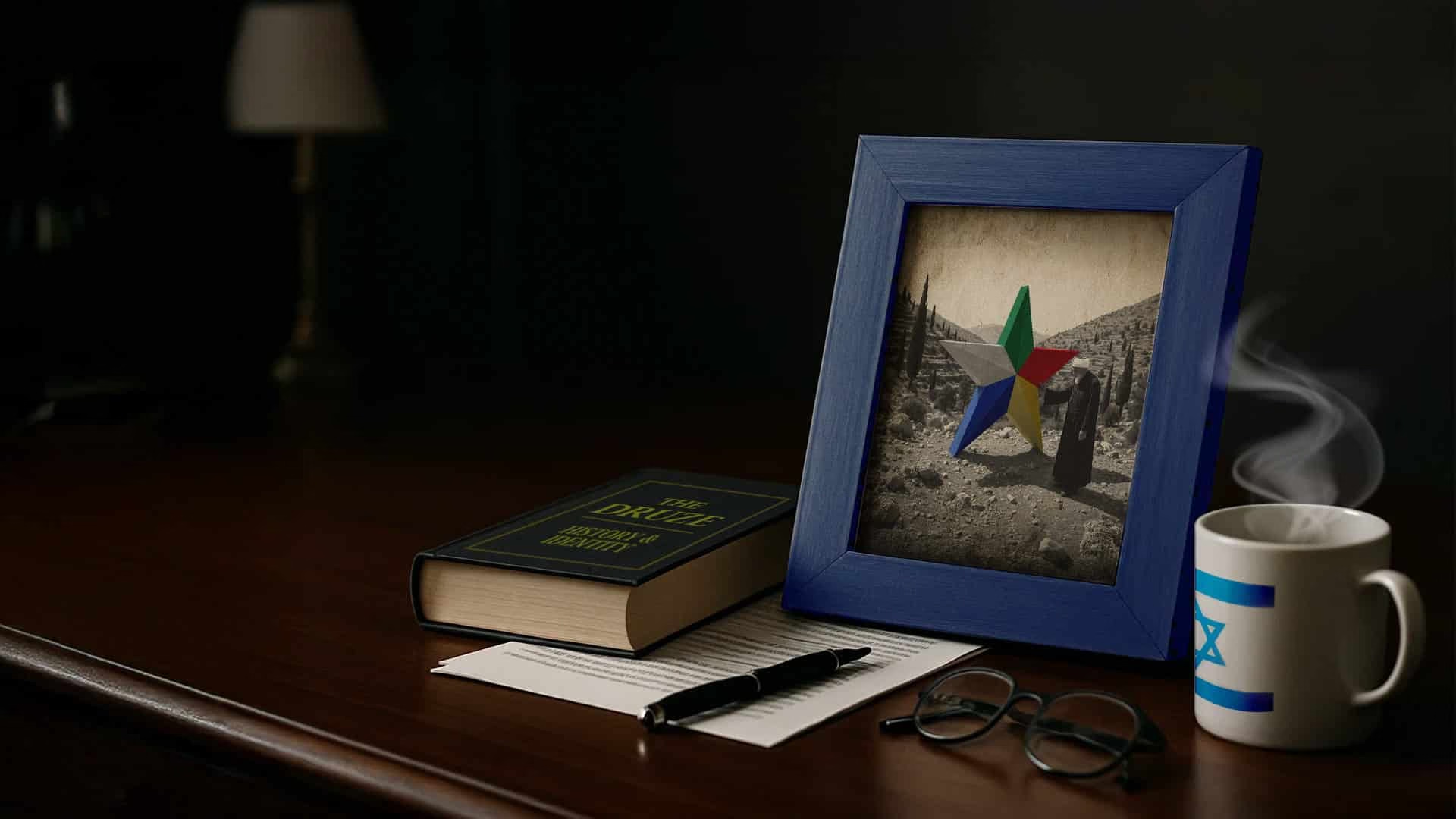
Similarly, Israel has sought to influence Druze consciousness by promoting a closed, “ethnic” perspective in recent years. It has sponsored academic studies and research claiming the Druze have a distinct genetic profile that sets them apart from their Arab and Muslim surroundings. These efforts are far from innocent; they are part of a broader propaganda machine aimed at reshaping Druze identity to serve Israel’s strategy6Lina Kassem, The Construction of Druze Ethnicity: Druze in Israel Between State Policy and Palestinian Arab Nationalism (2005). Doctoral dissertation exploring how Israeli state policies contribute to shaping a distinct Druze identity, and how this ethnic identity is at times used to separate the Druze from the broader Arab-Islamic identity.↓ of isolation and security exploitation.
Grievance Without Solutions
In the current political climate, the isolationist current appears increasingly fragile. Its rhetoric revolves around self-reproach, blaming Arab nationalist and socialist movements for every calamity—from Sultan Pasha al-Atrash’s revolt to Kamal Jumblatt’s experiment. Proponents of this view claim Druze blood was spilled in vain and went unappreciated by the greater Arab nation. While this sentiment is somewhat understandable after the recent takfiri onslaught on Sweida, the isolationist current confines itself to rejection and discontent, without offering any constructive alternative.
Experience, however, has shown that Israel acts solely in its own interests. In Sweida, it abandoned 35 Druze villages, leaving them exposed to a massacre—solely to drive a wedge between Sunnis and Druze. It then used this tragedy as a bargaining chip with the central government in Damascus while simultaneously placating the Bedouins enlisted in the Israeli army. This is the same policy once practiced by the former Syrian regime: threatening the Druze with the Bedouin card to keep them “in line.”
Even Sheikh Muwaffaq Tarif—the highest religious authority among the Druze in Israel—called on the Druze in Syria to address their grievances directly with Damascus, especially after it became evident that Israel was pursuing a “divide and conquer” policy through sectarian manipulation. He stressed that genuine solutions can only come from within an inclusive national framework, not from outside forces. By contrast, Sheikh Hikmat al-Hijri declared the right to self-determination “sacred” and put forward secession as an option for the people of Sweida. The divergence between the two sheikhs7“Druze Division: Tarif’s Statement Opposes al-Hijri’s Demand,” Sky News Arabia.↓ not only reflects the depth of internal turmoil, but also exposes Israel’s efforts to exploit isolationist impulses and weaken longstanding partnerships between the Druze and other communities.
This does not diminish the role of takfiri groups in striking at the core of Druze-Sunni relations, offering Israel free leverage for its expansionist project, and clearing the way for an isolationist narrative stoked from abroad. Sunni partners must therefore remain vigilant against these threats and actively work to contain them by reaffirming their historically moderate tradition.
The Real Battle: Unity Against Chaos
History has taught the Druze that isolation brings neither protection nor strength. Al-Tanoukhi’s religious and political reforms are what have safeguarded this community over time, while the real threats to its existence came from colonialism, partition, and insularity. The current isolationist and separatist rhetoric merely revives old, failed ideas in an attempt to confine the Druze to a narrow sectarian prison.
What is needed now is a broader vision: for the Druze to reaffirm their historical partnership with the Sunnis and deepen their openness toward the Shia, in the face of an agenda aiming to trap all sides in endless bloodshed. Israel is not targeting transient leadership but seeks to uproot the very foundation of Druze and Levantine identity: the legacy of al-Tanoukhi. Contrary to detractors’ claims, this legacy does not rest on taqiyya (concealment) or dhimmiyya (subordination), but on an inclusive project that guarantees protection for all faiths in the Levant.
The answer to the agenda of fragmentation cannot be isolation. Instead, it calls for holding fast to history and a unifying vision that redraws intercommunal relations on the basis of mutual respect and partnership. This is the real battle the Druze and their allies must wage today, not debates over isolationism or illusions of an insular identity.
This commentary was originally published in Al Modon.
Footnotesالهوامش
- 1See Michael Provence, The Last Ottoman Generation and the Making of the Modern Middle East, trans. Osama Esber (Beirut: Arab Center for Research and Policy Studies, 2020). ↩︎
- 2See Michael Provence, The Great Syrian Revolt and the Rise of Arab Nationalism, trans. Wissam Doudar (Damascus: Qadmus Publishing, 2011). ↩︎
- 3An academic study titled “Questioning Imperial Minority Rights: The General Islamic Conference of 1931 in Jerusalem and the Fate of Soviet Muslims” argues that the conference was not merely a religious event, but rather a transnational political forum that brought together thinkers and leaders from across the Muslim world, including Emir Shakib Arslan. The study highlights his role as a prominent anti-colonial voice, articulating a nationalist-Islamist vision that linked the defense of Palestine with the struggles of Muslims in other regions, such as the Soviet Union. ↩︎
- 4Wissam H. Halawi, Les Druzes en marge de l’islam: ésotérisme et normativité en milieu rural (XIVᵉ–XVIᵉ siècle). This French work examines Druze history in the medieval period, reassessing the social and religious role of al-Tanoukhi. It reviews his writings, the institutions he restructured, and his influence on the formation of Druze identity and jurisprudence, with a particular focus on rural Lebanon and its surroundings. The study argues that al-Tanoukhi established a Druze religious tradition rooted in Islamic culture, while at the same time introducing a social distinction within the Druze community between “initiates” and non-initiates—that is, between laypeople and sheikhs. This distinction, based on access to esoteric or mystical religious knowledge, did not reject Sunni Islam but rather drew upon it, incorporating elements of Sunni scholarship into the development of a distinct Druze legal-religious system. ↩︎
- 5
- 6Lina Kassem, The Construction of Druze Ethnicity: Druze in Israel Between State Policy and Palestinian Arab Nationalism (2005). Doctoral dissertation exploring how Israeli state policies contribute to shaping a distinct Druze identity, and how this ethnic identity is at times used to separate the Druze from the broader Arab-Islamic identity. ↩︎
- 7“Druze Division: Tarif’s Statement Opposes al-Hijri’s Demand,” Sky News Arabia. ↩︎