

Seven months after Bashar al-Assad’s departure, Syria’s transitional government is facing what is arguably its most precarious challenge. While the transition was never going to be smooth, the latest massacres in Sweida have revealed a domestic policy intent to consolidate power in the center that risks Syria falling apart—that is unless President Ahmed al-Sharaa’s government puts the interests of all Syrians before the hunger for concentrated power. It will not be a simple task.
From the outset, President Ahmed al-Sharaa’s government inherited a nation with fractured institutions, deep-seated distrust, and a legacy of sectarian tension. Despite claims of a new beginning, the transitional constitution promulgated in March has instead reinforced centralization of power in the presidency. Human Rights Watch has warned that this arrangement “grants the president significant authority… without any checks or oversight,” and perpetuates unchecked executive dominance reminiscent of the Assad era, a troubling continuation masked by revolutionary rhetoric.
This concentration of power isn’t simply symbolic; it has immediate implications for Syria’s diverse communities. For minority groups—Alawites, Christians, Druze, and even moderate Sunnis—this authoritarian continuity means persistent vulnerability. After the brutal massacre of hundreds of Alawite civilians in coastal villages in March, which took place under the watch of militia leaders who now enjoy official status in the army, the recent slaughter of Druze families in Sweida only deepened this disillusionment among minorities. Now, what began as a minor dispute escalated into violence when government forces intervened violently, rather than mediating impartially.
Home to Syria’s historically autonomous Druze community who were initially supportive of regime change, the Druze found their aspirations sidelined almost immediately once the regime fell. Sheikh Hikmat al-Hijri, the community’s spiritual leader, was excluded from key constitutional discussions. His repeated calls for binding guarantees of minority rights went unanswered, exposing the hollowness of official rhetoric about an inclusive Syria.
If minority communities seek protection from a historical enemy rather than their own government, Syria’s sovereignty stands compromised at its core.
Sheikh al-Hijri’s pleas to the international community for intervention—labeling the situation an “act of extermination”—reflect the desperation of a minority forced to look beyond their own government for safety. Alarmingly, al-Hijri’s calls have extended even toward Israel, a once-unthinkable partner. Though cautious in tone, his pointed comments about Israeli Druze enjoying freedoms Syrians still dream of cannot be misunderstood. This carefully calculated overture underscores Damascus’ failure: if minority communities seek protection from a historical enemy rather than their own government, Syria’s sovereignty stands compromised at its core.
The Druze Gamble
Al-Hijri’s strategy poses immense risks. Druze unity itself is threatened, as leaders remain divided over whether the best course lies in autonomy and outside alliances or cautious cooperation with Damascus. The recent visits by multiple delegations from Sweida—including notables, religious sheikhs, and militia leaders—to President al-Sharaa underscore the depth of these internal divisions. Some clearly still believe that engagement with the central government offers greater security than outright defiance. Adding to the complexity, influential Lebanese Druze leader Walid Jumblatt has voiced cautious support for maintaining Syria’s territorial integrity while warning against sectarian adventurism—effectively distancing himself from Al-Hijri’s more confrontational stance. But the stakes extend far beyond internal Druze politics. How this schism plays out will shape not only the fate of Sweida but the broader equation of minority rights and regional stability in Syria’s transition.
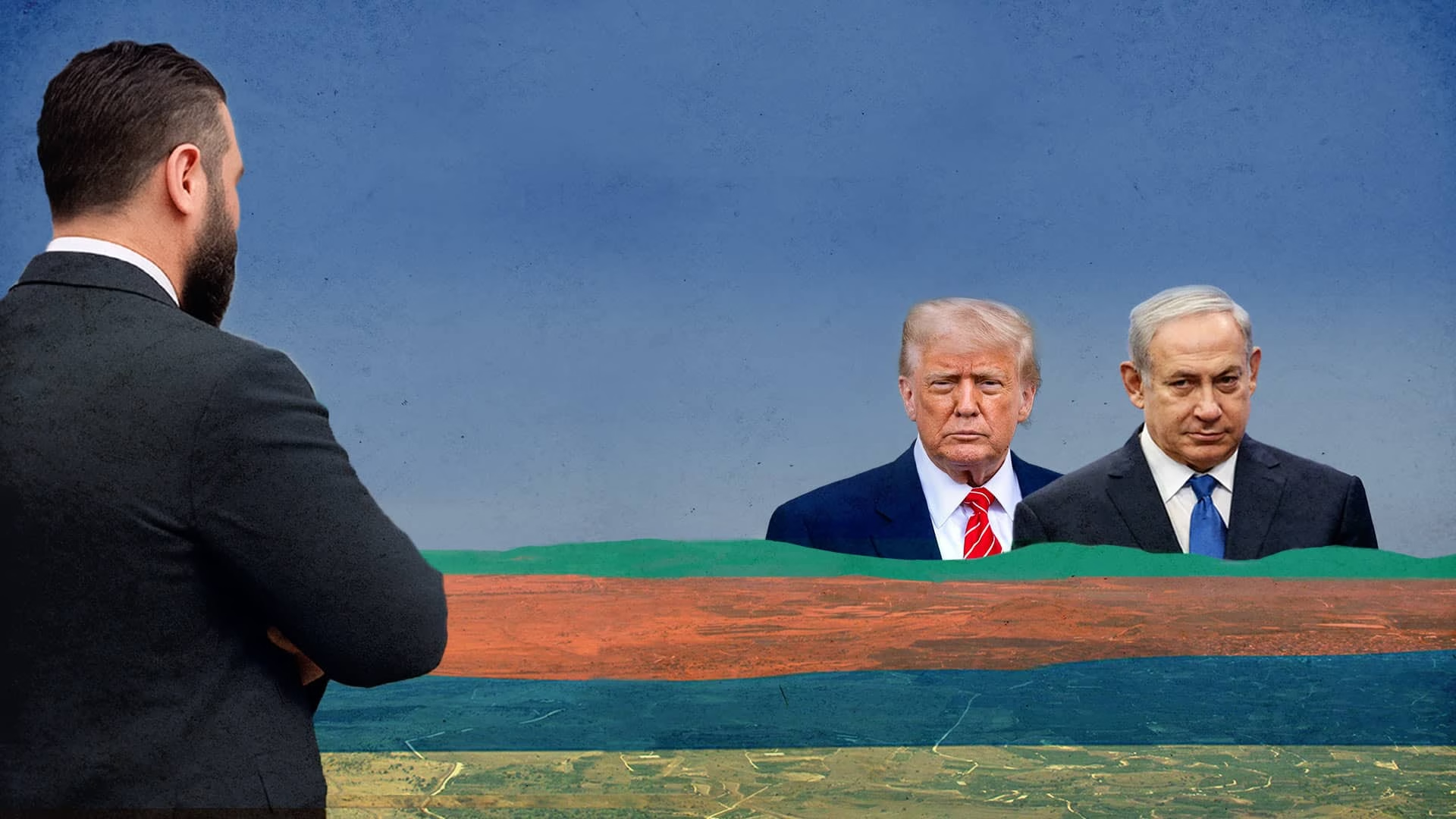
Southern Syria has rapidly become a geopolitical chessboard, attracting intervention from external actors pursuing their strategic agendas. For Israel, the turmoil in Sweida conveniently legitimizes its ongoing incursions into Syrian territory. Prime Minister Netanyahu’s government openly favors a fractured Syria, seeing autonomous zones for minorities as useful buffer states. The so-called “David’s Corridor,” a strategic route envisioned by Israel through southern Syria to the Kurdish-held northeast, would redraw regional geopolitics. Recent Israeli airstrikes, publicly justified as protecting minorities, illustrate how Israel instrumentalizes Syrian sectarian divisions. It is no surprise, then, that Turkey, anxious about any empowerment of Kurdish groups, perceives these maneuvers as provocative and dangerous.
Prime Minister Netanyahu’s government openly favors a fractured Syria, seeing autonomous zones for minorities as useful buffer states.
President Erdoğan’s support for al-Sharaa’s unity government is born of this anxiety. Ankara, alongside Arab states, staunchly opposes Syria’s partition, recognizing that fragmentation would empower Kurdish entities and weaken regional stability. Hence, the unprecedented joint diplomatic response from Saudi Arabia, Jordan, Egypt, and others, supporting Syria’s “security, unity, stability, and sovereignty,” while “rejecting all foreign interference” in its affairs. Tehran, similarly threatened by any further disruption to its regional alliances, stands aligned with these traditional rivals in its opposition to Israel’s plans.
These diplomatic maneuvers reveal that what appears superficially as sectarian conflict is fundamentally political: a struggle over Syria’s future political architecture. However, Damascus’ authoritarian inclinations, rather than addressing grievances, exacerbate divisions and undermine the transition itself. Al Sharaa’s reliance on former Islamist rebels and various tribes—dominant in both the military and political apparatus—undermines its legitimacy among minorities. The sectarian violence on the coast and in Sweida, coupled with Damascus’ unwillingness to hold perpetrators accountable, reinforces minority fears that the revolution merely replaced Assad’s authoritarianism with another oppressive regime—even if Sharaa dawns a tie instead of a turban.
Institutional reforms, already timid, have fallen victim to the rule of the sword. Constitutional and judicial changes remain largely symbolic, reflecting political expediency rather than systemic transformation. The absence of opposition parties, a free press, independent oversight, coupled with the president’s extensive powers, reinforces rather than dismantles authoritarian legacies. Appointments made without transparency illustrate how justice remains subject to political calculations, undermining any meaningful transition toward the rule of law needed to assuage the fears of minorities, or the Syrian people.
Open for Discussion
Yet, despite this grim picture, Syria’s social fabric remains salvageable. Intercommunal violence is not inevitable. Examples from cities like Aleppo show how ordinary Syrians across sectarian divides still choose coexistence. The challenge lies not in sectarian hatred per se but in political power arrangements that either facilitate reconciliation or reinforce division. The current trajectory, shaped by zero-sum logic and short-term sectarian calculus, risks entrenching divisions and inviting ongoing foreign meddling.
Discussions of federalism, decentralization or any form of local autonomy must be held politically, not imposed at gunpoint.
What Syria desperately needs is dialogue rooted in political realities, not sectarian fears. Transitional authorities must bring Kurdish forces, Druze leaders, and all minorities to the negotiating table. Transparency and accountability for past war crimes—regardless of affiliation—are non-negotiable. Transitional justice mechanisms cannot selectively prosecute crimes of the old regime alone; accountability must extend to crimes committed in the revolution’s name. And critically, discussions of federalism, decentralization or any form of local autonomy must be held politically, not imposed at gunpoint. Such discussions may not benefit the interests of external powers such as Turkey who would loathe to see any new form of Kurdish autonomy take root in the Northeast. Yet now is the time for Syria to make decisions for its own benefit rather than the interests of other states. Equally, minority leaders like Sheikh al-Hijri must pursue their legitimate concerns through peaceful negotiation rather than risky alliances that deepen internal divisions and internationalize Syria’s conflict further.
Ultimately, this means replacing coercive, authoritarian tendencies with genuinely inclusive politics. The transitional period should not merely reproduce previous hierarchies of power under different leadership. Rather, it must become a genuine moment of national reconciliation, rebuilding trust through accountable governance. Syrians must decide whether their transition becomes a foundation for long-term stability or a brief interlude preceding further cycles of violence. The path ahead requires courage not just from Syria’s leaders but from the international community, whose complicity or courage will shape whether Syria emerges unified or irreparably divided.