Influence Before Oil: How Iraq Bargains with a Pipeline that May Never Be Built

Prospect of new Mediterranean export routes redraws Baghdad’s relations with Ankara, Erbil, and Washington.

A Washington-backed proposal to rehabilitate a pipeline built in 1952 from western Iraq to the Syrian coast may never pump a drop of oil, and yet it is already changing the terms on which Baghdad negotiates. Ankara, which controls Iraq’s only functioning pipeline to the Mediterranean, is now bargaining with a counterpart that has other options on the table. Erbil, whose autonomy was built on its own pipeline revenues, is seeing its leverage with federal Iraq narrow even further. Meanwhile, Washington, which brokered the arrangement, has attached American companies to the effort, making Iraq’s independence from one patron seem contingent on another.

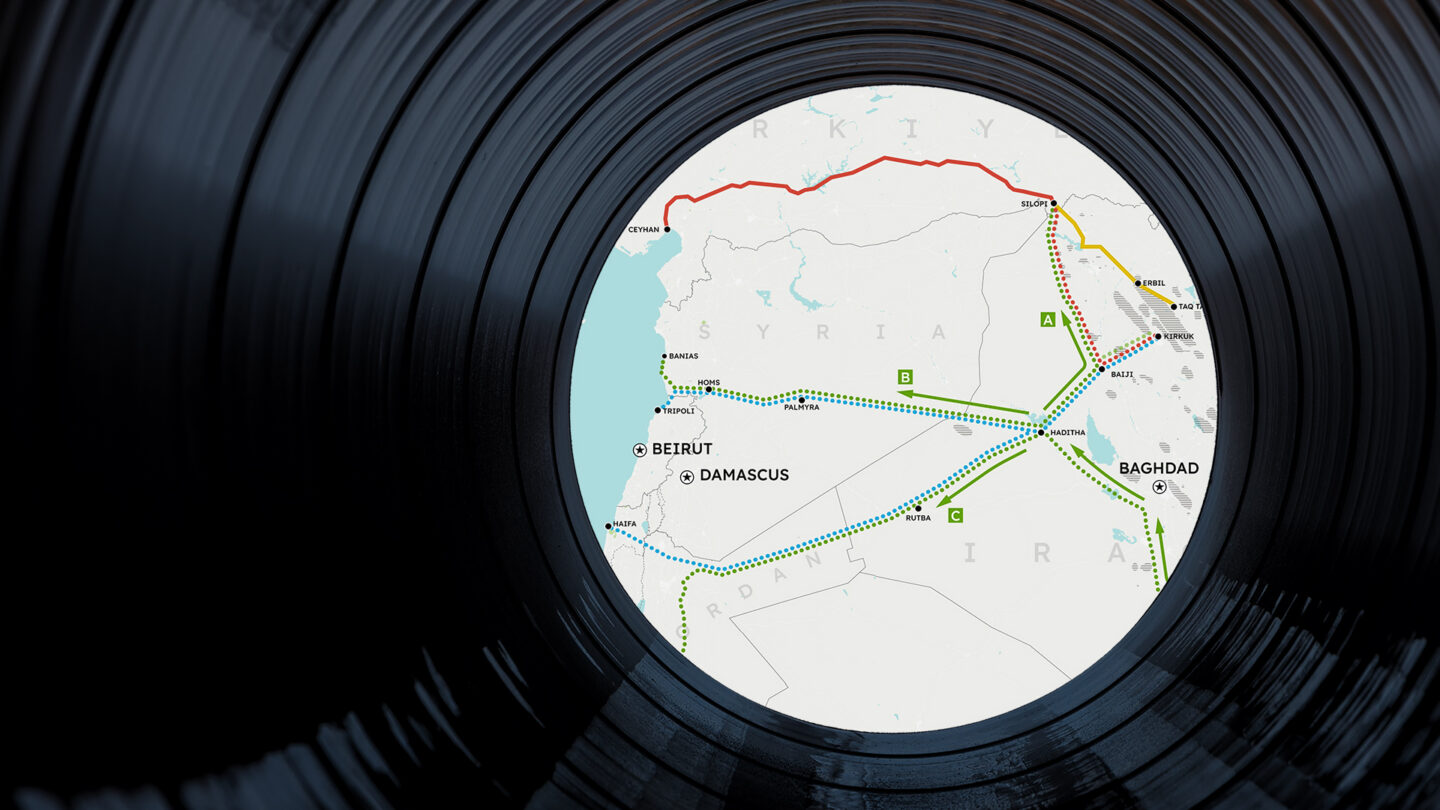
On July 17, Iraq’s Basra Oil Company and the Syrian Petroleum Company signed a memorandum in Washington to revive the line, but this time aiming to funnel oil from Iraq’s southern fields in Basra to the Mediterranean terminal at Banias. The US State Department welcomed the two governments’ intent and the engagement of a US-led consortium to handle the technical and financial work, putting the rehabilitated line’s initial capacity at 2 million barrels per day (bpd). Importantly, there is no financing, no timeline, and no legal framework beneath any of it, only a commitment to create them, allowing Baghdad room to maneuver as it seeks alternatives to sending its oil exports through the war-ravaged Strait of Hormuz.

Building out options to get its most important export to market has been a challenge for Iraq since it first began industrial oil production more than 90 years ago.

Iraq’s July 5 cabinet decision that revived the Banias option also authorized a US-Qatari consortium including Chevron to study a parallel line to Türkiye’s Ceyhan port, sharing a common trunk from Basra to Haditha. Both begin in Basra because that is where most of Iraq’s oil is, and where nearly all future growth is expected. At commercial scale, that crude has one outlet: tankers through the Strait of Hormuz. Iraqi exports, which averaged 3.4 million bpd before the US-Israel war on Iran began in February, fell as low as 500,000 bpd in May and June amid repeated closures of the strait, and a July 16 drone strike on the Basra loading terminal made the exposure plain.

Building out options to get its most important export to market has been a challenge for Iraq since it first began industrial oil production more than 90 years ago. In a region regularly beset by upheaval, each new pipeline, built to escape the constraints of the last, has created vulnerabilities of its own: another neighbor with bargaining leverage, another soft target during the outbreak of war. That the strategy of developing new export options has worked before makes the move credible now; that it has never worked for long is a challenge the new efforts will similarly struggle to overcome.

Pipeline Politics Through Decades of Upheaval

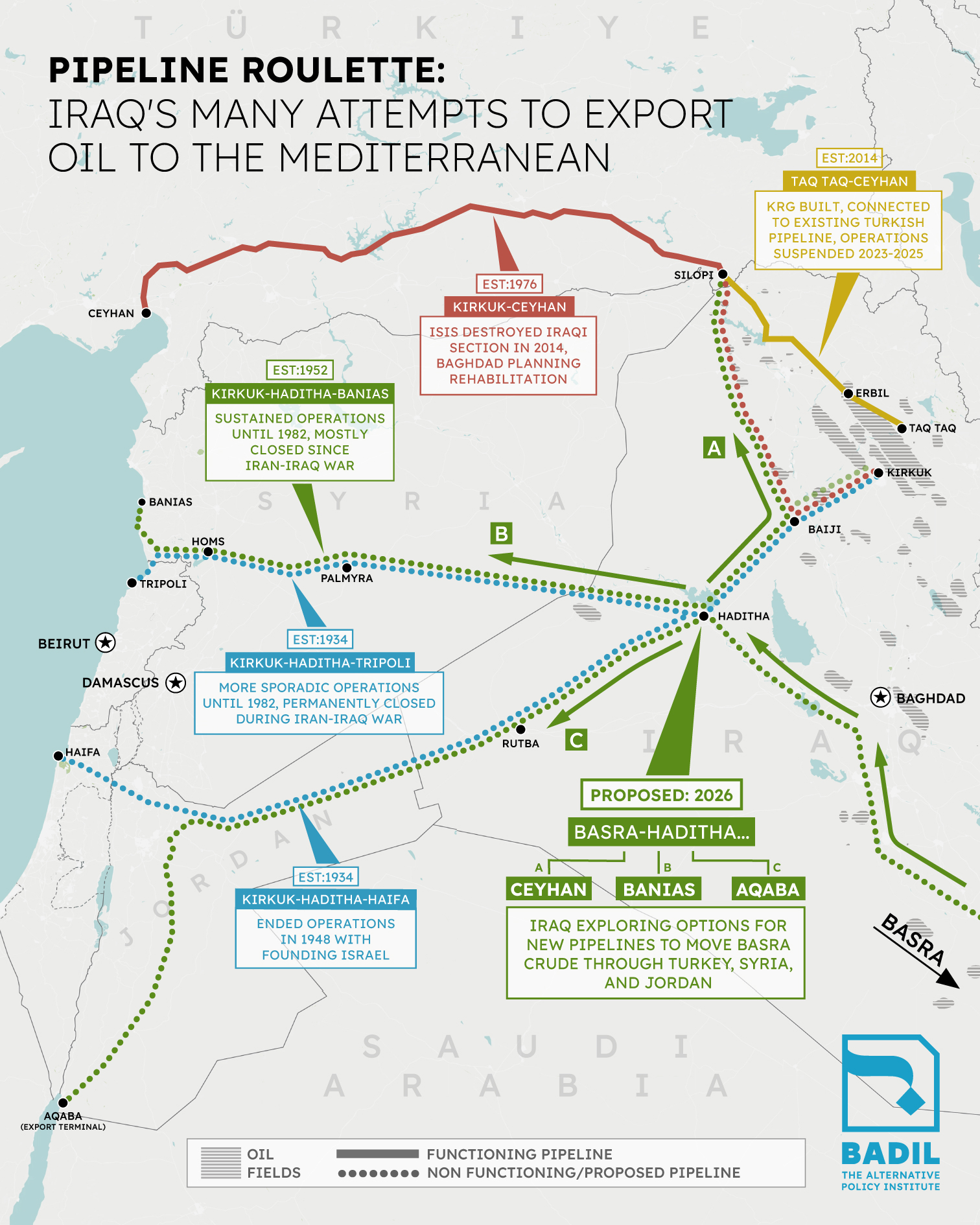
The Iraq Petroleum Company opened the world’s first transnational oil pipelines in 1934. This saw a single line run from the Kirkuk wells in northern Iraq to Haditha in the country’s western desert, splitting there between a northern line running through Syria and Lebanon to the port of Tripoli, and a southern route through what was then Trans-Jordan and Palestine to Haifa.

Baghdad closed the Haifa line in 1948 in response to the creation of Israel, and in 1952 replaced it with another pipeline through Syria to Banias. The years that followed saw Syria repeatedly use the pipelines for geopolitical and economic leverage, closing them during the 1956 Suez Crisis, and again from December 1966 to March 1967 when Damascus’ new Ba’ath government forced a transit-fee showdown with Baghdad. By the 1967 June War, with the Suez Canal closed and Iraq lacking the deepwater infrastructure to load supertankers in the Gulf, Baghdad saw little choice but to begin talks with Ankara to send a pipeline to Türkiye’s Mediterranean coast.

In 1973, Iraq caved to Syrian fee demands again, a humiliation that hardened its determination to build an independent route through Türkiye. Baghdad also constructed the Kirkuk-Basra pipeline, designed to move crude in either direction, and dramatically increased Basra’s export capacity by the mid-1970s. The impetus to shift dependence from Syria was compounded in October 1973, when Israeli strikes during the Arab-Israeli war knocked the Banias tank farm out of operation for three weeks and damaged pipeline installations at Homs and Tartous, raising real fears in Baghdad that a future war could sever the Syrian route altogether.

1974 saw the Baghdad-Ankara agreement for the Kirkuk-Ceyhan pipeline, which began pumping in 1976, ending Iraq’s dependence on Syria for a Mediterranean export route. Ba’athist rivalry led to the closure of, followed by the Banias line in 1982 with the Iran-Iraq War. In 1983, as the Lebanese Civil War raged, Syrian artillery shelled the Tripoli terminal directly, rupturing storage tanks in one o. This led to the Turkish route becoming increasingly important to Baghdad, which tripled its capacity throughout the 1980s. Tripoli never recovered as an export option, but the pipeline to Banias proved more durable, anchored by its capacity to accommodate supertankers. It returned to operation intermittently after 1982, such as in 2000, to help Iraq skirt United Nations sanctions.

Seeking further avenues to get its crude to market, in 2013 Iraq and Jordan agreed to a pipeline deal that would see oil flow from Basra to Haditha, and on to the Red Sea port of Aqaba. This, however, was shelved the next year with the rise of ISIS in western Iraq. Compounding Baghdad’s woes in 2014, ISIS also blew up the Kirkuk-Ceyhan pipeline, while the semi-autonomous Kurdistan Regional Government (KRG) in northern Iraq brought its own pipeline into operation, connecting directly into the pipeline on the Turkish side of the border but with the Iraqi federal government cut out of any revenues. Days after the first cargo of Kurdish crude loaded independently at Ceyhan, Baghdad took Ankara and its pipeline operator before the International Chamber of Commerce (ICC), arguing that the 1973 treaty let nothing move through the line without federal consent. The next decade saw the KRG build its autonomy off of these oil exports as the ICC case proceeded at a glacial pace.

In February 2023, the ICC awarded Iraq roughly $1.5 billion in damages, while also certifying that the 1973 treaty gave Baghdad primacy regarding oil exports to Türkiye. Ankara responded by filing an appeal and shutting its side of the pipeline entirely, seeking to use both the closure and the unpaid award to improve its position in any successor deal. Baghdad, for its part, let the silence do its work, as the KRG’s finances and bargaining position withered without the export revenues. When the crude finally moved again in September 2025, it was on Baghdad’s terms: Erbil handed its oil to the state marketer, accepted federal pricing, and surrendered its independent export channel. The pipeline the Kurds had once used to route around Baghdad became the instrument that tied them back in. For his part, President Recep Erdogan, seeking Turkish leverage, announced last year the termination of the 1973 agreement, effective July 27, 2026. Baghdad asked for a one-year extension, but Ankara refused, pushing for broader terms.

The Iran War and the repeated closures of the Strait of Hormuz since March have been a game-changer for Banias

Iran War Ups the Ante for Export Alternatives

Syria’s oil refinery and terminal in Banias had never fully stopped operations after the pipeline from Iraq shut down in the 1980s, continuing to process Syria’s modest domestic crude production and, post-2011, Iranian crude shipments during the Syrian Civil War. Operations paused briefly after the fall of the Assad regime in December 2024, restarting on Russian crude in 2025.

The Iran War and the repeated closures of the Strait of Hormuz since March have, however, been a game-changer for Banias, with the first Iraqi convoys carrying fuel oil arriving at the terminal in April. Since then, thousands of tanker trucks have offloaded refined Iraqi fuel products at Banias for re-export, so much so that in June Syria was the region’s largest fuel-oil shipper, accounting for some 720,000 tons and 28% of total Middle East volumes. Interest consequently spiked in both Syria and Iraq in reopening the Haditha-Banias pipeline, which can carry far more to export markets than trucks. On March 16, Baghdad also announced it was seeking to revive the Kirkuk-Ceyhan line, which would further reduce the KRG’s bargaining position. Two days later, Türkiye upped the stakes, with the country’s energy minister, Alparslan with capacity expanding to 2.5 million bpd.

The Banias route presents a far more uncertain political and infrastructural proposition, yet one in which Damascus possesses considerably less leverage over Baghdad than Ankara does today.

The past month then saw a flurry of activity as regional actors jockeyed for leverage through competing pipeline proposals, with Baghdad clearly seeking optionality to avoid overreliance on any one direction. On July 5, the Iraqi cabinet issued a decision to study options for a new Basra-Haditha trunk line that feeds branches to either Ceyhan or Banias. Among the arguments for the Turkish route is that much of the infrastructure is already in place, with oil currently moving through Ceyhan; however, the two-and-a-half-year closure of the pipeline following the ICC ruling also illustrates Baghdad’s dependence on Türkiye. The Banias route presents a far more uncertain political and infrastructural proposition, yet one in which Damascus possesses considerably less leverage over Baghdad than Ankara does today.

On July 9, Türkiye appeared to reassert its position, with energy minister Bayraktar announcing that a new one-year interim protocol to extend the 1973 agreement had reached its final stage. By mid-month, however, Baghdad was clearly demonstrating that it was exploring all options. This included Iraq and Jordan announcing July 16 that they were in talks, under US facilitation, to revive the pipeline proposal to move Basra crude to Aqaba. A days later came the announcement of the Iraq-Syria MoU to rehabilitate the Haditha-Banias line.

These alternative pipeline routes were obvious cards that Iraqi Prime Minister Ali al-Zaidi took with him during his visit to Ankara on July 28. The main outcome was an announcement by Erdogan that the Turkish state oil company TPAO would acquire a 15% stake in a BP-led consortium in Kirkuk, adding that the two countries aim to lift exports to 1 million bpd and sign a “comprehensive energy cooperation agreement.” By August 1, the two countries formally agreed to a one-year extension that will keep oil flowing to Ceyhan.

Notably, Türkiye’s March proposal to extend a new pipeline south to Basra would capture the very production growth Baghdad is now trying to route through Haditha. The two proposals aim at the same destination by different means: Iraq’s Basra-Haditha plan keeps Ceyhan and Banias as live options, with Baghdad controlling the trunk line and the choice of where crude ultimately goes; Türkiye’s extension would fold that same crude into the Ceyhan pipeline itself.

Even Lebanon launched a longshot bid to be reconnected to the Iraqi pipeline network at the end of July, announcing the formation of a joint technical team with Iraq on the prospect of . The proposal, however, remains outside Baghdad’s formal pipeline program. Any revived line would still route through Syria before reaching Tripoli, making Beirut’s bid a stake in Banias’s success rather than a genuine rival to it.

Every past solution to Iraq’s transit problem eventually became a new point of vulnerability, and a new dependency.

The Most to Win, The Most to Lose

Should the Iraq-Syria MoU result in the completion of the Haditha-Banias pipeline, able to carry crude from both Kirkuk and Basra, the clearest winner would be Baghdad itself. For decades, Iraq’s export strategy has been shaped by dependence, whether on the Gulf, Türkiye, or the political constraints surrounding individual transit routes. The Basra-Haditha trunk pipeline seeks to reverse that logic. History offers caution, though. Every past solution to Iraq’s transit problem – Haifa’s branch, the Tripoli line, even Ceyhan itself after the 2023 arbitration – eventually became a new point of vulnerability, and a new dependency. Diversification multiplies routes, but it has never eliminated Baghdad’s exposure, only shifted where the exposure sits, and who holds leverage over it.

Syria stands to benefit as well. Reviving Banias would restore economic value to infrastructure that has remained underutilized for decades while reinforcing Damascus’s gradual reintegration into regional energy networks, a process already underway with Syria shipping increasing volumes of Iraqi oil products this year.

The United States would also benefit. US companies occupy a central position in Iraq’s emerging export strategy, while the project advances Washington’s broader efforts to reintegrate Syria economically and help stabilize Iraq and Syria. Chevron secured exclusive rights in February to negotiate for Iraq’s 460,000-bpd West Qurna 2 oilfield, after Iraq nationalized it from sanctioned Lukoil. It is now negotiating MoUs for that field, along with the smaller, 90,000-bpd Nasiriyah oilfield, while also leading the consortium studying the proposals to route Basra crude through Haditha to either Syria or Türkiye.

Türkiye’s position illustrates the shift. At first glance, a revived Banias corridor appears to threaten Ceyhan by introducing a competing Mediterranean outlet. Yet Ankara’s own proposals suggest a more nuanced reality. Türkiye is no longer seeking merely to preserve the existing Kirkuk-Ceyhan pipeline. It hopes to extend the system south toward Basra, chasing future production growth, not just declining northern volumes. If that ambition succeeds, Türkiye could ultimately transport more Iraqi crude than before, even while surrendering some of the exclusive leverage it once enjoyed. For Ankara, the challenge is adapting from being Iraq’s indispensable transit route to becoming its preferred one, and TPAO’s move into BP’s Kirkuk consortium is an early sign of that adaptation. By buying a direct stake in the crude itself, it benefits regardless of which export route Baghdad ultimately favors.

The Kurdistan Regional Government faces a more difficult future. Baghdad is aiming to reduce Kurdish exports’ strategic importance within Iraq’s overall export system, not eliminate them. As Basra increasingly supplies the volumes needed to fill northern pipelines, Kurdish production risks becoming supplementary, rather than essential. Erbil may continue to play an important role in Iraqi energy exports, but one exercised within a federal system that enjoys far greater flexibility than it has in the past.

Regionally and internationally, Iran and Russia would lose the most through increased Iraqi export options, though not equally. Iran’s leverage over global oil markets rests heavily on the Strait of Hormuz remaining the principal route out of the Gulf. Saudi Arabia’s Red Sea pipeline and the UAE’s line to Fujairah offer partial bypasses, but neither substitutes for Hormuz at scale. Every barrel that reaches the Mediterranean by pipeline is a barrel Tehran can no longer hold hostage. Russia’s loss is more commercial than strategic. Any additional non-Russian, non-sanctioned crude or refined product reaching European buyers, whether by pipeline through Banias or tanker from elsewhere, chips away at Moscow’s market position, and Banias is one contributor to that erosion.

Infrastructure projects of this scale require years of financing, engineering, and political agreement, and many never progress beyond the planning stage.

All of this only holds, of course, if the pipeline gets built. Infrastructure projects of this scale require years of financing, engineering, and political agreement, and many never progress beyond the planning stage. Moreover, even the strongest geopolitical strategy cannot eliminate physical vulnerability. Pipelines are often repaired within days, but damage to export terminals, refineries, and processing facilities may disrupt flows for months or even years. Ukraine’s campaign against Russian energy infrastructure, Iran’s strikes on Qatar’s Ras Laffan LNG complex, and the attack on Fujairah all demonstrate that the greatest bottlenecks often lie at the ends of the system, not along the route. A revived Haditha-Banias corridor would remain exposed to the same risks. US backing may improve the project’s prospects, but its durability will ultimately depend on whether the states it connects continue to share an interest in protecting it.


John Bowlus is a Non-Resident Fellow at Badil | The Alternative Policy Institute

The views expressed in this article are solely those of the author and do not necessarily reflect the views of BADIL | The Alternative Policy Institute or its editorial team. 

Related