
Executive Summary
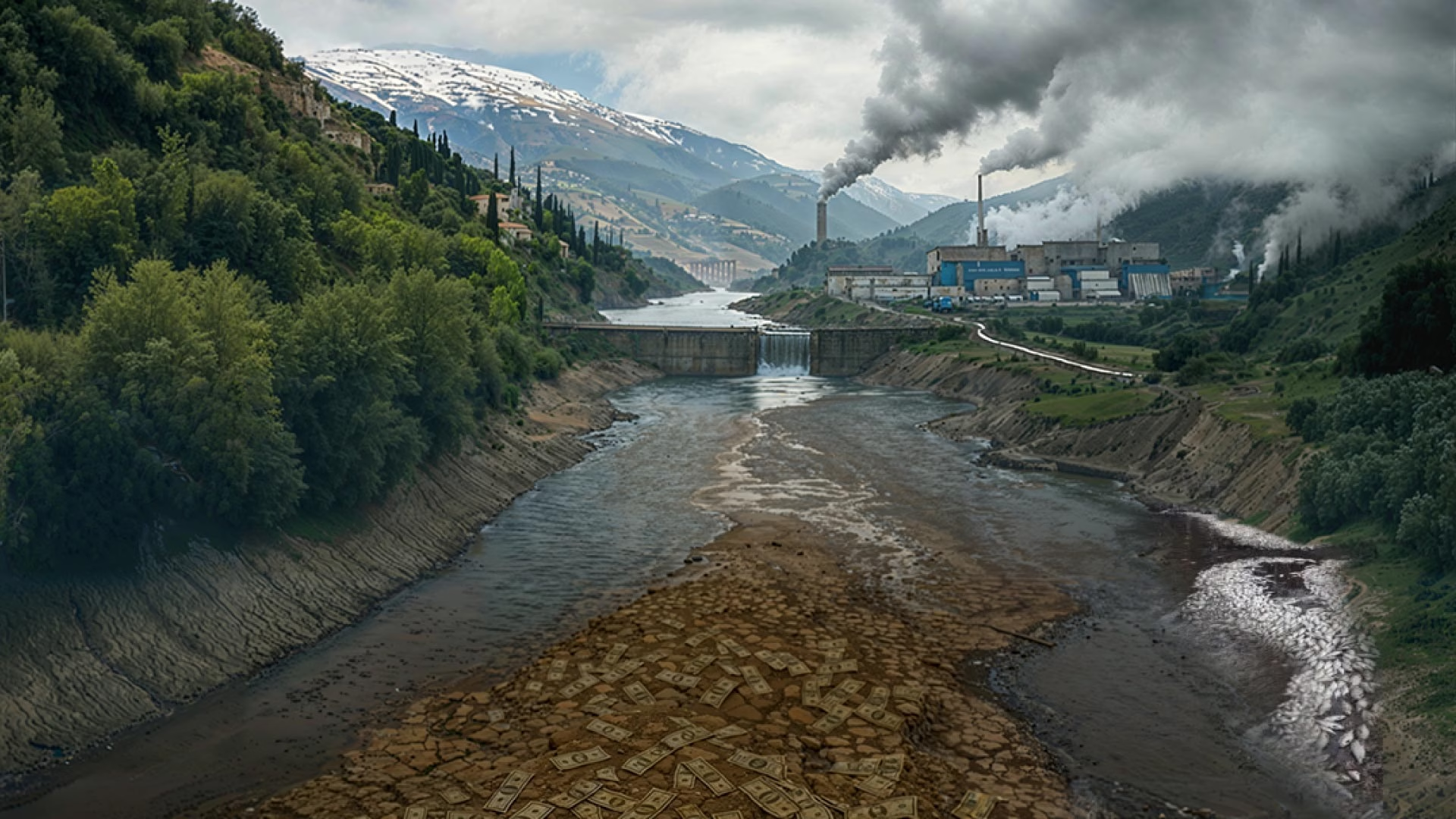
Lebanon is thirsty, desperate, and vulnerable — and politicians know it. Facing the worst drought in decades, people are exhausted, frustrated, and primed for quick promises.This is precisely the moment for the shock doctrine: when governments strike fast deals and borrow heavily for big, flashy infrastructure — no questions asked.
Now comes the ‘Second’ Greater Beirut Water Supply Project (SGBWSP), freshly announced at a cost of $257.8 million in World Bank loans. It’s pitched as an essential lifeline to Beirut, promising to finally bring clean water from the heavily polluted Qaraoun reservoir — fed by the Litani, one of Lebanon’s dirtiest rivers — straight into homes across the capital.
But on closer inspection, the promise quickly evaporates. This isn’t a new idea; it’s a sequel to the disastrous Greater Beirut Water Supply Project (GBWSP), launched 15 years ago at a cost of $370 million. Today, that project delivers exactly zero liters of water to Beirut. Not a single cubic meter flows through its unfinished tunnels or half-built pipelines.
Will this second try succeed where the first failed? Perhaps — for a few years, at best. But at what cost?
For starters, there’s the debt: Lebanon will pay millions annually in interest just on this new loan, adding to tens of millions more for earlier failed water schemes. Then there’s the government’s latest ‘strategy’ behind this flashy announcement: laying groundwork for the revival of the Bisri Dam, a deeply unpopular mega-project cancelled in 2020 due to seismic risks and public outrage. Quietly resurrected in Lebanon’s latest national water strategy, Bisri now waits conveniently in the wings, ready to be reintroduced as an unavoidable necessity.
Dams themselves aren’t the issue — but rushed decisions, driven by politics and desperation rather than real concern for the foundations of life. Lebanon doesn’t just have a drought problem. We have a theft problem, a pollution problem, and most of all a management problem. We leak half our water before it even reaches the tap. So, cleaning water at the pipeline’s end is not a solution — it’s an expensive and unsustainable surrender.
Our critics will say that opposing this project means depriving Beirut’s residents of desperately needed water. We say the opposite: if Lebanon’s politicians truly cared about bringing water (or electricity, or healthcare, or transport) to their people, those basic services would already be here. They aren’t — because every crisis has been used the same way: to borrow money, to build grand monuments to political vanity, and to push real solutions indefinitely down the line.
Parliament must pause before it ratifies the SGBWSP loan agreement. Lebanon urgently needs water — not just in Beirut, but in the Bekaa for crops, in the South for rebuilding, and in the North for industry. We can’t keep betting our future on shortcuts or the logic that ‘there is no alternative.’ There is.
Lebanon doesn’t need more pipelines to nowhere — it needs a dam to stop the flood of mismanagement. We’re not thirsty for ideas or poor in water; we’re drowning in broken promises. Until we fix how we govern this resource, every drop we chase will slip through our fingers — and every loan we sign will leave us thirstier than before.
Sami Halabi
Director of Policy
BADIL | The Alternative Policy Institute
Introduction: Lebanon’s Intensifying Water Crisis
Lebanon’s water disaster is no longer looming — it’s here, and it’s emptying both taps and wallets. With state supplies drying up, families now pay more than ten times the official rate to private water truckers, just to meet their daily needs. The alarms sounded early this year when, in January, the Beirut and Mount Lebanon Water Establishment (BMLWE) announced “severe rationing” following a 70 percent drop in precipitation over the winter.
There are several major forces draining Lebanon’s water supply — some are structural and others other climatic. The first is longstanding: agriculture accounts for nearly 60 percent of the country’s water use, far outpacing municipal (29 percent) and industrial (11 percent) demand, according to the most recent figures from the Ministry of Energy and Water in 2010. Back then, water was more abundant, less contested and the country had not lost 35 percent of its economy to a financial crisis — today Lebanon’s water crisis is perhaps the most pressing existential issue on which the liveability of its people depends.
Layered atop this is the second and perhaps more ominous force: climate change. Warming temperatures have slashed snowfall on Lebanon’s mountains, reducing snowmelt that once replenished rivers, reservoirs, and aquifers. Without this seasonal recharge, Lebanon’s dry-season water availability is projected to halve by 2040, according to the World Bank. The Lebanese Ministry of Environment’s Climate Change unit warns that even modest warming will have a steep cost: a 1°C increase could shrink the country’s total freshwater supply by up to 8 percent. At 2°C, that drop could reach 16 percent. When combined with current overuse and misallocation, the trajectory is clear: less water for more people — and no plan to fix the system before it collapses.
Yet perhaps the most critical driver of the water crisis is more human: systemic neglect. On average, nearly half of the country’s water is lost to leaks, theft, or other technical issues with a significant portion of the water that is delivered also remaining unbilled. The technical term for this ‘lost’ water is Non-revenue Water, which some experts believe runs as high as 60 percent in different areas of the country.
Environment Minister Tamara el-Zein said she considers the human causes of water scarcity paramount: “Lebanon is a water-rich country,” she told BADIL, “yet mismanagement has prevented the optimal use of its resources.” The Minister is right.

According to the Ministry of Energy and Water’s Lebanon’s National Water Strategy (2024–2035) published in June, Lebanon isn’t water poor — it’s water wasteful. Lebanon receives around 8.6 billion cubic meters of precipitation every year, yet we only manage to capture about 2.7 billion. The rest — almost 6 billion cubic meters — is lost to evaporation, deep infiltration, and surface runoff we fail to store. As such, the water crisis is less about scarcity, and more about failure to manage abundance. Now factor in the 2019 financial implosion and it’s little wonder that daily public water supply went from 120 liters per capita to less than 35 liters in 2021.
Just two years later, Lebanon was classified by the World Resources Institute (WRI) as among the five most water-stressed countries globally alongside Bahrain, Cyprus, Kuwait, and Oman. According to the institute, WRI’s Aqueduct Water Risk Atlas consistently shows Lebanon facing “extremely high-water stress,” meaning the country withdraws more than 80 percent of its available renewable water supply every year for agriculture, industry, and domestic use.
The latest response to this state of affairs came in May this year when the Lebanese Finance Minister Yassine Jaber and Minister of Energy and Water Joe Saddi recently signed off on a new loan agreement with the World Bank to fund the Second Greater Beirut Water Supply Project (SGBWSP). Worth $257.8 million, the project still needs parliamentary approval, the stated aims for the project are to address Lebanon’s chronic water shortages by completing critical water infrastructure, improving water quality, and reducing reliance on costly private water sources. Yet if the first iteration of the project is anything to go by, the SGBWSP may pour more borrowed money into the same leaky system, with little to show for it.
Tried and Failed
The first Greater Beirut Water Supply Project (GBWSP), launched in 2010 to the tune of $370 million, was intended to solve Beirut’s chronic water shortages within five years. The project is a patchwork of where it should have been today, some 15 years later and with at least $350 million of public money spent – more than $192 million from a World Bank loan and at least $158 million from the Lebanese government and the BMLWE. As of earlier this year, the World Bank deemed progress toward project goals simply “unsatisfactory.”
While originally conceived as a single-stage project to deliver clean water to Beirut and improve utility capacity, the first Greater Beirut Water Supply Project failed to meet even its most basic targets. The GBWSP was designed to divert raw water from the Qaraoun reservoir — fed by the Litani River in the Bekaa Valley — pump it through 26 kilometers of tunnels across mountainous terrain to a treatment plant in Wardanieh, and then distribute it via new pipelines to serve 1.2 million people in Greater Beirut, making it one of Lebanon’s most ambitious and logistically complex infrastructure undertakings. If it was ever achieved, it would bring 50 million cubic meters of water per year to Greater Beirut, enough to meet about 20 percent of the region’s peak demand for around 1.2 million residents, including 350,000 in low-income neighborhoods.

After 15 years, the volume of additional potable water delivered: zero. Not one cubic meter was flowing by the project’s final closure in April 2025, due to incomplete tunnels, unfinished pipelines, and a still-under-construction Wardanieh Water Treatment Plant.
Other metrics were just as damning. The project had aimed to connect 20,000 poor households in southern Beirut to the network; only 5,125 were actually connected, covering roughly 21,500 people. Importantly, critical infrastructure — including tunnels and the Wardanieh Water Treatment Plant (WTP) — was left unfinished. The World Bank, in a statement to BADIL, cited a financing shortfall, the BMLWE’s inability to fund the WTP, inflation, as well as the bankruptcy of the primary Italian contractor as core obstacles to completion. “The work initially progressed very well, even achieving a record in tunnel drilling,” said Randa Daher, BMLWE’s project lead.
It is worth noting that the original closing date for the GBWSP was June 2016, more than three years before the Lebanese financial collapse in late 2019. Similarly, it wasn’t until January 2019 that Cooperativa Muratori & Cementisti di Ravenna, the project’s Italian contractor, entered bankruptcy restructuring negotiations. Neither of these events nor the October 2019 financial crisis would have impacted the water supply project had it been completed by its originally scheduled closing date, or indeed any time within the subsequent three years of that initial deadline.

Second Time Lucky?
The new project — again overseen by the CDR and the BMLWE — promises to do what the first one never did: finish the job. On paper, it includes everything you would expect from a proper water plan. There’s the completion of the leftover tunnels and reservoirs, long-abandoned pipelines, upgrades to the still-incomplete Wardanieh treatment plant, and reforms to modernize BMLWE’s operations. There’s a line item for land acquisition, another for capacity building at the Ministry of Energy and Water, and a vague contingency fund to cover future emergencies. In other words, it’s the same blueprint — just relisted, repackaged, and rebranded with some adjustments under a new $257.8 million loan. This time, we’re told, it will work because it’s fully financed by the World Bank, not dependent on local co-financing. But financing isn’t free (see Box 1), nor was it what left the last project unfinished. The problems were structural, institutional, and political. And not one of those has changed.
Box 1
Despite being labeled as “soft loans,” Lebanon’s borrowing from the World Bank still carries significant costs. The Second Greater Beirut Water Supply Project (SGBWSP), for example, is structured with an interest rate tied to the Secured Overnight Financing Rate (SOFR) benchmark (currently 4.31%) plus a 1.44% variable spread—bringing today’s total to around 5.75% annually. That rate fluctuates with SOFR, and additional fees apply: a 0.25% annual charge on undisbursed funds and a one-time 0.25% front-end fee. The World Bank was not able to respond to a request for clarification on interest paid and due as BADIL went to print.

Officials have framed the project as essential. “This project is vital for Greater Beirut,” a Ministry of Energy and Water spokesperson told BADIL, adding that once operational, it will “improve the supply, distribution, and water networks in the area” and relieve residents of the financial burden of buying water.
According to the World Bank, the SGBWSP will benefit around 1.8 million people (up from 1.2 million), including 350,000 low-income residents, who currently receive less than a quarter of their daily water needs. Many of them, similar to the rest of the population, depend on private water tankers that are up to ten times more expensive than publicly supplied water. The new system aims to boost dry-season supply from 24 percent to 70 percent of demand and increase piped water availability in Greater Beirut by 75 percent during the wet season. Water sources for this increased supply include Lake Qaraoun and the Awali River, with additional springs along the way and Ain Zarqa (see Map).
The plan calls for enhanced pollution management at the Wardanieh treatment plant, with Randa Daher of BMLWE telling BADIL that the plan’s contingencies will allow for the WTP to be financially sustainable. She said increasing quantities and subscribers will allow 50 million cubic meters of water to be treated and sold annually, ensuring financial viability without the need for future loans.
“The implementation of the project will start once the Government of Lebanon fulfills all the conditions for its effectiveness, including the ratification of the signed loan by Parliament,” the World Bank told BADIL in a statement. The Ministry of Energy and Water is reportedly working with the Ministry of Finance, the CDR, and BMLWE to meet these requirements.
Quantity: The Mirage of Abundance
Despite this year’s unprecedented drought and the clear prospect of climate change, officials involved with the Second Greater Beirut Water Supply project continue to sound confident in Lebanon’s ability to meet water demand. Randa Daher of the BMLWE insists that the Litani River, the primary feeder for Lake Qaraoun, can deliver the required 50 million cubic meters per year, calling the past winter’s decreased precipitation an “exceptionally and extremely dry” year.
Indeed, Lake Qaraoun’s inflows are collapsing. In March 2025, only 43 million cubic meters flowed into the reservoir, far below the historical average of 233 million cubic meters for the same period. Sami Alawieh, Director of the Litani River Authority (LRA), the public body overseeing the river basin, projects total inflows for 2024-25 will reach just 65 million cubic meters, an 80 percent drop from the long-term annual average of 320 million cubic meters. From September 2024 to May 2025 alone, expected inflows are only 55 million cubic meters, barely enough to meet any of the competing demands now placed on Qaraoun.
The World Bank nevertheless shares the BMLWE’s optimism, stating that Lake Joun receives sufficient water from the Awali River, Lake Qaraoun, and various springs to support system needs during the dry season. This characterization aligns with Presidential Decree No. 14522, issued in 1970, which allocates three cubic meters per second — roughly 50 million cubic meters annually — from Lake Qaraoun between April and October to supply potable water to the Greater Beirut area.
But what the World Bank omits is more revealing than what it includes. In October 2011, the Council of Ministers issued an updated allocation strategy for the Litani River, recognizing the rising strain on water resources. That decision prioritized the Greater Beirut Water Supply Project (Awali-Beirut Conveyor), but only on the assumption that the project’s completion does not coincide with the completion of other projects that are now slated for completion. At the time, the Council of Ministers counted on the future construction of the now-cancelled Bisri Dam (see below) to offset deficits once Canal 800, a massive irrigation initiative, slated to become fully operational in 2036. In fact two large-scale irrigation infrastructure projects are tipped to rely heavily on water from Qaraoun and the Litani. Canal 800, currently under implementation, is designed to irrigate 15,000 hectares of farmland and provide drinking water to 77 villages, with 100 million cubic meters annually drawn from Lake Qaraoun. Canal 900, initiated in the 1970s to expand irrigation in South Bekaa, aimed to cover 21,500 hectares, which currently supplies 1,900 hectares. Expansion of the Canal 900 has stalled, largely due to Lake Qaraoun’s advanced levels of pollution (see below). The World Bank itself stated to BADIL the Canal 800 will create “more competition to meet all water uses” that will require an “assessment of the feasibility of the irrigation project under the conditions that will prevail in 2036.”
What that means is if planned irrigation projects coincide with the SGBWP finishing on time in seven years, then the Qaraoun will only be able to supply Beirut unhindered for four years. Do that math and Lebanon will have spent around $151.95 million per year to ensure unhindered supply to Beirut for just four years.
Longer term, the picture is even more bleak. According to an addendum of the CDR and BMLWE’s Environmental and Social Impact Assessment (ESIA) Addendum for the Second Greater Beirut Water Supply Project, the availability of water in both the Litani and Awali basins needed to meet the project’s required daily supply in the dry summer months will deteriorate sharply in the 2044–2050 period: By 2044–2050, the ability to meet daily water requirements in the dry season will drop to just 47.9 percent of days — meaning more than half the time, the system will not be able to provide the full planned water supply for Greater Beirut. This is a dramatic decline compared to the period 2026–2030, during which almost all days (99.8 percent) are expected to meet water demand.
Quality: Poisoned at the Source
Anyone who’s ever stood at the edge of Lake Qaraoun or walked along the upper Litani River knows the truth: these are not water sources, they’re open sewers. The stench, the color, the visible scum — they all tell the same story long before any test result does. And yet, this is the water the government plans to pipe directly into Beirut’s homes. The Wardanieh Treatment Plant is supposed to make it safe to drink. But even if it’s built and maintained flawlessly — a big assumption given Lebanon’s track record — the complexity and scale of the treatment may simply be too much to handle.
The World Bank knows this reality all too well. In 2016, the Bank approved a $55 million loan for the Lake Qaraoun Pollution Prevention Project. A 2022 investigation revealed that, five years in, only a fraction of the money had been spent, the lake remained “an open sewer,” and cancer rates in surrounding communities were reportedly climbing. The project’s deadline was extended to December 2025, but as of this writing, little had changed.
“Addressing pollution at its source would indeed be the most effective strategy for achieving a long-term solution to the water quality issues associated with the supply system proposed under SGBWSP,” the World Bank said in a statement to BADIL. It added that operationalizing existing wastewater treatment in the Bekaa was not sustainable given that many “have deteriorated over years of inactivity and inadequate maintenance,” while “the high costs of treatment and the weak financial capacity of operators… can create dependency and is not sustainable in the long term.” The World Bank added that non-point pollution sources, or types of pollution that don’t come from one single place like a pipe or a factory, “have increased in the decade since the SGBWSP was slated for completion.” Thus “the depollution of Lake Qaraoun is unlikely to be achieved in the short and medium terms as it will require concerted efforts across several sectors and stakeholders, therefore justifying the investment under the SGBWSP to meet the urgent water supply needs for Greater Beirut in the interim.”
Thus, with neither the government nor the World Bank able to address the problem at the source through enforcement, a complex multi-stage treatment plan has been put in place at the Wardanieh Water Treatment Plant (WTP).
Environment Minister Tamara el-Zein drew a direct comparison to past failures: “When we want to transfer water from one place to another, at the very least, this water should be suitable for use,” she said, recalling how the GBWSP initially overlooked water quality, forcing costly retrofits of Wardanieh. She emphasized the need for rigorous pollution studies before launching loan-funded infrastructure, and warned of the long-term burden of operating such plants once external funding dries up.
Lama Abdul Samad, a public health engineer specializing in water and sanitation highlights that the most pressing threats to public health is not limited to the contamination by heavy metals, but also by sharply elevated levels of faecal coliforms, ammonia, nitrates, and phosphorus, largely due to intensive agriculture and uncontrolled discharge of untreated sewage. Today, Lake Qaraoun, the main source of water for the SGBWSP, is smelly and visibly brown in color. A 2022 study has deemed it unfit for irrigation purposes, let alone water supply to the general public, without prior treatment. In an unprecedented event in late April 2021, 40 tonnes of fish washed up dead upon the Lake Qaraoun shores due to extreme contamination.
This comes as no surprise. As early as 2010, highly elevated levels of heavy metals including cadmium, chromium, nickel, zinc, aluminium and barium were measured in the lake water samples, alongside arsenic in lake sediment samples.
According to Lebanon’s national drinking water standards (NL 161:2016), the maximum allowable concentration for ammonia (NH₃) in drinking water is 0.5 mg/l. For comparison, the Litani River’s average recorded ammonia value of 4.6 mg/l far exceeds the Lebanese standard for drinking water by 920 percent. Elevated levels of ammonia, alongside the plethora of other dangerous contaminants in drinking water indicate a significant concern if such water is supplied without adequate treatment for drinking purposes.
And while experts who spoke with BADIL generally agree that the Wardanieh treatment plans should be able to deal with the vast majority of contaminants coming to Beirut, doubts were raised about Lebanon’s ability to manage and maintain large-scale water treatment projects.
In its defense, the World Bank says the SGBWSP will use “adaptive management” to calibrate Wardanieh’s systems to different seasonal contamination levels, ensuring the final output “meets stringent drinking water standards.” The World Bank insists Wardanieh will be able to treat these “anticipated levels” of pollutants. But past performance offers little reassurance.
Abdul Samad said the elevated pollution levels made Wardanieh a necessity — but warned that multi-phase treatment would raise operational costs and deepen Lebanon’s debt. The SGBWSP continues a cycle of borrowing for infrastructure, noted Abdul Samad, without a viable repayment plan. Daher contends that with the increased supply in Beirut, more subscribers will sign up and thus bring in the required cost recovery to avoid the need for more loans to operate the plant. By the BMLWE’s own data, the subscription rate had already reached some 87 percent in 2021.
This reality means while the World Bank speaks of “adaptive management” and “stringent drinking water standards,” the government has proved time and time again that it doesn’t have the ability — or perhaps even the will — to make upstream cleanup a priority. Instead, Lebanon is being asked to bet on a high-cost, high-maintenance treatment system in a country where such maintenance rarely happens often and budgets don’t last. If that gamble fails, it won’t be technocrats who pay the price. It will be ordinary households, drinking from taps they’ve been told to trust while paying out loans they probably shouldn’t have taken in the first place.
Bisri: The Dam That Refuses to Die
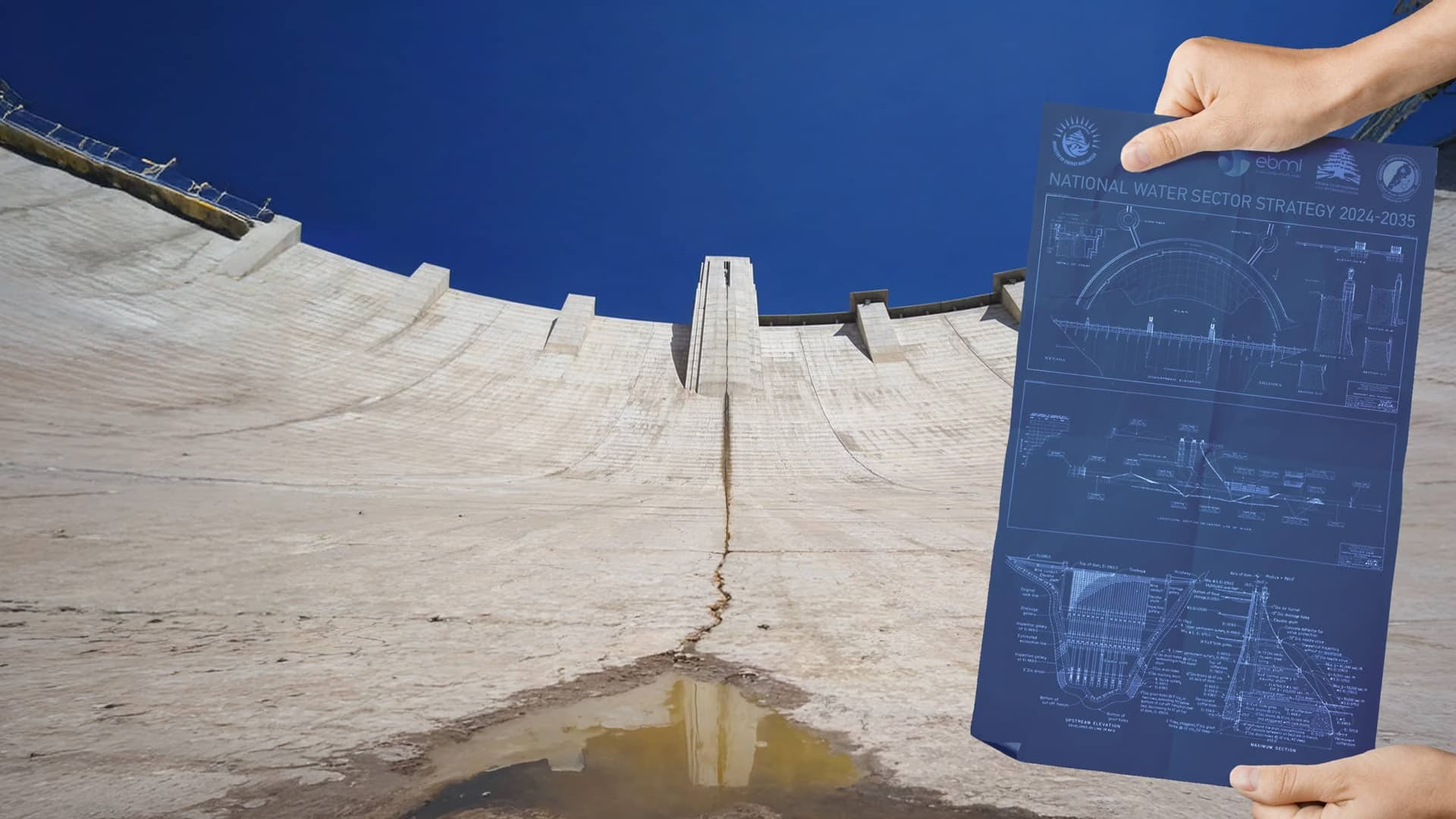
Released in June 2024, Lebanon’s updated National Water Sector Strategy outlines an ambitious roadmap for water infrastructure through 2035, with a total projected investment of $1.76 billion. It prioritizes the construction of 18 new dams over the next ten years, the rehabilitation of supply and irrigation networks, and targeted efforts to reduce Non-revenue Water (NRW), while advocating for governance reforms within water establishments. Notably, it revives the long-contested Bisri Dam as a “priority project”, despite its cancellation in 2020, something the World Bank is all too aware of.
In 2014, the $617 million Lebanon Water Supply Augmentation Project was launched with joint funding from the World Bank ($474 million), the Islamic Development Bank ($128 million), and the Lebanese government ($15 million). Commonly known as the Bisri Dam Project, the effort was to be implemented by the CDR and aimed to create a secure water supply for the Greater Beirut and Mount Lebanon area. The plans envisioned a 125 million cubic meter dam near the village of Bisri, 35 km southeast of the capital, that would fill during the winter and spring. In the summer and autumn, this water would then travel through a 26 km of underground, gravity-fed tunnels to the Wardanieh WTP for treatment before being sent on to taps and sinks in the city.
The ambitious plan quickly encountered controversy, with critics questioning its overall geological feasibility and the expected environmental impact (details below). The incomplete project was canceled in 2020 after $244 million had been disbursed. In explaining the cancellation, the World Bank cited the government’s failure to provide critical information regarding institutional and financial mechanisms tied to the Ministry of Energy and Water. Additionally, the government neglected to implement the ecological compensation plan, a fundamental component of the environmental impact assessment, which expired in 2016.

Seen in this light, the Second Greater Beirut Water Supply Project may not be a standalone fix at all — but a smokescreen for the Bisri Dam’s quiet resurrection. The tunnels, the treatment plant, the familiar promises about future supply — all of it sets the stage for a larger water transfer system that can’t function without major new sources: expensive new dams.
Although the World Bank insists that the SGBWSP is independent of the Bisri Dam, the long-term viability of the project tells a different story. The SGBWSP’s goal of delivering a reliable, round-the-clock water supply to 1.8 million residents of Greater Beirut appears unattainable without an additional water source – and that source, once again, is likely Bisri. In fact, the Bisri Dam constitutes the first of its ‘Priority 1 – Batch 1’ dams, which alongside four other much smaller dams, it wants to secure $595 million in financing.
The Bisri Dam has long been one of Lebanon’s most controversial infrastructure projects. Criticized by environmentalists, hydrogeologists, and civil society groups, the project was halted in 2020 after years of protests and expert warnings about seismic risk, ecological loss, and financial waste. Yet despite its cancellation, the updated national water strategy under former Energy Minister Walid Fayad includes no reference to past opposition, failed assessments, or the considerable scientific evidence against the dam’s feasibility.
Dr. Samir Zaatiti, a hydrogeologist, told BADIL that Lebanon’s landscape is fundamentally incompatible with large dams: “Lebanon contains sinkholes and large voids. We must learn from nature rather than work against it.”
He referred to a French geological study that described the Bisri Valley as suffering from effondrement (subsurface collapse). Drilling revealed cavities and caves that expand over time due to water flow and melting snow, weakening the ground and causing repeated collapses. Gravel and sediment deposits from the Al-Awali River only add weight and instability to an already fragile terrain.
Activist Amani Beainy echoed this concern: Hassan Hajjar, of the Local Committee for the Protection of Bisri Valley, said the dam project is “doomed to fail.”
“The project would require removing 27 million cubic meters of rock at an initial cost of $1 billion,” he said. “With long-term costs, it could reach $5–6 billion and wouldn’t be completed for 20–25 years.” “Following the Turkey earthquake, it seems absurd to revisit discussions about the Bisri Dam… tampering with nature after everything we’ve witnessed is sheer madness.”
Hajjar also emphasized the broader risks: “It would turn six million square meters of fertile valley into a swamp,” he said, noting that it would destroy the Chouf Cedar Reserve and 52 archaeological sites, including the Roman Temple and Saint Moussa Church. Together, Zaatiti, Beainy, and Hajjar agree: the dam is technically, geologically, and financially unfeasible.
A Damming Ambiguity
Despite the Bisri Dam project having been officially canceled, Decree 2066 of 2015, which designated it a project of public utility, was never annulled. The project’s prioritization in the new national water strategy now appears to foreshadow its resuscitation.
In interviews with BADIL, however, officials gave conflicting signals. The Ministry of Energy and Water stated that “the [SGBWSP] project has no relation to the Bisri Dam,” while confirming that a comprehensive study of stalled and completed dam projects is underway at the request of Minister Joe Saddi.
Meanwhile, Environment Minister Tamara el-Zein has not taken a firm stance, acknowledging that dam projects are “globally proposed solutions,” but questioning their relevance in Lebanon:
“There are three dimensions that must be considered when evaluating any dam project: site suitability, cost, and the availability of alternative solutions,” she said. “Costs in Lebanon might be higher than elsewhere for known reasons, but there are also indirect costs that must be taken into account. Could effective alternatives have been used instead?”
A spokesperson for the World Bank maintained that the SGBWSP is “technically and economically viable” without Bisri and denies knowledge of any current discussions about restarting the project. She added that the SGBWSP focuses on reducing NRW lost through physical leakage or unbilled usage, rather than on increasing supply through dam construction.
But even with these disclaimers, voices from within the government suggest a more dependent relationship. Randa Daher of the BMLWE underscored that the SGBWSP cannot fully meet Beirut’s growing water demands alone. She described the Bisri Dam as a “complementary project”, noting that while the two are technically separate, the dam would be essential to securing a continuous, reliable supply in the long term. She added that its implementation would necessitate a new treatment facility beyond Wardanieh. Indeed, World Bank documents from the first GBWSP clearly show that the bank anticipated that it would receive anywhere from 60 – 100 million cubic meters from the Bisri Dam “depending on the year.”
In this light, the Bisri Dam remains a dormant but not dead project, reintroduced on the edges of the public policy discussion but outside the spotlight of public scrutiny or transparent analysis. As Lebanon once again stakes its water future on projects with a history of failure, one must question whether our policymakers are captured by the madness of repeating the same decisions and expecting a different outcome.
Alternative Streams to Policy Myopia
A growing number of environmental experts and sector professionals argue that Lebanon’s water challenges cannot be solved through supply expansion alone. Instead, they advocate for a shift toward integrated, efficient, and sustainable resource management – one that maximizes existing potential before investing in new megaprojects.
For instance, Hussam Hawwa, founder of the environmental consultancy Difaf, estimates Lebanon’s NRW could be as high as 60 percent, but that this could be dramatically reduced through improved metering, leak repair, and addressing illegal connections. This would then recover substantial volumes of water already within the system. This perspective is echoed by Environment Minister Tamara el-Zein, who told BADIL that Lebanon’s aging and fragmented water networks should be a priority before pursuing large-scale water collection projects.
For Abdul Samad, the water and sanitation specialist, the solution lies in rethinking the broader water management paradigm. While she says the Bisri Dam may appear technically sound on paper, she argues that sector strategies often take a linear, engineering-first approach that overlooks climate resilience, social development, and long-term sustainability.
She calls for adopting Integrated Water Resource Management (IWRM) — a cross-sectoral planning model that balances agricultural, industrial, and environmental needs to optimize both economic and social outcomes. Without addressing systemic inefficiencies, she warns, adding new water sources may not translate to real gains for end users.
According to a World Bank spokesperson, the SGBWSP is part of the Lebanese government’s broader water strategy, which includes “initiatives to improve water availability and quality, the development of new sources, and the implementation of conservation measures.” A representative from the Ministry of Energy and Water affirmed that alternatives to current water infrastructure were discussed internally and reviewed by the CDR, with the most effective solutions ultimately pursued.
Still, many experts interviewed for this investigation believe that more can be done with existing resources. This includes improving the management of spring water, such as from the Jeita and Kashkoush springs, and enhancing governance practices to reduce waste and improve utilization.
Hawwa proposes a decentralized approach, suggesting small-scale infrastructure like check dams, hill lakes, and retention ponds to support agriculture and boost local water security.
Multiple interviewees referenced a proposal from the German Federal Institute for Geosciences and Natural Resources, which recommended developing public wells around Beirut. The plan suggested that Jeita Spring, if optimized, could supply the capital with enough water to meet the city’s current needs for between $30–50 million in infrastructure costs. As Hajjar noted, the Jeita Spring currently discharges around 185 million cubic meters annually, yet only 35 million reach Beirut. This leaves a theoretical surplus of 150 million cubic meters — more than double the capacity of the canceled Bisri Dam.
Hydrogeologist Samir Zaatiti supports this approach. He claims to have previously submitted a proposal to the Ministry of Energy and Water based on studies of groundwater near the capital. According to Zaatiti, regions like Wadi Shahrour–Kfarshima and Jisr Al-Qadi–Damour, underlain by Jurassic-era karstic rock, could yield fresh water through wells drilled at moderate depths. His estimates are based on successful groundwater extraction in Wadi Jilo and Wadi Fakhr al-Din, which currently supply 80 villages in southern Lebanon.
“Lebanon’s mountains act like sponges,” he notes, “absorbing and storing water in natural reservoirs. Large dams are not the only option — we should be investing in smart groundwater use.”
He estimates that 1.5 billion cubic meters of groundwater could be sustainably extracted each year, suggesting that this route may be more economically and environmentally viable than the construction of large-scale dams.
Although experts like Zaatiti and Hassan Hajjar raise concerns about external funding priorities, Minister el-Zein stresses the role of Lebanese institutions in directing those investments effectively.
“Funding agencies spend according to their priorities,” she said, “but the greater responsibility falls on us as officials to direct this funding more efficiently and ensure projects continue operating after funding ends.” She acknowledges that the cost of infrastructure in Lebanon is higher than in many other countries and that indirect costs — like environmental and operational burdens — must be factored into future decisions. “The major problem is that much of the funding has been spent without sufficient consideration for operation and maintenance.”
Looking Ahead: Borrowed Money in a Leaky Bucket
The World Bank’s new plan to revive and expand the Greater Beirut water network is built on a familiar foundation: borrowed money and overly optimistic technical projections. The Second Greater Beirut Water Supply Project arrives with a $257.8 million price tag and a mandate to deliver clean water to almost two million residents. But the core risks that undermined the first phase — leaky infrastructure, toxic water sources, inadequate oversight, and unfulfilled reforms — remain largely unresolved. With Lake Qaraoun still dangerously polluted and the Wardanieh treatment plant not fully operational, the SGBWSP risks repeating the mistakes of its predecessor, now with even more public money on the line and even less public confidence.
Over the past 15 years, hundreds of millions of dollars in concessional loans have flowed into Lebanon’s water sector with precious little to show for it. The World Bank is now presenting the new project as a lifeline. However, its exclusive focus on completing unfinished infrastructure, rather than addressing water quality issues at the source, reforming distribution, or alternative supply options, reflects a narrow reading of what went wrong, and a risky bet on what might still go right.
None of this is to say that Beirut doesn’t need more water. It does — urgently. A viable solution must secure both, and must do so within a governance framework and revenue model capable of maintaining the system over time. Credible alternatives already on the table: rehabilitating the Jeita Spring transmission channel, expanding public wells under tighter oversight, investing in decentralized filtration, and aggressively reducing non-revenue water losses in the network through repairing existing infrastructure. These paths may not be as grand or splashy as a large capital project, but they are arguably more aligned with Lebanon’s current needs and institutional capacity.
The story of Lebanon’s water crisis is not one of scarcity, but of mismanagement. The question now is whether decision-makers can learn from the past before repeating it — whether borrowed solutions can finally be channeled into lasting reforms. Otherwise, the cycle will continue: more plans, more loans, and still no water. Thirsty Lebanese can little afford another pipeline full of promises that ends up down the drain.
Editor’s Note:
BADIL would like to thank the many journalists, researchers, supporters, and activists who have helped compile this investigation. Special thanks go to: Alexandros Chatzipanagiotou, Manal Moukaddem, Michael Huijer, Lyne Mneimneh, Sami Halabi, Spencer Osberg, and the many others who made this investigation possible.
Response from the Council for Development and Reconstruction
More than two months after the publication of our investigation into the Second Greater Beirut Water Supply Project, the Council for Development and Reconstruction (CDR) submitted a formal written response to BADIL. The delayed timing of this communication followed several unanswered outreach attempts on our part—via email, telephone, and official letter—to offer CDR an opportunity to provide comment prior to publication.
Nonetheless, in line with our commitment to transparency, we are publishing CDR’s response in full. The document is available for download as a PDF below.
Download the CDR response here (PDF)
This investigation was compiled with the support of the Samir Kassir Foundation.