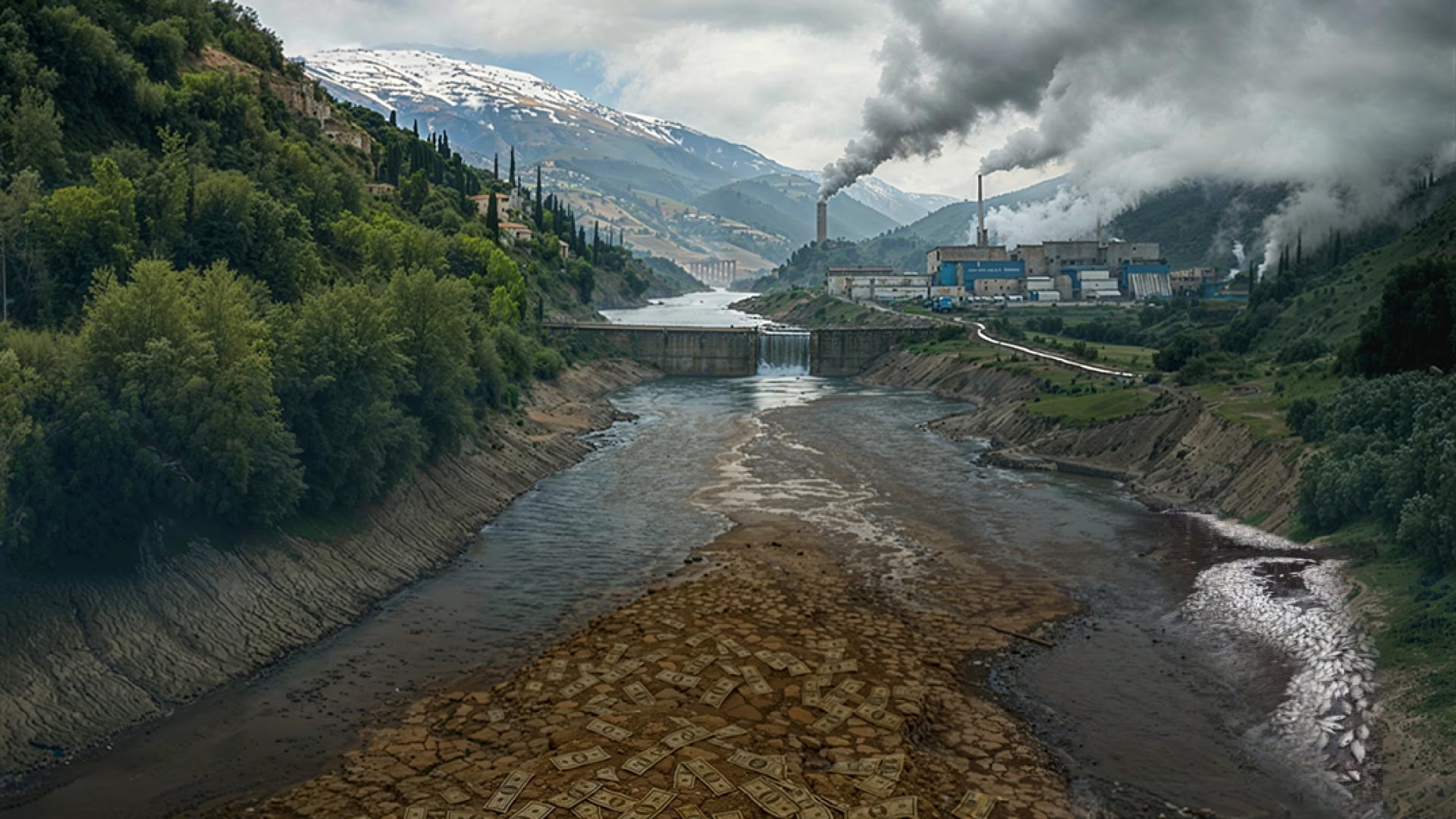

Amid Lebanon’s worst water crisis in decades and a future promising only further scarcity, our government’s strategy to keep the taps flowing is, unfortunately, as well-intentioned as it is unfeasible. With the liveability of our country at stake, Lebanon must get its water planning right. A better path is possible if only our leaders can abandon the outdated mindset that new infrastructure projects are a fix-all and instead commit to the hard work of governance reforms, demand management, and pollution control.
Lebanon has long prided itself on being water-rich compared to its arid neighbors, but as the past year has made painfully clear, that perception – and precipitation – no longer holds up. Energy and Water Minister Joe Saddi said last month that 2025 rainfall has been less than half the country’s annual average. Even if 2025 ends up being an anomaly, accelerating climate change paints a long-term outlook that is frighteningly dry: average yearly rainfall in Lebanon is expected to drop as much as 20% by 2040, and 45% by 2090.
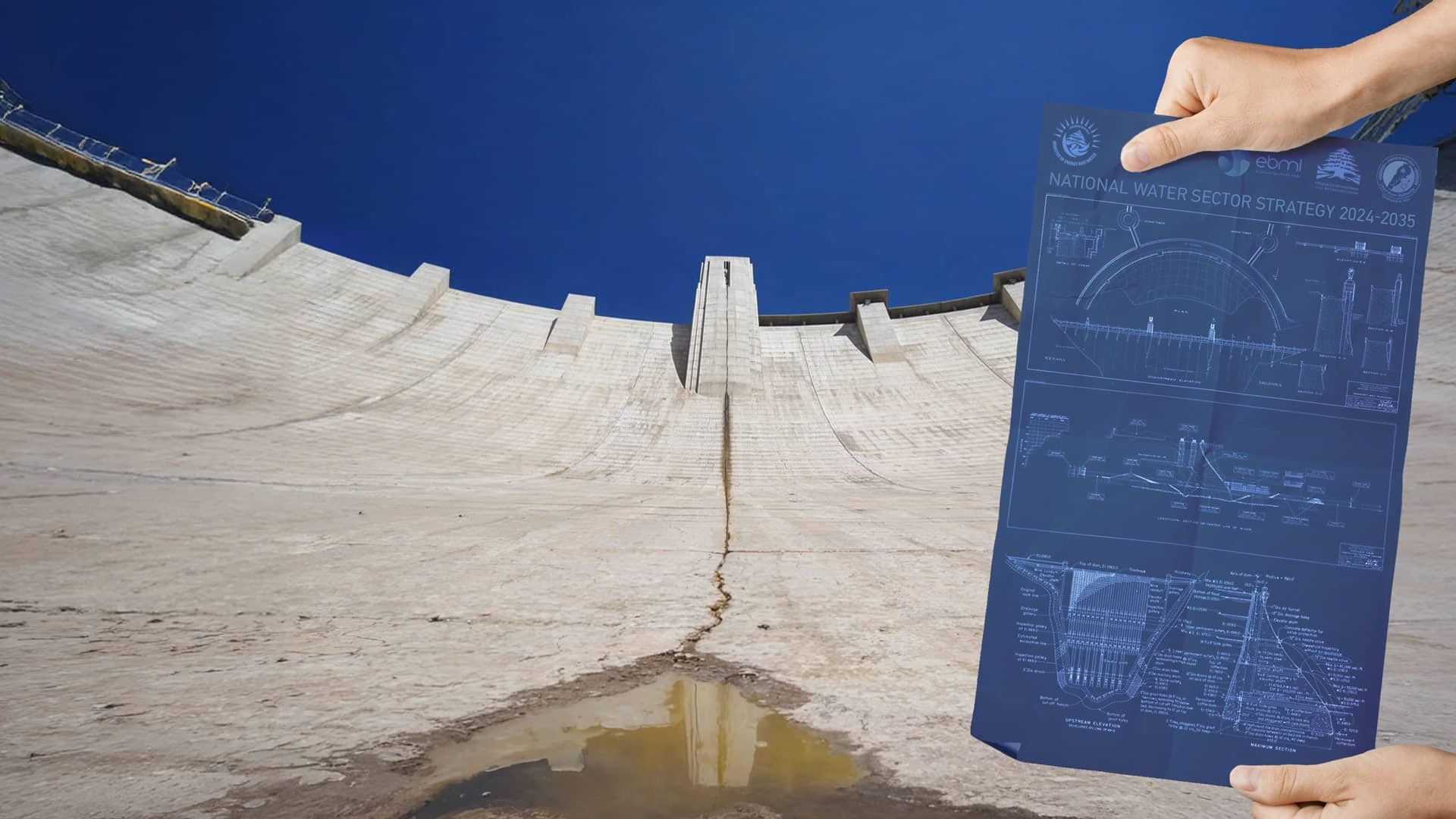
In a proactive initiative, the Lebanese government released its updated National Water Sector Strategy (NWSS) 2024–2035 last year, a comprehensive policy framework designed to address the country’s water challenges through a decade-long modernization of the sector. The updated NWSS represents a notable improvement over its predecessor. It clearly assesses the mounting pressure on water resources and predicts that climate change will intensify water stress by 2035. The strategy also speaks to the importance of non-conventional resources and integrated planning. Beyond this, however, the strategy offers little guidance on concrete steps to turn its vision into reality.
What’s more, the strategy essentially frames water shortages as a future problem. This is made evident by its failure to state the current national water deficit, which obfuscates the reality that Lebanon is already water insecure.
Lebanon’s water crisis results from both quantity and quality challenges: there is not enough water and a large amount of the existing supply is contaminated. Yet the strategy does little to meaningfully tackle pollution.
Decades of mismanagement and weak governance have turned our water troubles from an occasional challenge into a chronic condition, simultaneously creating spiraling negative feedback loops
There are numerous viable ways to address Lebanon’s water challenges. However, the NWSS’s approach overwhelmingly emphasizes flashy and expensive infrastructure projects as the solution, overlooking the reasons why similar grand ambitions in the past have failed.
Decades of mismanagement and weak governance have turned our water troubles from an occasional challenge into a chronic condition, simultaneously creating spiralling negative feedback loops: In response to inadequate government-supplied water, tens of thousands of unregulated private wells have been dug, leading to excessive groundwater extraction that has lowered water tables, drawn sea water into coastal aquifers, and eroded potable water supplies. Meanwhile, the lack of environmental enforcement has allowed untreated wastewater and solid waste pollution to contaminate many rivers, springs, and reservoirs, leaving much of the supply unfit for drinking or agriculture. The Litani River, once a symbol of national abundance, now embodies this decline – its water so degraded that it poses a threat to both livelihoods and public health.
Any national strategy that does not include structural governance reforms, stronger demand management, better pollution control, and greater reliance on non-conventional resources, risks leaving us chronically short of water and our country far less livable. Counterintuitively, there is a silver lining to the government’s repeated failures in addressing the country’s water woes: they offer valuable lessons from which to learn. To benefit from them, however, the government must be agile — acknowledging past mistakes, learning from them, and changing course rather than clinging to the same old tried-and-failed models.
The New Water Sector Strategy: Theory vs Reality
The NWSS acknowledges Lebanon’s mounting water challenges, noting the gap between limited renewable resources and growing demand, underdeveloped and deteriorating infrastructure, over-abstraction of groundwater, and widespread contamination from untreated wastewater and solid waste. It explicitly calls for integrated, cross-sectoral planning and recognizes the looming risks of climate change, with projections of longer droughts and heavier rainfall events that Lebanon’s fragile systems cannot manage.
To respond, the NWSS outlines a multi-pillar agenda: (i) expanding supply through surface and groundwater mobilization and new storage; (ii) rehabilitating and extending networks to reduce losses and improve service continuity; (iii) scaling up wastewater collection, treatment, and reuse; and (iv) reforming governance and financing frameworks. On paper, these pillars align with global best practices.
The Bisri Dam Project is just one of the many expensive lessons our policymakers should learn from.
In practice, however, the strategy has a myopic focus on large-scale infrastructure projects, envisioning dozens of new dams, canals, and water treatment plants, to name just a few of the new construction efforts planned over the next ten years. This approach reflects a traditional engineering mindset: build more infrastructure and water security will follow. This sidelines measures that could yield faster, more sustainable benefits, such as governance reform, pollution control, and demand management.
The failed Bisri Dam project is one that the NWSS aims to resurrect; in reality, it should serve as a cautionary tale for what to avoid. Touted as a solution to Beirut’s water shortages, the dam was suspended after donor withdrawal prompted by social opposition, environmental concerns, and financing barriers. Its collapse shows that infrastructure cannot substitute for effective institutions, regulatory enforcement, and community trust. Without these foundations, new projects risk repeating the same cycle of stalled implementation and unmet expectations. The Bisri Dam Project is just one of the many expensive lessons our policymakers should learn from.
Recognize and Address the Political Economy of Water
Water management in Lebanon is as political as electricity or solid waste management. Its political economy is shaped by patronage networks, fragmented mandates, and chronically underfunded public utilities. The Regional Water Establishments (RWEs), established by Law No. 221 of 2000, were intended to be autonomous bodies responsible for planning, operation, maintenance, tariff-setting, and cost recovery within their regions. In reality, their autonomy remains limited. RWEs are underfunded, understaffed, and lack the capacity to function as effective utilities. They depend on the Ministry of Energy and Water (MOEW) and agencies like the Council for Development and Reconstruction (CDR) for major investments and staffing approvals.
Unregulated wells keep multiplying, while ongoing service gaps have made private water truckers and vendors an essential part of the landscape.
This fragmented authority and institutional weakness have led to striking inefficiencies. As the NWSS itself notes, non-revenue water exceeds 50% – a figure that captures water revenue losses from leaks, unbilled usage, and widespread illegal connections that face little enforcement. Unregulated wells keep multiplying, while ongoing service gaps have made private water truckers and vendors an essential part of the landscape.
The NWSS tends to sidestep these hard realities, presenting a technical roadmap that gestures toward institutional reform – clarifying mandates, improving financial sustainability, and strengthening oversight – without setting measurable targets for utility performance, mandating transparent procurement, ensuring accountable finances, or prescribing credible steps to address the chronic failure to enforce regulations.
Commit to Water Pricing Reforms and Demand Management
Demand-side water management has historically been overlooked in Lebanon. Water was seen as plentiful, leading to a heavily subsidized flat-rate tariff disconnected from actual usage, and the adoption of metering was never pursued in earnest. The NWSS calls attention to this, recognizing the importance of structured pricing, reducing leaks, and raising public awareness as part of a well-rounded water management approach.
The current strategy recommends a gradual shift from flat rates to progressive volumetric tariffs backed by metering, aiming to encourage conservation and boost utility revenues. But while the NWSS commits to developing a new pricing framework in 2024, no real plan has emerged, showing once again how stated intentions often fail to produce results. Similarly, although the NWSS highlights the importance of reducing non-revenue water – through better leak detection and rehabilitation – it stops short of integrating these efforts into a comprehensive demand management approach. Cutting system losses remains one of the most cost-effective ways to increase water availability, yet it’s consistently overshadowed by costly infrastructure projects in both emphasis and financing.
For tariff changes to succeed, policies will need social safety nets for vulnerable households and a transparent, sequenced rollout that ties higher tariff rates to actual service improvements.
Although the need for pricing reform and demand management is recognized, the NWSS leaves operational details weak. There’s no phased plan for metering, no clear tariff scenarios linked to better service, nor any real discussion of the political complexities surrounding reform. For tariff changes to succeed, policies will need social safety nets for vulnerable households and a transparent, sequenced rollout that ties higher tariff rates to actual service improvements. Only then will pricing and demand management become trusted, effective pillars of Lebanon’s national water strategy.
Pursue Genuine Integrated Water Resource Management
The NWSS positions itself within the Integrated Water Resources Management (IWRM) framework, promising to balance sectoral demands, protect the environment, and improve water efficiency. But aside from a handful of references, the strategy provides little evidence of truly applying IWRM principles; it often treats IWRM as an end goal rather than as a practical approach for managing water resources.
This comes into sharp focus in the case of the Litani River basin. Once seen as the backbone for agricultural irrigation and hydropower, today it’s one of Lebanon’s most polluted rivers—untreated sewage, farm runoff, and industrial waste have left stretches unsafe even for irrigation. Despite this, the Litani is expected to sustain a cascade of large-scale projects for irrigation, hydropower, and urban water supply.
Agriculture dominates water use in the basin: the Canal 900 scheme diverts regulated flows from Qaraoun reservoir for irrigation in the central and southern Bekaa Valley, while Canal 800 extends water southward for irrigation and drinking water. The river also supports the country’s three major hydropower plants, which depend on Qaraoun releases for electricity production – even though hydropower is renewable, its operations compete for water with irrigation and environmental flows. On top of that, if parliament gives final approval to the Second Greater Beirut Water Supply Project (SGBWSP), water from Lake Qaraoun will also be piped to Beirut. This will require the Litani River to somehow support agriculture, energy, and the capital’s drinking water, all despite its degraded quality and a projected climate-induced water deficit in 2044.
Although the NWSS adopts the language of IWRM, this piling up of disconnected projects shows how integrated planning is lacking. Genuine IWRM would require a basin-level governance structure that can coordinate overlapping projects, enforce water quality standards, align with hydrological realities, involve stakeholders, and ensure fair allocation across sectors. The Litani River Authority (LRA), in charge of Qaraoun dam, irrigation schemes, and water quality, is mentioned only minimally in the strategy and currently lacks adequate authority, resources, and support to play a strong coordinating role.
Empowering the LRA, linking irrigation expansion to demand-side reforms, and enforcing pollution controls could transform the Litani into a genuine IWRM model.
Clearly Define Climate Preparedness Plans
The NWSS recognizes climate change as a core challenge for Lebanon’s water security. It recommends multipurpose reservoirs and managed aquifer recharge to cope with unpredictable flows, and highlights irrigation modernization and wastewater reuse as ways to ease pressure on freshwater supplies. The strategy also points to adapting agricultural practices—like drip irrigation and crop diversification—for a hotter and drier climate. Importantly, it calls for preparedness measures, emphasizing the importance of drought contingency planning and emergency action protocols to handle extreme events. In principle, this represents an important step toward integrating climate extremes into sectoral planning rather than treating them as one-off crises.
For the NWSS to truly demonstrate climate readiness, infrastructure adaptations should be paired with detailed, actionable contingency measures for droughts and floods.
But the NWSS’s climate preparedness remains underdeveloped. Although it notes the need for emergency plans for floods and droughts, it stops short of defining operational and management protocols. Instead, the strategy once again defaults to large infrastructure solutions, justifying supply expansion while lacking enforceable preparedness frameworks.
For the NWSS to truly demonstrate climate readiness, infrastructure adaptations should be paired with detailed, actionable contingency measures for droughts and floods – setting out clear institutional roles, triggers, and monitoring systems to support real-time decision-making.
Create Actionable Wastewater Reclamation Blueprint
Lebanon’s wastewater sector remains a major weak point in its water management system. The United Nations Food and Agriculture Organization estimates the country generates about 310 million m³ of municipal wastewater annually, yet the NWSS reports that less than 10% is properly treated before discharge. Remaining wastewater flows untreated into rivers, valleys, and the Mediterranean Sea. The Litani River and Qaraoun reservoir are the most stark examples: both are heavily polluted by raw sewage, farm runoff, and industrial waste, leading to eutrophication, fish kills, and the loss of recreational and irrigation use. Along the coastline, untreated sewage has degraded marine ecosystems, lowered bathing water quality, and raised public health risks in dense urban centers. Groundwater, Lebanon’s main source of drinking water, is now increasingly contaminated with nitrates and pathogens due to poor wastewater collection and treatment.
The NWSS acknowledges these challenges and puts wastewater treatment and reuse among its priorities, positioning it as a buffer against climate stress—both boosting supply and protecting ecosystems. If fully collected and treated, this non-conventional resource could cover a meaningful share of Lebanon’s water deficit, especially for irrigated agriculture in the Bekaa and along the coast. Properly managed, it could also restore environmental flows to polluted rivers, such as the Litani, helping to reverse ecological decline and relieve pressure on dwindling freshwater sources.
Treated wastewater reuse is promoted, but the NWSS sets no concrete targets for the volumes to be delivered to agriculture and doesn’t spell out how farmers will be encouraged to use it for irrigation.
Yet the NWSS’s wastewater commitments are short on actionable details. Over 50 treatment plants built in the past decade remain largely idle due to power shortages, staffing gaps, and missing collection networks. The strategy doesn’t address these underutilized facilities directly, nor does it outline a coherent financing plan for operations and maintenance. Treated wastewater reuse is promoted, but the NWSS sets no concrete targets for the volumes to be delivered to agriculture and doesn’t spell out how farmers will be encouraged to use it for irrigation. Unless wastewater management is reframed as both a public health and resource recovery priority—with enforceable standards, dedicated funding, and real integration with agricultural water planning—Lebanon risks losing the chance to turn hundreds of millions of cubic meters of wastewater into a lifeline for irrigation and ecological restoration.
The Better Path to Quenching Lebanon’s Long-Term Thirst
Lebanon’s updated NWSS marks a clear improvement over its predecessor, with its recognition of climate pressures, the role of non-conventional resources, and the importance of integrated planning. Yet its proposed solutions are unfit for the Lebanese context. The NWSS sets out ambitious project lists but offers limited clarity on how these will be delivered and how they’ll be sustainably financed. Without concrete operational and financing pathways, the strategy risks remaining more aspirational than actionable.
In broad terms, Lebanon’s water sector challenges are similar to those faced by the country’s other sectors: governance needs strengthened and empowered institutions, robust legal enforcement, clear accountability, and transparent reporting.
Water resources must be managed under a genuinely integrated approach, ending the siloed projects that undermine basin-wide sustainability.
Specifically, the country’s policymakers must revamp their water strategy to place demand management at center stage, ensuring our scarce resources are used efficiently. In doing so, however, tariff reforms must balance cost recovery with protections for vulnerable households.
Water resources must be managed under a genuinely integrated approach, ending the siloed projects that undermine basin-wide sustainability. Management should unify agriculture, urban supply, industry, hydropower, and environmental flow in a coherent framework.
Lebanon’s response to climate change must entail more than new infrastructure builds. Our country needs comprehensive preparedness protocols, including clear triggers, early warning systems, emergency plans, and financial mechanisms.
Wastewater treatment and reuse should also be treated as foundational in a reworked national strategy. Lebanon must operationalize existing facilities, secure dedicated financing, and enforce standards for safe reuse in agriculture and ecosystem restoration, making this sector a cornerstone for both pollution control and bridging water deficits.
Ultimately, Lebanon’s water security will not be achieved simply by building dams, canals, or treatment plants. Success will depend on political will, capable institutions, and the recognition that water management is less about engineering feats and more about leadership, responsibility, and a sustainable future for our country.
Lama Abdul Samad is a water and environmental specialist with over twenty years of experience in water governance, WASH programming, and climate resilience across the Middle East and North Africa.
The views expressed in this article are solely those of the author and do not necessarily reflect the views of BADIL | The Alternative Policy Institute or its editorial team.