

Lebanon’s reformist government claims to be on a quest for national sovereignty, led by the armed forces’ effort to dismantle Hezbollah’s military apparatus and establish a state monopoly over arms in the country. In reality, however, it appears to be the repetition of a historic pattern of trading patrons, one that risks leaving state authority compromised once again. This time, Hezbollah, and by extension Iran, are losing the sway they’ve held over Beirut for most of the past two decades, with Washington, and by extension Israel, seeking to establish the new dominion.
The United States’ aid to the Lebanese Armed Forces (LAF) has become crucial for the army’s continued operations, and Washington has openly wielded this leverage to force the agenda of disarming Hezbollah. While both US and Lebanese officials have cloaked this endeavor in the language of asserting Lebanese sovereignty, they omit that national sovereignty requires both state authority within its borders and the capacity to defend those borders from external threats.
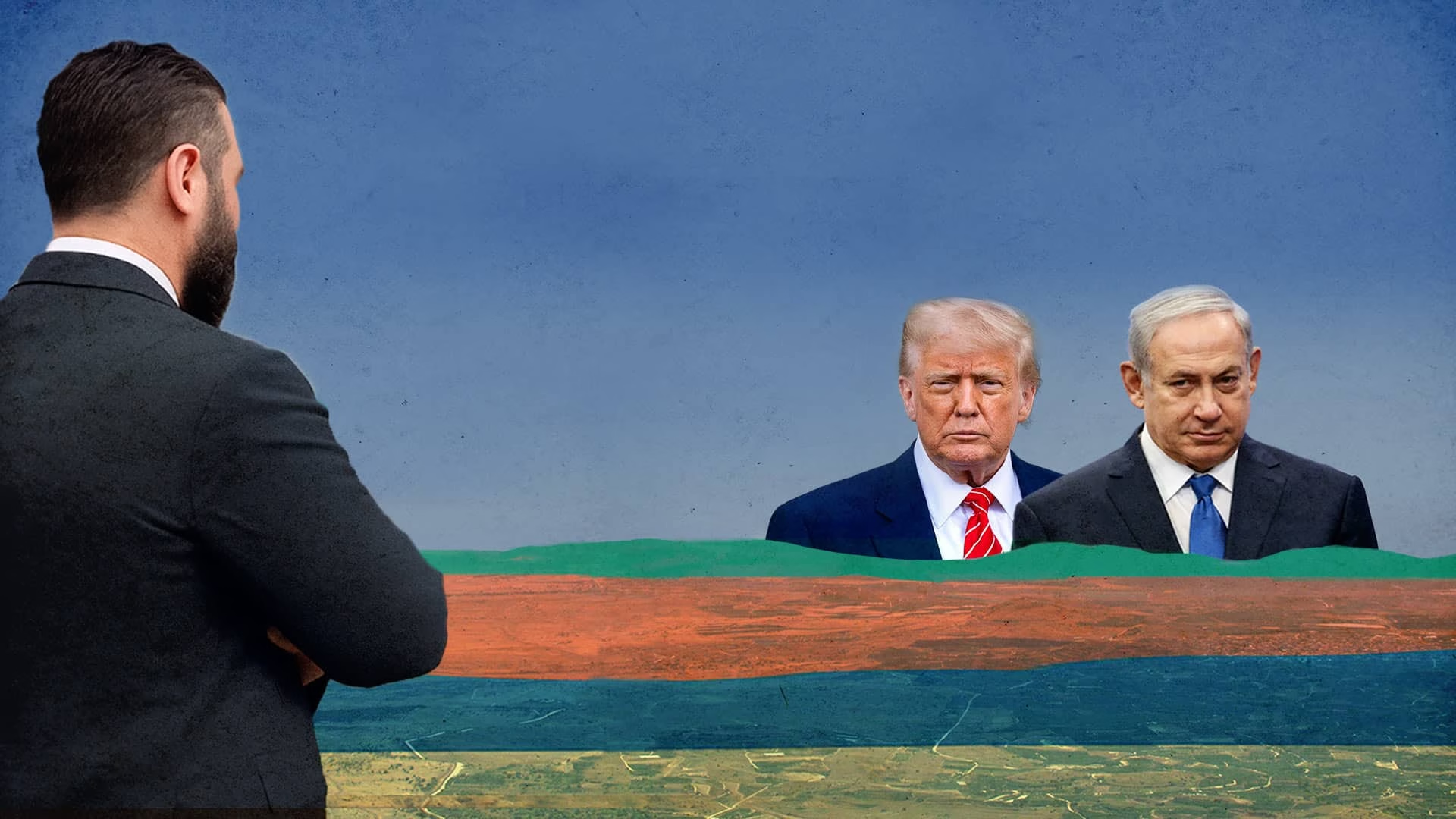
Similar to Washington’s arrangement with Egypt and Jordan, US policymakers seem happy to support the Lebanese government in policing its own citizens but have no intention of developing the LAF into a force that could credibly deter Israeli military aggression. Indeed, quite the opposite: the US’ legally sanctified commitment to ensuring Israel’s “qualitative military edge” in the region remains as ironclad today as it has been for generations.
In place of equipping Lebanon with military deterrence, Washington is instead essentially telling the Lebanese to trust in the goodwill of Israeli leaders. Once the LAF has disassembled the only force in Lebanon with the potential to challenge the Israeli military, Israeli leaders will willingly withdraw their forces from South Lebanon, desist in their near-daily airstrikes since the November “ceasefire”, and we will all live in peace – or so the story goes.
There is good reason for the Lebanese to be wary of this fairytale ending. First, there is the enduring tragedy of Palestine, where the proliferation of Israeli settlements across the West Bank and more recent Israeli moves towards outright annexation demonstrate that Israel is fundamentally an expansionist project. The genocide in Gaza, which has persisted for more than two years despite being livestreamed and condemned across the world, also demonstrates that Israel faces few restraints on its militarism, particularly from the US, no matter how violently and unjustly it manifests.
True sovereignty in Lebanon, with stabilizing implications for the region, requires a Lebanese army capable of ensuring domestic security and dissuading Israel’s military adventurism.
Zionist extremists are on the ascent in Israeli politics, explicitly espousing the vision of a “Greater Israel” extending beyond historical Palestine to the rest of the Eastern Mediterranean. Last year, for instance, Israel’s Minister of Diaspora Affairs, Amichai Chikli, claimed that Lebanon “does not meet the definition of a country” and that Israel should “recalculate” its northern border. Israel Finance Minister Bezalel Smotrich has said this will be an incremental, long-term project, whereby Israel will “little by little” expand its borders to encompass all Palestinian territories, Lebanon, Jordan, Syria, Iraq, Egypt, and Saudi Arabia. Zionist settler pilgrimages to Israeli-occupied areas of South Lebanon over the past year and ongoing Israeli efforts to splinter off Druze areas of southern Syria add further evidence of extra-territorial ambitions.
Whether the Greater Israelists will continue to grow their influence and ability to dictate Israeli policy is yet to be determined, but the threat that they could is undeniable. It is thus an existential concern for Lebanon to have a credible military able to deter Israel’s expansionist proclivities. The consequences go well beyond Lebanon’s national sovereignty. Zionism’s century-long colonial project in historic Palestine has been catastrophic for regional stability, sowing recurring conflicts and intensifying upheaval. A world in which Zionist extremists feel undeterred from expanding this project to the surrounding region will mean exponentially greater destabilization with likely global consequences.
Hezbollah had filled that deterrent role in Lebanon, but with an accompanying ideology and allegiance to Iran that ultimately undermined Lebanese sovereignty and unnecessarily dragged the country into multiple, devastating conflicts. True sovereignty in Lebanon, with stabilizing implications for the region, requires a Lebanese army capable of ensuring domestic security and dissuading Israel’s military adventurism.
Suspended Sovereignty: Lebanon’s Enduring Curse
For more than a century, Lebanon has endured a condition of suspended sovereignty, with the state’s authority continually delimited by other actors, whether foreign, domestic, or both. Under the French Mandate (1920–1943), Paris controlled Lebanon’s key political and economic affairs and institutionalized the confessional system that would define its politics. Independence and the 1943 National Pact only reinforced this system, tying sovereignty to the fragile balance of sectarian compromise and external neutrality. The 1948 Nakba led to the influx of tens of thousands of Palestinian refugees, catalysing internal tension and later a civil conflict and the 1958 American military intervention. President Fouad Chehab’s subsequent administration ushered in a brief assertion of state authority; however, regional conflict led to a further influx of Palestinian refugees and armed factions, with the 1969 Cairo Accord officially granting the latter armed autonomy in Lebanon. The 1975–1990 Civil War shattered national integrity altogether, as militias, foreign armies, and sectarian factions divided the country. The war ended with Israeli forces occupying South Lebanon and Syrian-enforced tutelage over the rest.
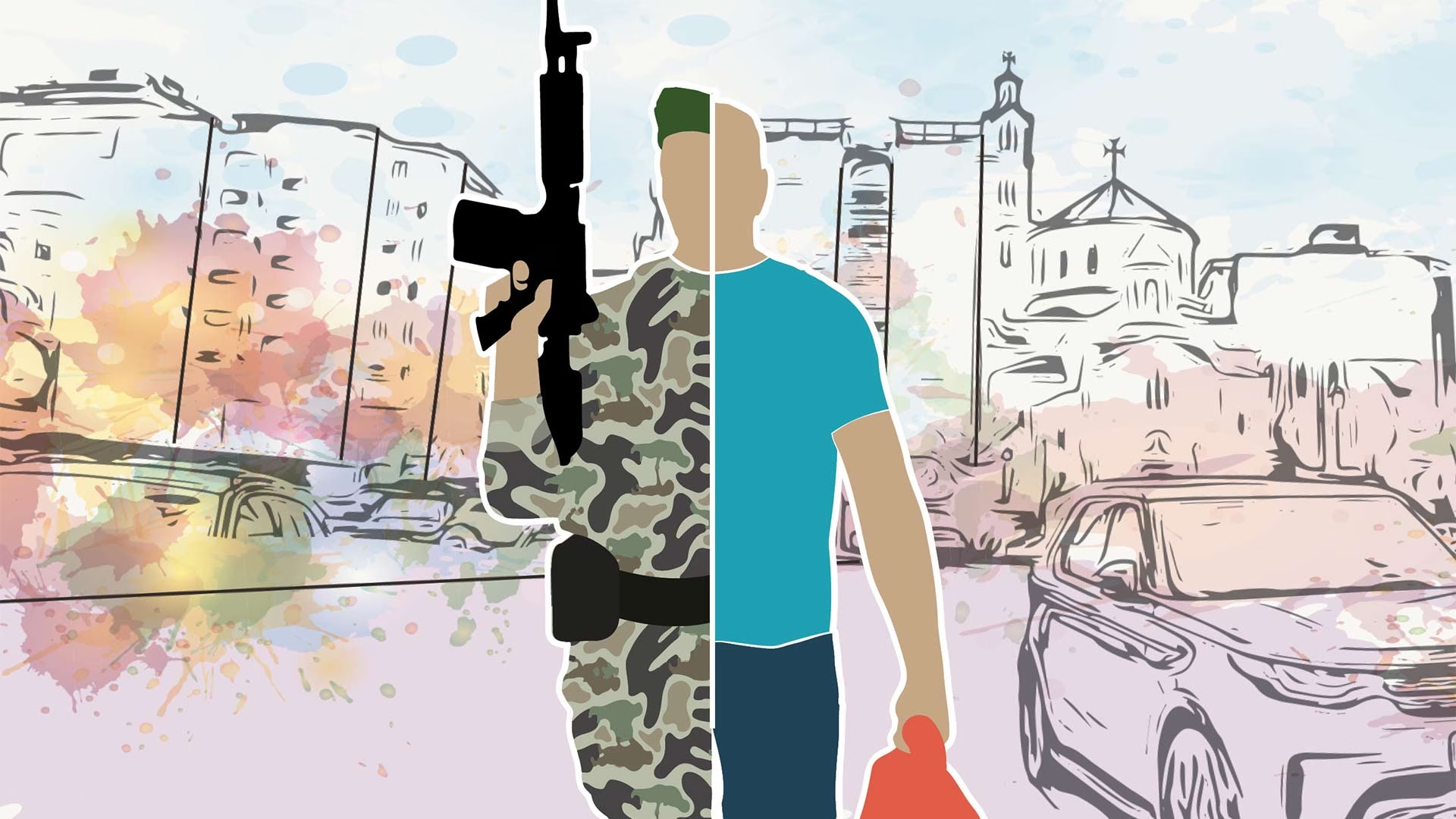
Hezbollah emerged in the early 1980s from the Lebanese state’s inability to defend its territory and provide for its citizens amid civil war and Israeli occupation. Backed by Iran, it presented itself as the defender of Lebanon’s sovereignty and the provider of services to neglected communities. Yet as Hezbollah’s power and military capabilities expanded, it replaced state authority in parts of the country, creating a parallel governance system and a military force more capable than the national army. What began as a resistance to foreign occupation became, over time, a force delimiting the very state sovereignty it claimed to protect, drawing Lebanon into the orbit of Iran’s regional confrontation with Israel and the United States.
Within this military dualism, the LAF and Hezbollah maintained a functional rapport through the tacit understanding that the former’s focus was internal stability and the latter’s defence against foreign aggression – namely, Israel.
Israel withdrew from the south in 2000, and Syria from the rest in 2005, and in 2006, another war with Israel saw Hezbollah declare a “divine victory” against its arch nemesis, though much of Lebanon was left in ruins. Following this, two tracks proceeded in parallel: first, Hezbollah’s strength and influence in Lebanon rapidly increased, leading the group to effectively hold veto power over government decisions. Second, US policy turned toward strengthening the Lebanese Armed Forces (LAF) as a counterbalance to Hezbollah. Even as both these tracks progressed, Lebanese officials articulated the state’s official security posture as being “the army, the people, and the resistance.” Within this military dualism, the LAF and Hezbollah maintained a functional rapport through the tacit understanding that the former’s focus was internal stability and the latter’s defence against foreign aggression – namely, Israel. In instances where their two mandates appeared to conflict, the LAF would inevitably defer to Hezbollah, thereby avoiding situations in which the latter would feel compelled to flex its superior military strength.
Influence Born through Military Aid
The LAF’s dependence on US aid has grown largely as an inverse relation to the Lebanese government’s capacity to finance its own armed services. From 2006 to 2010, Washington provided an average of almost $210 million annually in funding, training, and equipment to the LAF (all figures adjusted for inflation to today’s dollars). Over the same period, Lebanon’s annual military expenditure averaged $1.27 billion, meaning US aid was equivalent to about 16.5% of overall military spending – a meaningful portion but not necessarily critical the LAF’s sustainability.
The LAF’s dependence on US aid rose massively after Lebanon’s 2019 financial crisis shriveled the country’s budget and military spending. From 2020 to 2024, Lebanon’s annual military expenditure averaged roughly $350 million, while US military aid averaged $165 million, equivalent to almost half of defense spending.
In October 2023, Hezbollah joined the war against Israel in support of Hamas in Gaza, leading to most of its political and military leadership being killed and swathes of Lebanon being destroyed. Following the November 2024 Israel-Hezbollah ceasefire, a reformist government took office in Beirut, and Washington announced approximately $100 million in LAF support. In October, the US announced another $190 million for the army and $40 million for Lebanon’s Internal Security Forces. That makes US aid to the LAF in the first 10 months of the year equal to half of the $586 million the Lebanese government allocated to defense spending in this year’s budget.
In tandem, the Lebanese government articulated a far more forceful security posture, demanding that the state exercise a monopoly over arms within national borders – an explicit call for Hezbollah to disarm. Leaders in Beirut and Washington have framed this as a project of Lebanon asserting national sovereignty – even if on American terms, given that Washington conditioned its assistance on progress in disarming Hezbollah.
American officials have repeatedly applauded the LAF’s efforts in this regard, such as when the Lebanese army announced in April that it had dismantled over 90 percent of Hezbollah’s infrastructure south of the Litani River. In early August, the Lebanese government then adopted a US-authored roadmap under which Beirut committed to disarming Hezbollah and all other non-state actors by the end of 2025, deploying the LAF to key areas along the border and elsewhere, among other items. If Lebanon fully complies, the country is slated to receive US and international aid for reconstruction and economic stabilization, with the plan also calling on Israel to withdraw from South Lebanon and desist in military operations in the country.
Given a Knife for a Gun Fight
At present, the Lebanese government is unlikely to fulfil the demands of the US roadmap, and certainly not by year’s end. Israel resumed airstrikes and ground operations in Lebanon almost immediately after the ceasefire was announced, albeit on a reduced scale, insisting that it maintains “freedom of action” against Hezbollah. However, LAF personnel and positions have also been periodically targeted. Doing this, while the Israeli army also continues to occupy five key locations in South Lebanon and undertake ground operations, physically prevents the LAF from deploying to all areas of the country. In preventing the LAF from being seen as protecting the country and its border, the Israeli military, in turn, denies it the institutional legitimacy of being the nation’s preeminent military force.
Israel’s continued military belligerence has buttressed Hezbollah’s argument that the Lebanese state remains impotent, and the group must retain its arms as the country’s only capable deterrent force.
Israeli actions are also a public relations win for Hezbollah, with its Secretary-General Naim Qassem stating that the group refuses to accept a state monopoly on arms before full implementation of the truce and an Israeli withdrawal, warning of civil unrest if the state moves against the group while ceasefire violations persist. He called on the government to ensure Israeli compliance with the ceasefire before opening dialogue on national security strategy, knowing full well that the Lebanese state lacks the leverage to compel Israeli concessions.
Thus, while the war eroded Hezbollah’s image as the defender of the nation, Israel’s continued military belligerence has buttressed the group’s argument that the Lebanese state remains impotent, and Hezbollah must retain its arms as the country’s only capable deterrent force.
Despite US officials asserting that they are supporting Lebanon’s aspirations for sovereignty, the military aid they are providing to the LAF is insufficient for such a task. As with previous assistance to the Lebanese army, the new US packages are explicitly aimed at internal stabilization and militia demilitarization, not for building an army that could legitimately replace Hezbollah’s claimed role of defending the country from Israel. As former LAF General Dr. Hassan Jouni told BADIL, “American aid can help achieve state sovereignty, but it also remains loyal to Israeli interests, which are opposed to Lebanese sovereignty.”
Washington’s economic leverage also has important limits: there is likely no amount of US or Israeli coercion that would see the LAF attempt to use force against Hezbollah.
The US has also tied economic aid and reconstruction to progress on Hezbollah disarmament, creating its own leash on the Lebanese state. Where Hezbollah’s veto over Lebanese government decisions had been its implicit recourse to force, Washington’s leverage is financial, which it is using to create a compliant domestic security force. The approach materially equips the LAF to act against non-state armed groups, structurally entrenches Lebanese dependence on this foreign support, and advances the US’ agenda of supporting a regional power imbalance in Israel’s favor. In preventing the LAF from attaining any deterrent capacity to Israeli aggression, however, the US makes it far more difficult for it to gain the domestic legitimacy to replace Hezbollah in the role of national protector.
Washington’s economic leverage also has important limits: there is likely no amount of US or Israeli coercion that would see the LAF attempt to use force against Hezbollah. As a multi-confessional institution that has cemented a position of neutrality amid Lebanon’s fractious sectarianism, any LAF attempt to move against Hezbollah – an explicitly Shia Muslim party – would almost certainly lead to rupture within the army. In 2008, the LAF refused a cabinet order to move against Hezbollah and its armed allies as they took over areas of Beirut; orders to move against Hezbollah today would likely be met with the same result. Hezbollah, meanwhile, also has reason to avoid a clash that would deepen public resentment and risk further political isolation.
A Century of Suspended Sovereignty
Lebanon has been here before: as one patron weakens another moves to fill the vacuum, claiming, just as the last one did, to champion the country’s sovereignty – but on their terms. Washington’s offer appears particularly odious, however: Lebanon is being asked to pacify its own population while remaining exposed to foreign (Israeli) aggression. In exchange, the US will provide the state and army with enough financing to continue functioning. Such an arrangement has many names, but sovereignty is not one of them.
A genuine path to national agency requires more than dismantling militia arsenals or courting aid packages. True sovereignty requires internal cohesion and external deterrence. It demands that the Lebanese Armed Forces be capable of enforcing order on the streets and protecting the border. Until Lebanon can do both, its sovereignty will remain compromised.
The challenge is existential, but not hopeless. A comprehensive national defense strategy that ties public welfare to the state’s survival, combined with genuine security guarantees rather than mere rhetoric, may begin to close the gap between Lebanon’s form and its long-elusive function. Whether Lebanon can achieve this remains uncertain. But until it does, its sovereignty will continue to hang in suspension: caught between disarmament and deterrence, between the promise of self-rule and the reality of perpetual tutelage.