
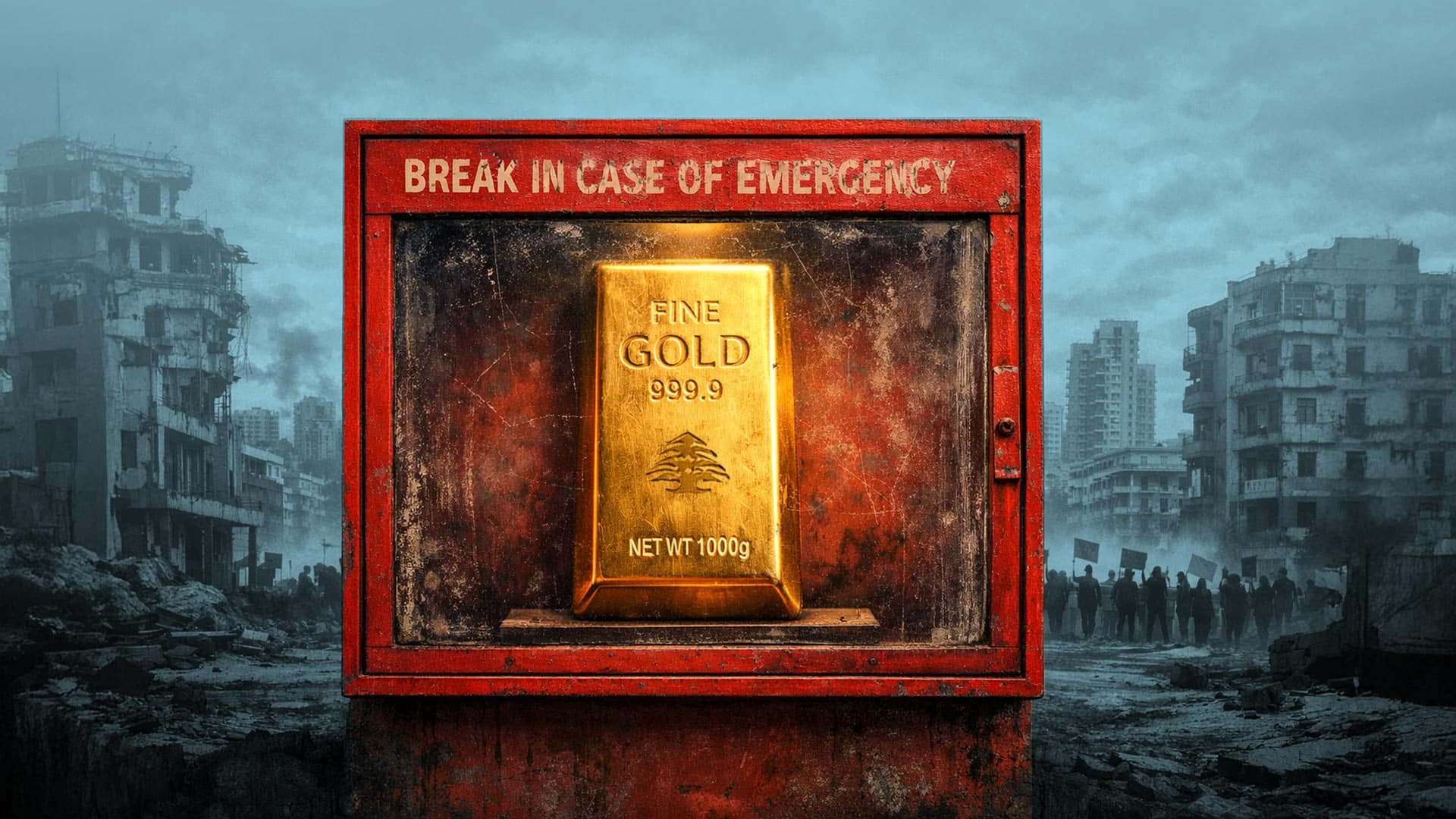
Lebanon’s political class is inching toward a decision that could redefine who pays for the country’s financial collapse. At the time of this writing, the so-called Financial Gap Law – a law that defines Lebanon’s financial losses and how they should be allocated between banks, the central bank, the state, and depositors – was moving from cabinet to Parliament. Included in the law are provisions which open the possibility for the state to draw on the Banque du Liban’s (BDL) assets – most importantly its gold reserves – in order to back long-term bonds for large depositors of more than $100,000. On paper, the proceeds from “investing,” “leasing,” or even liquidating these assets might be used to service bonds maturing over 10 to 20 years. In practice, should the law pass in its current form it would keep the option of turning the Central Bank’s balance sheet, and the public assets on it, into a buffer for those at the top of the depositor pyramid, although a new legislation will still be needed to tap into the gold reserves.
The draft law’s ambiguity appears deliberate. It leaves open how far “revenues” from gold can stretch, and how directly bondholders might benefit from any future appreciation in the metal’s price. At the same time, powerful actors are lobbying to make the link more explicit. The Association of Banks in Lebanon has already seized on the surge in gold’s value to argue that BDL’s assets should be mobilized to repay depositors, a position that conveniently shrinks the losses commercial banks would bear in any restructuring. The International Monetary Fund (IMF), focused on debt sustainability, has also pushed for clearer language on how gold could be used to support the recovery of deposits – without resolving who, exactly, absorbs the cost.
This debate risks treating gold as just another pot of money to plug a hole. Yet Lebanon’s gold is not a windfall generated by the pre-2019 financial bubble. It is a massive sovereign reserve accumulated from foreign currency surpluses decades before the current crisis, and it now anchors a balance sheet otherwise hollowed out by unrecognized losses. Liquidating or pledging this asset to protect large claims today would dissipate a strategic buffer, erase the upside of future price gains, and raise profound questions about who gets shielded and who gets sacrificed.
How Lebanon Got Its Gold
Lebanon began building gold reserves at its central bank in 1948, shortly after joining the IMF and securing recognition of the Lebanese Pound as an independent currency. Back then, decoupling the pound from the French Franc meant pegging its value to gold and acquiring enough bullion to back the cash in circulation.
The 1949 monetary law tightened this framework by requiring that 50 percent of Lebanese Pound banknotes in circulation be covered by gold and hard currencies. The state soon went further, lifting coverage to around 90 percent of cash in circulation by the end of 1954.
Until 1971, Lebanese authorities routinely used foreign currency surpluses at the BDL to expand gold holdings. That year, Lebanon halted gold purchases after the United States abandoned the Gold Standard, the previous global monetary system where the US Dollar was fixed to a specific amount of gold, allowing paper money to be exchanged for gold. Since then, the BDL no longer links the Pound to gold, with reserves stabilizing at roughly 286.8 tons.
By 1986, amid the civil war, the Lebanese Pound was in freefall, and the state had lost authority over many of its significant economic assets, deepening financial and monetary turmoil. As Central Bank Governor Edmond Naim and Finance Minister Camille Chamoun clashed over responses to the crisis, and some officials pushed to tap the gold, Parliament intervened with Law 42/1986, which prohibits “disposing of the gold assets of the Central Bank of Lebanon, or on its behalf, regardless of the nature or form of such disposal, whether direct or indirect, except through legislation issued by Parliament.”
Shinier than Ever
Today, Lebanon’s gold reserves at the Central Bank are the second largest in the Arab world and rank nineteenth globally. With gold prices up by nearly 70 percent this year, the market value of these holdings now exceeds $40 billion, or more than 140 percent of Lebanon’s GDP, one of the highest ratios worldwide. About two-thirds of this gold is stored in BDL’s vaults in Beirut, while the remaining third is held in the United States at undisclosed locations.

As of mid-December, gold makes up around 41 percent of BDL’s balance sheet and roughly 75 percent of its liquid or potentially liquid assets, once items representing unrecognized losses and claims on the Lebanese state are stripped out. Alongside gold, BDL reports other foreign currency reserves of about $11.99 billion. Taken together, this puts the total value of gold, foreign currency reserves, and other liquid assets at over $52 billion, compared to BDL’s reported $83.62 billion in liabilities to commercial banks.
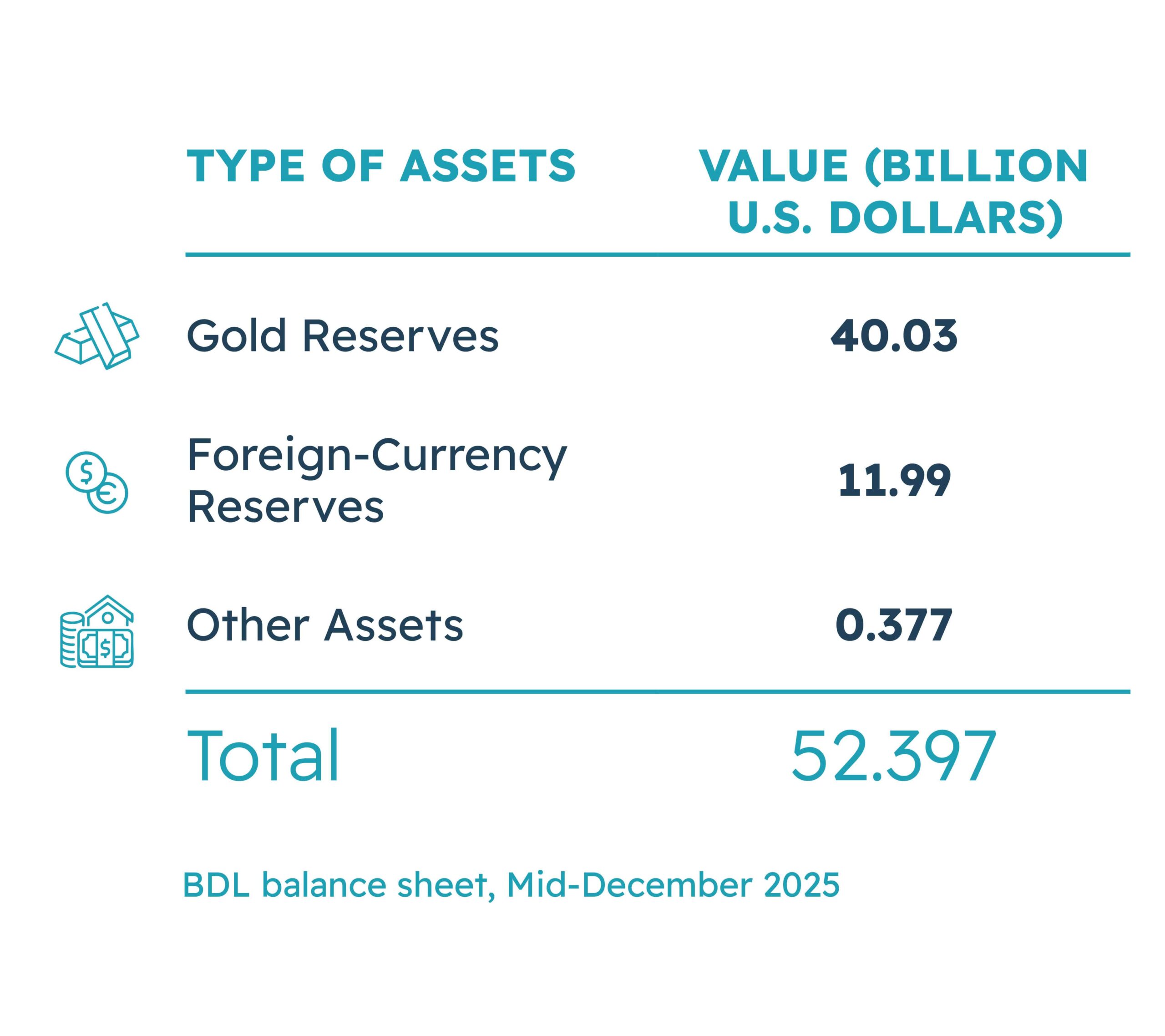
This mismatch defines the financial gap that the banking restructuring process is supposed to address, including through the long-awaited Financial Gap Law. Since 2019, successive government plans have counted gold as part of BDL’s assets when estimating this gap, even though Law 42/1986 prevents the authorities from treating gold as an asset that can be readily used.
For that reason, when drafting the Financial Gap Law, policymakers relied only on foreign currency reserves to determine how much can be immediately guaranteed per bank account in the short term, setting the ceiling at $100,000. Gold, by contrast, has been treated as a pillar of BDL’s long-term solvency, backing the liabilities it is expected to honor toward larger depositors after the balance-sheet hole is addressed.
Selling the Golden Goose
In early 2025, the Institute of International Finance, a global association of financial institutions, proposed a sevenpillar roadmap for dealing with Lebanon’s collapse, centered in part on monetizing BDL’s gold. The plan argues that, thanks to soaring prices, gold has become Lebanon’s largest deployable sovereign asset, especially as foreign currency reserves have eroded sharply in recent years.
The IIF calls for selling about 100 tons of gold in 2026 – worth around $15 billion – and channeling the proceeds to commercial banks so they can repay small deposits in monthly installments over a year. It also recommends placing another $16 billion worth of gold abroad to earn a 5–6 percent annual return, which would help service future obligations.
Liquidating BDL’s reserves for short-term dollar liquidity would therefore mean giving up a strategic asset whose value and importance are both rising.
However, this logic runs against the current behavior of central banks worldwide, which have been increasing, not liquidating, their gold holdings. Between July and September alone, central banks bought an additional 220 tons of gold, a 28 percent jump compared to the previous quarter, reflecting deepening doubts over the dollar’s long-term dominance as a reserve currency. The dollar’s share of global reserves has fallen to about 56.3 percent, its lowest level in more than three decades, with geopolitical tensions, the US’ increased use of financial sanctions as a foreign policy tool, and a bias in Washington toward a weaker dollar have all strengthened gold’s role as a hedge.
Liquidating BDL’s reserves for short-term dollar liquidity would therefore mean giving up a strategic asset whose value and importance are both rising. Lebanon would also forfeit potential upside if prices continue to climb, a scenario many large investors consider likely: in a recent Goldman Sachs survey of over 900 institutional clients, nearly 70 percent expected gold to rise further by the end of 2026, with more than a third predicting prices above $5,000 per ounce next year.
Leasing, Investing, and Praying it Pays Off
Other proposals focus on leasing the gold, depositing it with foreign investment firms, or tying it to derivatives that could generate returns for the state. Before the appointment of current BDL governor Karim Souaid, then-acting governor and current first deputy Wassim Mansouri said a gold-leasing scheme was ready for implementation and only awaited new leadership to move forward. The idea has since been shelved pending the Financial Gap Law, but continues to surface in policy and media debates. Indeed, before becoming BDL governor in March 2025, Karim Souaid’s former company Growthgate commissioned and provided the financial support for a 2023 Harvard study which recommends leveraging Lebanon’s gold reserves as a strategic national asset to facilitate financial recovery without outright liquidation.
Yet this route carries significant legal and political economic risks. Any leasing or investment abroad would subject the reserves to the laws and courts of host countries – just as the third of Lebanon’s gold held overseas is already exposed – opening the door to seizures or legal actions if the state or BDL were to default again after restructuring. The likely returns from such operations would be modest compared to the scale of these risks.
Domestically, weak governance and opaque central bank practices make complex gold-linked contracts especially dangerous to elite capture. Even basic operations, such as interventions in the parallel exchange market, still lack transparent reporting, let alone parliamentary oversight. Under these conditions, layering on derivative structures or long-term leasing arrangements would invite non-transparent, potentially abusive deals and expose the reserves to counterparty risk if foreign financial institutions themselves face stress or crisis.
A third idea, discussed alongside the draft Financial Gap Law, is to issue long-term gold-backed bonds to compensate large depositors instead of returning their funds in cash. In theory, tying these instruments to BDL’s gold could push up their market value over time, allowing wealthy depositors to recover more of their losses, and giving them a claim on the pledged reserves if the Bank fails to honor the bonds at maturity.
Keeping Lebanon’s gold with the central bank for the foreseeable future would turn it into a shared guarantee for all remaining obligations on BDL’s balance sheet, rather than a private safety net for a narrow class of creditors.
The core problem is fairness. Such a scheme would carve out a privileged class of depositors with access to first-rate collateral, while the vast majority are forced to accept long-term installments in depreciating local currency. As inflation erodes the real value of ordinary repayments, holders of gold-linked bonds could preserve or even grow their wealth by trading these instruments at high prices, entrenching the very hierarchy that produced the crisis in the first place.
The Fairer Way Forward
Keeping Lebanon’s gold with the central bank for the foreseeable future would turn it into a shared guarantee for all remaining obligations on BDL’s balance sheet, rather than a private safety net for a narrow class of creditors. Instead of using gold, the BDL has a wealth of assets – among them real estate, and stakes in Middle East Airlines, Intra Bank, and Casino du Liban – which could be used as a common pool to rebuild the Bank’s solvency over time. Any future rise in gold prices instead would be used to strengthen its ability to honor obligations to the wider public, not just the best connected.
By contrast, the main “monetization” schemes now on the table – large gold sales, leasing to foreign institutions, or gold-backed instruments reserved for big depositors – effectively shift the cost of the financial gap onto the state and, by extension, ordinary Lebanese. Using strategic sovereign assets to refill bank balance sheets allows the same political-banking elite that engineered and profited from the 2019 collapse to preserve their offshore wealth, while externalizing their losses onto public resources that belong to current and future generations. In practice, this would bring the so-called Shadow Plan into the open: crystallizing private gains, socializing losses, and hardcoding impunity into the country’s recovery architecture.
The political context only sharpens this risk. As Parliament prepares to debate and amend the Financial Gap Law, pressure is mounting from domestic financial elites and international officials, including US presidential envoy Morgan Ortagus, who have publicly expressed skepticism about the IMF deal and the reforms it mandates. This alignment of forces is pushing Lebanon to lean on gold and other state assets rather than confront the banking sector’s insolvency through genuine loss recognition and accountability. Sidelining structural reforms in favor of asset liquidation would not “solve” the crisis so much as repackage it: shielding culpable actors, deepening moral hazard, and inviting a new cycle of reckless lending and speculative schemes once the immediate storm has passed.
Objectively, the distributional outcomes of these choices are stark. Routes that liquidate or pledge gold to compensate large depositors or recapitalize banks concentrate protection at the top, while leaving the broader public to absorb inflation, degraded services, and the erosion of what little remains of their state protections. A path that preserves gold as a long-term guarantee of BDL’s solvency, by contrast, keeps open the possibility that future gains from this asset are used to honor obligations more fairly across depositors and citizens, especially if paired with a progressive recovery framework that prioritizes smaller and more vulnerable claimants against the actual value of what banks own or sent abroad during the early days of the financial crisis.
If Lebanon’s gold is consumed now to rescue those who already escaped with their fortunes, the crisis will not be remembered as an accident of history but as a decision: to let a kleptocratic class walk away intact, and to mortgage the country’s last strategic buffer for their benefit. Preserving the gold as a common guarantee does not erase the damage already done, but it draws a line against turning the collapse into a permanent settlement – one in which the public pays twice, and those who sank the system are handed the lifeboats.
The views expressed in this article are solely those of the author and do not necessarily reflect the views of BADIL | The Alternative Policy Institute or its editorial team.