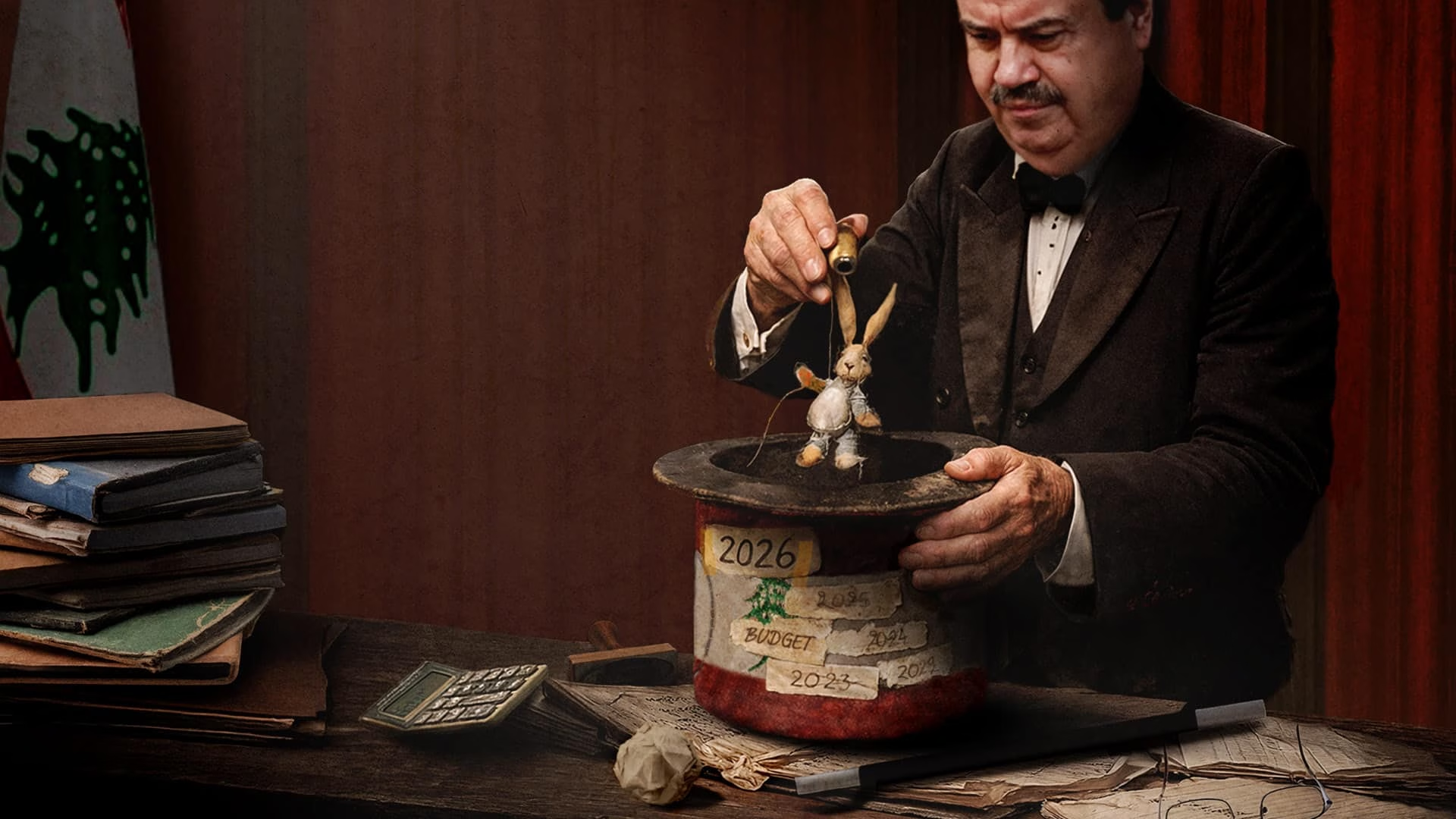

Lebanon’s 2026 budget was rushed through Parliament at the tail end of the constitutional deadline — touted as proof of “discipline” and even a “balanced budget.” Yet the numbers conceal a familiar reality: a regressive revenue model, selective enforcement against rent‑seeking sectors, and major fiscal blind spots. As protesters gathered outside Parliament, the vote passed. But the budget’s significance lies less in what it claims to achieve than in what it excludes.
Spending also remains roughly one third of pre‑2019 crisis levels, underscoring how far Lebanon remains from any recovery framework.
On the surface the budget presents a 20% increase in revenues compared to 2025, rising from around $ 4.97 billion to $ 5.97 billion. Policymakers quickly highlighted this topline improvement and the idea of a balanced budget. But such readings obscure the political choices inside the numbers: who pays, who is protected, and what spending is kept off the books. Spending also remains roughly one third of pre‑2019 crisis levels, underscoring how far Lebanon remains from any recovery framework.
Absent public sector overhaul, taxation reform, debt restructuring, and a reorientation of spending priorities, the budget remains palliative — closer to an accounting exercise than a recovery tool.
Regressive Revenues
Taxes account for the overwhelming share of revenues (83%). Yet the taxation mix virtually treats a millionaire and an average worker the same way. VAT remains the single largest source of tax revenue, while fees and indirect charges do much of the heavy lifting. Taken together, VAT and excise fees generate more than double the revenues from income, profits, capital gains, and property taxes combined (47% of total revenues compared to 18%). As long as the overwhelming majority of taxes remain regressive, Lebanon will remain bound to breeding inequality.
An equally revealing is an examination of who is taxed. The budget includes no revenues from the quarries and crushers sector — a notorious rent‑seeking industry known for monopolization, environmental harm, and political protection, and estimated to owe the state over $3 billion. It also excludes revenues fees on illegally constructed maritime properties, another long‑standing symbol of impunity and selective enforcement that could have been addressed in the budget.
The public sector remains riddled with patronage and low productivity, while wage scale distortions remain unaddressed.
Finance Minister Yassine Jaber acknowledged the scale of both omissions in Parliament, referencing coordination between the ministries of Public Works, Finance, and the Environment to begin collection processes and map violations. Whether these professed commitments by the minister translate into real revenue and accountability remains uncertain, particularly given entrenched political and financial interests that seek to shield these sectors — and the fact that these items remain absent from a process as fundamental as the state budget itself.
One positive development is improved tax enforcement. Jaber highlighted that 200 major cases were referred to the Financial Public Prosecutor’s Offices on charges of tax evasion amounting to money laundering. If these efforts are sustained, they could strengthen collection capacity — but only if they are not applied preferentially.
Chronic Habits Die Hard
On the expenditure side, the budget continues to reflect Lebanon’s distorted spending structure. Over half of ongoing expenses go to public sector salaries and benefits, around $3.1 billion, but with no hints of the promised reforms for equitable wage adjustments. Instead, the public sector remains riddled with patronage and low productivity, while wage scale distortions remain unaddressed.
Such commitments, however, made publicly and under pressure, remain absent from the budget’s formal architecture.
Social spending remains limited. The budget allocates $55 million to the AMAN cash transfer program for lower-income households and $14 million to the national disability program. Yet in a country where 80% of the population have no, or only partial, health insurance, the $478 million allocated to healthcare remains far below what is required. Investment, in all its forms, is only 11% of total expenditure — reinforcing unproductive patterns rather than building a recovery. This level of austerity is questionable at best while foreign currency reserves pile up in the coffers of the Central Bank, having reached some $12 billion.
The government also made public pledges to address urgent social sector issues, such as allowances for public school teachers and retired military personnel — both of whom were protesting outside Parliament during deliberations. Such commitments, however, made publicly and under pressure, remain absent from the budget’s formal architecture.
One should not forget that the 2017 public sector wage scale later became a driver of debt dynamics during the 2019 collapse. The issue, then and now, was never the wage adjustment per se, but rather decisions taken for political expediency rather than fiscal logic. The same pattern risks repeating itself today, as politically expedient promises are again kept off the books to protect an oligarchic patronage system that treats the budget as flexible when its interests are at stake.
A Balanced Budget — If We Ignore the Elephant in the Room
Behind the language of “fiscal discipline”, the 2026 budget preserves ambiguity around major liabilities.
First, it ignores significant hard‑currency obligations. Lebanon still faces over $12 billion in Eurobond debt, which continues to grow with interest. It also owes over $1.5 billion to Iraq for fuel provided during the fuel crisis. In addition, the budget ignores loans and assistance from international actors, including World Bank loans totaling $1.8 billion and counting. By keeping these issues outside the core fiscal picture, the state produces a “sound” budget that does not reflect the real balance sheet.
Second, the budget process again failed to comply with Article 87 of the Constitution, as the government did not issue a law mandating final accounts for past spending – a prerequisite for meaningful fiscal accountability. Procedural concerns were also raised during parliamentary sessions. Separate analysis has highlighted how Speaker Nabih Berri recited figures rapidly and approved them with limited room for members of Parliament to scrutinize the numbers, prompting several to leave in protest.
Palliative Care
As such, this budget should be viewed as a ritual rather than a serious national policy instrument. Finance Minister Jaber’s commitments to pursue revenues from quarries, crushers, and maritime properties could help shift the debate toward fairness – if these files move from rhetoric to enforcement. Regressive elements could also be reversed, including repealing tax exemptions on empty properties (including the more than 380,000 identified ones). Digitalizing tax administration, unifying taxable income, and introducing progressive taxes on wealth could reduce reliance on VAT and fees.
Unless the discussion shifts from deadline compliance to recovery planning, this budget – like those before it – will remain a ritual of governance, not an instrument of change.
Ultimately, however, these steps will remain palliative if they are not embedded within a broader recovery plan. Lebanon’s fiscal crisis is not a spreadsheet problem; it is a political economy problem. A credible trajectory would require restructuring public debt, reforming public sector governance, and shifting away from a rentier model toward productive growth — alongside social protection safeguards that protect the most vulnerable rather than reproducing inequality. That hasn’t happened this year. And unless the discussion shifts from deadline compliance to recovery planning, this budget – like those before it – will remain a ritual of governance, not an instrument of change.
Marwan Issa is a Non-Resident Fellow at Badil | The Alternative Policy Institute
The views expressed in this article are solely those of the author and do not necessarily reflect the views of BADIL | The Alternative Policy Institute or its editorial team.