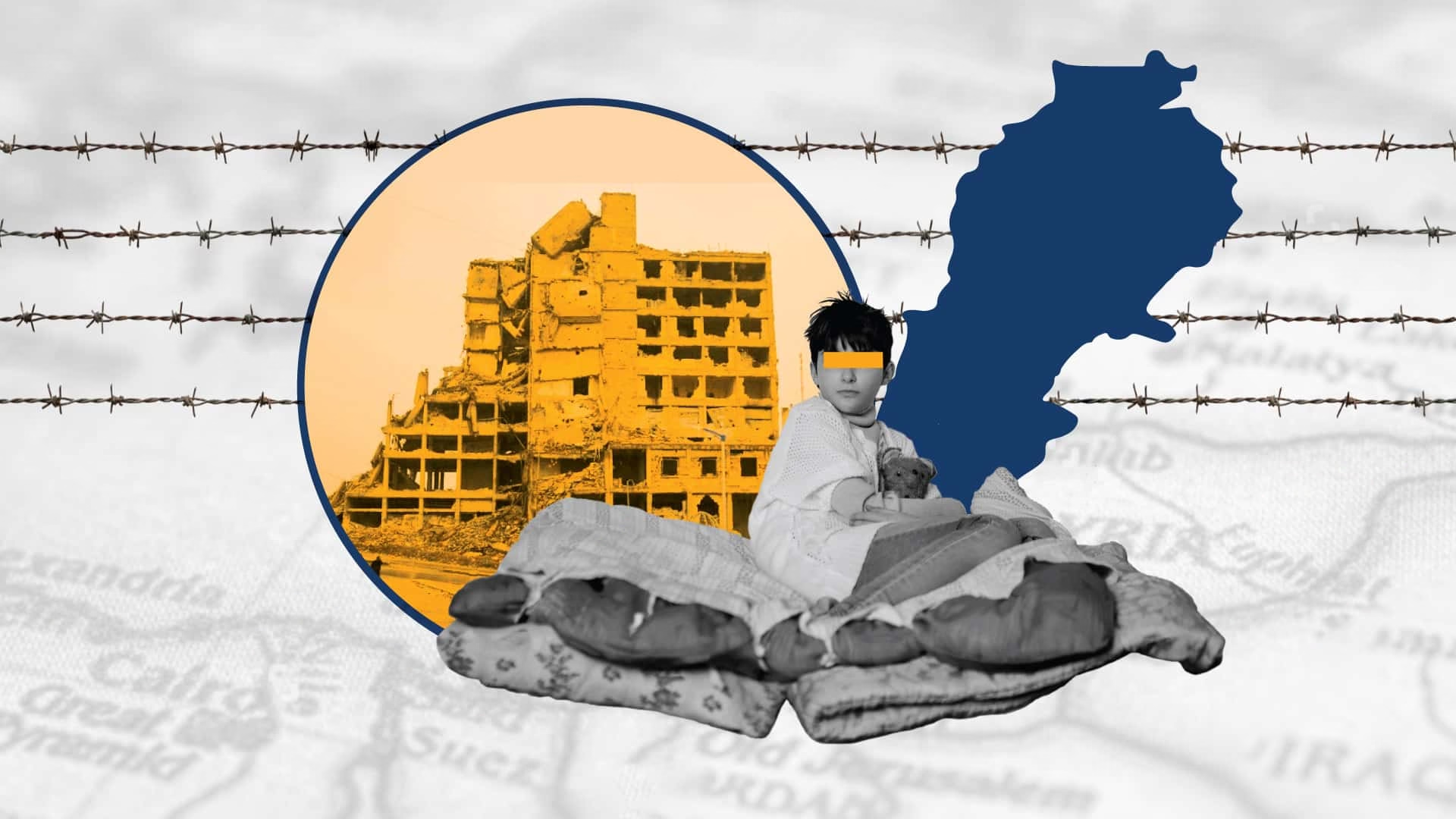

Europe’s push to send Syrian refugees home is colliding with a hard reality: Syria is nowhere near ready to receive them. More than a year after long-time Syrian dictator Bashar al‑Assad fled the country, Syria’s reconstruction remains painfully slow, the domestic political transition fragile, and international assistance scarce.
At the same time, rising right-wing populism has pushed antimigration sentiment to the top of the policy agenda across much of Europe. Governments have raced to announce “tough” stances, prioritizing speed over practicality and domestic optics over durable solutions.
The mismatch – between what is possible and what is expedient – threatens to trap refugees in legal limbo, deepen Syria’s instability, and ultimately stymie the very returns Europe seeks.
An Inconvenient Reality
European governments may not like to be reminded of this, but the challenges they faced in managing Syrian refugees during the 14-year civil war were relatively peripheral. Germany, the European country that took in the most Syrian refugees, has hosted less than one million. This figure is dwarfed by Syria’s neighbours, Turkey, Lebanon, and Jordan, which took in 3.7 million, 1.5 million, and 1.3 million refugees, respectively. Within Syria itself, the war created roughly 7 million internally displaced people.
Returnees cite unemployment, elevated living costs, poor infrastructure and lack of support as their main challenges, while some surveys show Syrians now place economic concerns ahead of security.
Over the past year, the rate at which Syrians have returned to their home communities has similarly gradated outwards from the country itself: 2 million of Syria’s internally displaced were able to go home; Turkey, Lebanon, and Jordan have seen roughly 500,000, 380,000, and 170,000 Syrian refugees go back, at least according to recent reports. Meanwhile, the German government has reported just 1,300 Syrians – 0.1% of its Syrian population – have voluntarily left. Notably, a recent UNHCR survey found only about 3% of Syrians in Europe plan to return in the short term, while EU Asylum Agency reports that just 6% intend to go back soon and only one third in the longer term.
There are numerous challenges preventing Syrians from returning, the most prominent being the devastation the war brought to their country. The World Bank estimates physical reconstruction of infrastructure and buildings will cost about $216 billion, a sum that will take years to materialise given the sharp drop in international funding. Public services, such as Syria’s health care facilities and water resources, are in disastrous condition. Many Syrians struggle to make ends meet, relying on remittances, humanitarian aid, or simply living in poverty. Returnees cite unemployment, elevated living costs, poor infrastructure and lack of support as their main challenges, while some surveys show Syrians now place economic concerns ahead of security.
Regardless of what some European politician state, Syria remains unsafe. Major outbreaks of violence in March and July, affecting minority Alawite and Druze communities, underline the volatile security landscape as does the current fighting in Kurdish areas. Even US forces fighting ISIS have recently been targeted alongside Syrian personnel. Territorial fragmentation, compounded by ongoing Israeli military actions in Syria, seriously limit the new authorities’ ability to provide security and pursue reunification.
Amid the rise of right-wing parties in Europe and hyper-aggressive United States stance on immigration, many political leaders see it as politically necessary to project a tough-on-migrants image.
Then there is the trust problem. Surveys show that while perceptions of security have improved over the past six months, trust in Syrian President Ahmed Al‑Sharaa’s government is declining amid rising polarisation and identity-based politics, where legitimacy stems less from broad consensus or economic performance than from allegiance to the interim authority. This erosion undermines the government’s credibility and fuels concerns over transparency in decision-making and the distribution of power.
Syrians know rebuilding will take time and want to contribute, but uncertainty over what comes next sparks doubts. While much has been made of Al-Sharaa’s efforts to court the international community, his primary political challenge is to inspire confidence among Syrians considering return, reassuring them that they have not simply traded one dictator for another.
Expediency Over Policy
European officials who understand the Syrian situation know that conditions on the ground do not support durable returns. When German Foreign Minister Johann Wadephul visited Syria in October, he said it was still too early for people to return and that the country was not yet safe. Wadephul’s clear-eyed assessment was not one his colleagues wanted to entertain; his comments triggered a political storm at home and prompted German Chancellor Friedrich Merz to insist that voluntary repatriation is imminent.
Amid the rise of right-wing parties in Europe and hyper-aggressive United States stance on immigration, many political leaders see it as politically necessary to project a tough-on-migrants image. This dynamic was on full display shortly after Bashar al‑Assad’s fall, when European governments such as Austria, Germany and the United Kingdom halted Syrian asylum applications and signalled plans to start deportations, arguing that with the dictator gone, Syrians no longer needed protection in Europe.
Many of these ill-conceived efforts have faltered. Germany, for instance, announced a “very tough” line on border controls, asylum procedures and deportations. This included a case‑by‑case review of Syrians’ protection status, though out of almost 17,000 reviews as of this writing, less than 600 (~3.5%) have led to protection being revoked. A UK scheme to deport migrants to Rwanda was canceled as a financial fiasco, and Italy’s migrant offshoring deal with Albania was deemed illegal by an Italian court. EU countries have issued growing numbers of orders to leave, but with only about 20% of recipients actually departing, repatriation rates have remained stubbornly low. European countries and UNHCR are also offering cash to those willing to return voluntarily. However, Syrian returnees report that these grants are far too small to allow them to stay and support their families once back in Syria.
Europe’s core problem is not the number of refugees it hosts but the yawning gap between what European politicians are promising and what Syria can actually deliver.
European policymakers are now trying to change the rules, expanding their list of “safe countries of origin” and seeking to channel asylum seekers to third countries deemed “safe”, even where migrants have no meaningful links there. Some governments, including the UK and Denmark, are even reopening debate over the mandate of the European Court of Human Rights, which has a long record of upholding the rights of migrants and refugees (not to mention Europeans themselves). Such changes would likely herald a boon for migrant smugglers, increased numbers of family separations, and further erode protections for vulnerable populations – including Syrians in the European Union.
The Path to a Durable Refugee Solution
Europe’s core problem is not the number of refugees it hosts but the yawning gap between what European politicians are promising and what Syria can actually deliver. If Europe is serious about facilitating returns, it must recognize that this requires making Syria liveable again. That requires a comprehensive package of support measures – covering livelihoods and employment, infrastructure, property and land rights, safety and protection, and access to reliable information on conditions – that can be credibly offered to those who go back.
The EU could work more closely with the UN refugee agency UNHCR to monitor conditions across Syria and share accurate information with those considering return. Another practical measure would be for European states to facilitate “go and see” visits from Europe for Syrian asylum holders while guaranteeing their right to come back if they so choose. As Syria’s economy recovers, those who return will require substantial financial support, while the EU must also work with Damascus to promote economic self-reliance, expanded access to basic services and educational opportunities, and a wide political space for civil society.
While helping Syria’s new authorities address their legitimacy gap, international engagement also needs to prevent grand, externally driven macroeconomic initiatives becoming concentrated benefits among a narrow elite, as was the case with neighbouring Lebanon’s reconstruction. Instead, recovery loans and programmes need to foster Syria’s microeconomic landscape, dominated by small and medium-sized enterprises whose local economic exchanges are quietly helping to reconnect a fragmented country.
Most importantly, EU states must resist the urge the move the goal posts and respect the principle of non-refoulement, which prohibits returning people to places where they face a real risk of serious harm. Pressing for immediate returns or refoulment are not policy that will elicit sustained returns; more likely such moves will backfire all politicians to left of the far right. Despite the difficult politics of migration in Europe, governments need to manage a realistic pace of return with legal pathways open to Syrians, including resuming asylum procedures, expanding resettlement and other legal migration pathways, as well as safeguarding family reunification. Those policies may be politically uncomfortable, but they is the only realistic way to manage return migration sustainably while recognizing that Syria’s problems will not disappear when if its people leave European shores.
Kelly Petillo is a researcher on refugee and humanitarian issues focused on Euro-MENA relations. She also acts the MENA programme manager at the European Council on Foreign Relations.
The views expressed in this article are solely those of the author and do not necessarily reflect the views of BADIL | The Alternative Policy Institute or its editorial team.