
“What if I concede it’s apartheid rule? What if I concede the occupation is illegal?” asks the ardent Zionist. He agrees that the 1995 Oslo Accords – which envisioned a two-state solution to the Israeli-Palestinian conflict – are dead, and that the current state of affairs is untenable. But what are Israelis to do? “We have to accept the situation as it is because there is no alternative,” he concludes.
That argument stumped human rights lawyer Sarah Leah Whitson as she sat next to an affiliate of the American Israel Public Affairs Committee (AIPAC) on a train from New York to Washington. Their debate stuck with her long after: what is the alternative?
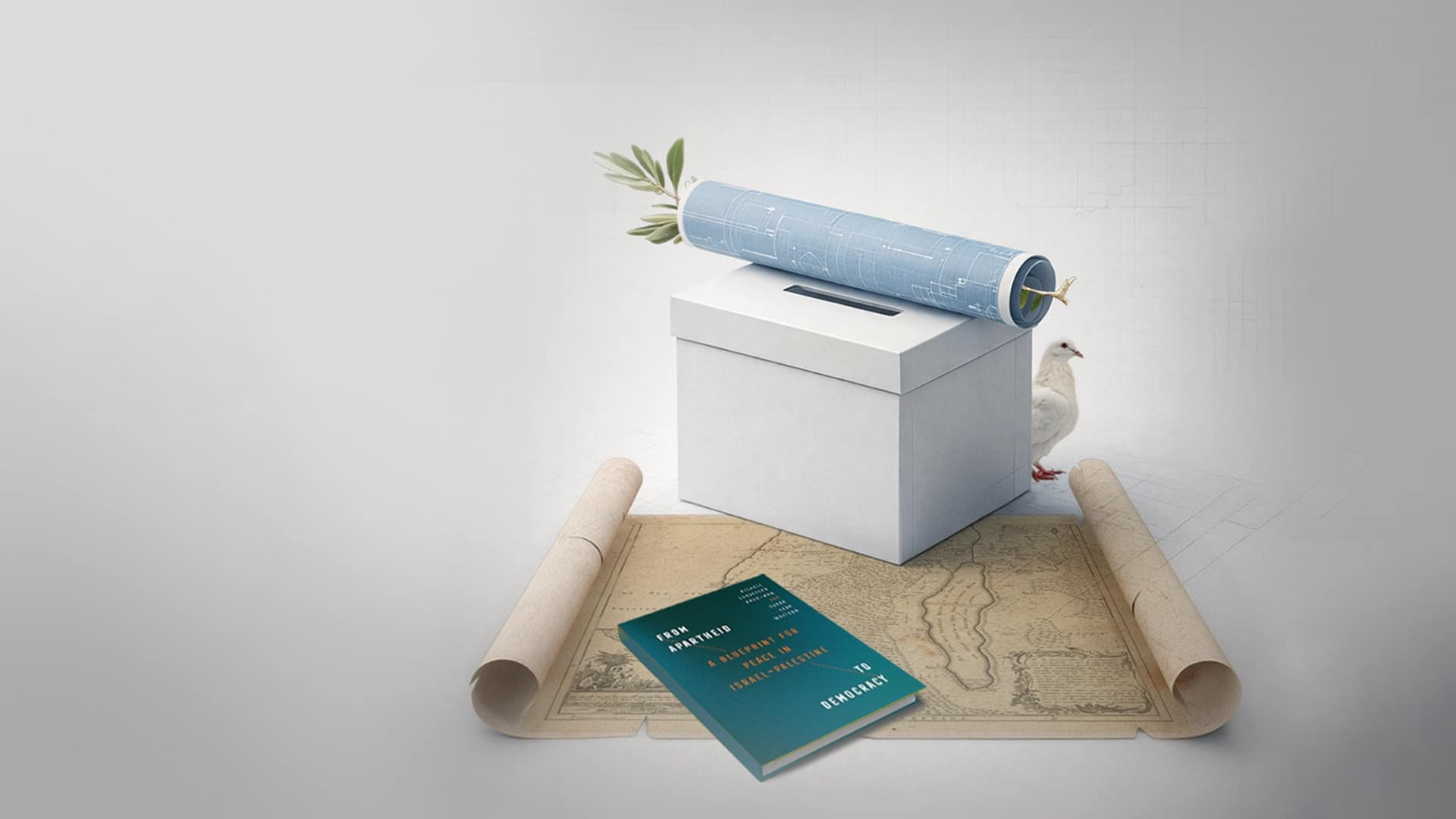
From Apartheid to Democracy: A Blueprint for Peace in Israel-Palestine, published last year by the University of California Press, became the answer.
“The world is outraged by Israel’s policies but has little to offer beyond outrage and condemnation,” she writes with co-author Michael Schaeffer Omer-Man. “Even if Israel faces international prosecutions, isolation, and crippling sanctions, the international community is still unable to articulate any positive policy demands or a vision for a just peace and rights-respecting governance.”
This is clearly a serious work by people deeply schooled in the machinery of Israeli oppression, who write with a refreshingly clear-eyed realism that places practical solutions above the sensitivities and biases that so often cloud discussions about the most enduring injustice of our era.
A remedy, suggest the authors, is their Blueprint, in which they have meticulously laid out a multi-year process to end the “apartheid and occupation and effectively transform an undemocratic one-state reality into a democratic one.”
Judge this book only by its cover (which is curiously drab), and one could be left with doubts: who are this Armenian-American (Whitson) and Israeli-American (Omer-Man) to propose an architecture for the future of Palestine when neither is Palestinian?
These concerns recede, however, the more pages one turns; this is clearly a serious work by people deeply schooled in the machinery of Israeli oppression, who write with a refreshingly clear-eyed realism that places practical solutions above the sensitivities and biases that so often cloud discussions about the most enduring injustice of our era.
Aside from the “nearly five decades” of combined legal and journalistic work related to Israel and Palestine the authors bring, buttressing the Blueprint’s credibility is its acknowledgements section: the dozens of people consulted for the project are a tour-de-force of the figures – Palestinian, Israeli, and otherwise – at the public and intellectual forefront of the struggle for Palestinian rights. The exhaustive endnotes and bibliography also exceed 50 pages. All that is to say: the authors have done their homework, and anyone truly invested in seeing Palestinians walk freely in their own land ought to hear them out.
To date, the United States and the wider international community’s efforts to coax an end to the Israeli-Palestinian conflict have prioritized the contours of the nation-states that should emerge from it. Palestinians securing their basic rights has been treated as what will follow from successfully concluded negotiations. The Blueprint flips this approach on its head.
The Blueprint uses as its starting point the reality that currently exists: the State of Israel exercises effective control over all people in Israel, East Jerusalem, the West Bank and Gaza – collectively referred to as “The Territory”. Roughly half these people “enjoy living under Israeli democracy, the other half experience Israeli governance as a military dictatorship.”
This generations-long arrangement upholds Jewish supremacy and impugns the basic civil, political and human rights of Palestinians in The Territory. That’s apartheid, according to the International Court of Justice (ICJ), which has ruled that both Israel’s apartheid regime and its military occupation of the West Bank and Gaza are illegal under international law and must end.
To date, the United States and the wider international community’s efforts to coax an end to the Israeli-Palestinian conflict have prioritized the contours of the nation-states that should emerge from it. Palestinians securing their basic rights has been treated as what will follow from successfully concluded negotiations.
The Blueprint flips this approach on its head, insisting that Palestinians’ basic rights cannot be contingent on negotiations and that ending Israel’s apartheid rule and illegal occupation must be the first step before all others. Once all people in the Territory have equal rights and suffrage under the same set of laws, let them decide through a democratic vote the form of governance they want – be it one state, two states, a confederation, or other arrangement. The Blueprint’s focus is how to successfully make this transition from apartheid to democracy.
The vision is for a caretaker government – including representation from Israelis, Palestinians, minority groups in the Territory, and the international community – to guide the way, with the Blueprint detailing a three-year schedule of tasks it must undertake.
Day 1 is busy, addressing the most urgent items immediately and serving as an abrupt reset for the Territory. It will see an end to Israeli military rule and the extension of civilian law over Palestinian areas, enforced by a unified national police force; the end of movement bans; the revoking of a long list of racist and discriminatory Israeli laws; a freeze on property sales and transfers; a public acknowledgement of the 1948 Nakba and the state’s obligations towards the refugees it created and their descendants today, and a host of other pressing tasks.
Within a month, the caretaker government is to reconfigure its roster of ministries and establish nine special committees and commissions to continue dismantling the various institutional supports for apartheid, expand equal rights, protections and services for all citizens, foster legitimacy for the transition, and curb potential spoilers. A primary emphasis is on reforming the military, intelligence, and policing bodies, vetting their personnel, and disarming, demobilizing, and reintegrating armed groups and specific security institutions. Other special bodies created during this period specialize in legislative reforms, judicial appointments, transitional justice, governance, and movement.
In the weeks and months that follow, the Blueprint details how these special bodies’ tasks will be expanded and refined as they, and a new elections authority, work towards creating the necessary conditions for a successful parliamentary vote at the end of year three. The new parliament, which will mark the end of the caretaker government’s mandate, will then be tasked with adjudicating the future form of governance in the Territory.
This parliament is to be consociational, with seat quotas ensuring representational parity between Jews and Palestinians (which is generally supported by their roughly equal numbers within the Territory of 7.4 million and 7.6 million, respectively). This safeguards against the legislative process being “hijacked by any one group or coalition of groups in ways that harm others or recreate a system of supremacy and domination.” The authors call parliamentary consociationalism a “temporary necessity… at least until the people are given a democratic choice to determine their political future… in a referendum.”
The Blueprint is not without its oversights. For instance, when proposing to mandate that the caretaker government provide urban and rural areas with equal service provision, the Blueprint doesn’t account for how to pay for such a massive, multi-year investment. While the Blueprint discusses spoilers in the context of parties that may pursue violence to derail the transition, it overlooks the likelihood of bureaucratic opposition and how highly motivated government workers, in far less conspicuous ways, could tie the transition in knots.
The authors also argue that while the caretaker government should lay the foundations for comprehensive restorative justice, many historic wrongs are beyond its “mandate to end apartheid and occupation and to lay the groundwork for democratic governance.” Among the issues specifically mentioned are the right of return for Palestinian refugees outside the Territory, and restitution for the homes and property confiscated from Palestinians and now in the possession of Jewish Israelis. The authors assert that to avoid the transition stalling, pragmatic necessity demands that such issues be the responsibility of a future elected government. Many, however, for whom these issues are central, may see punting them down the road as underming the legitimacy of the process.
Whitson and Omer-Man are clear about the Blueprints most important constraint: it has no provisions for compelling Israelis or their government to sign on. Rather, for the plan to proceed it “requires a level of earnest political will where there is almost none today.”
The authors note that Jewish Israelis still garner far more profit than pain from the apartheid and occupation, and only when that equation is reversed – when the costs of these crimes outweigh the benefits – would they support changes to the system.
Whitson and Omer-Man suggest that what tips the scales would “ideally” be international “sanctions, diplomatic isolation, and economic pressure,” but barring that the world may see “unimaginably painful, intractable violence” raising the costs of maintaining the occupation and apartheid beyond what Israelis are willing to bear.
In this writer’s view, Israelis will remain immunized from having to make meaningful concessions towards a just arrangement with Palestinians as long as Washington abides by its long-standing commitment to lavish Israel with arms, financing, and diplomatic support – even through Israel’s genocide in Gaza.
The Blueprint thus has limits, but its value is not weighed in its perfection, but in the plausible path it traces to a better world where many said none existed. It rightly rearranges the international community’s responsibilities to end Israel’s crimes first, then address national status issues. Progress is at the intersection of preparation and opportunity – with this Blueprint, we are now prepared.
The views expressed in this article are solely those of the author and do not necessarily reflect the views of BADIL | The Alternative Policy Institute or its editorial team.