
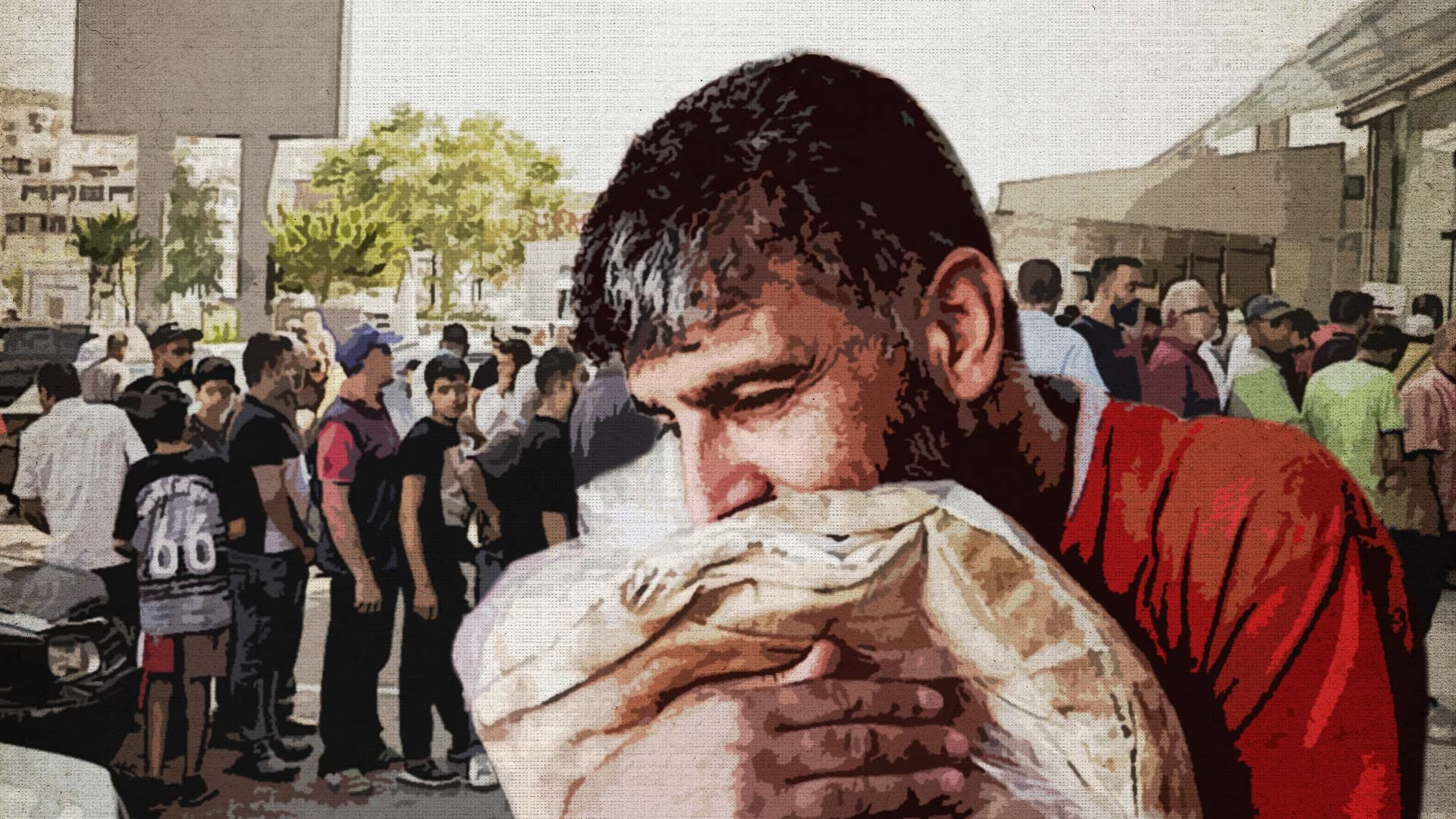

Bread in Lebanon is more than just a staple we eat with almost every meal. It is a symbol of basic dignity and the last defense against hunger for millions of people. Its affordability and availability are essential guarantees of public welfare. Today, however, those guarantees are dangerously frayed. While the country is not currently in a full-blown bread crisis, it hovers precariously on the edge. The conditions are in place: an undiversified wheat supply, limited reserve capacity, cartel-like market control and political capture, a collapsed currency and economy, to name just a few. Together, they are pushing Lebanon’s bread supply system toward the brink. This moment must serve as a warning. Addressing the looming threat to bread access is not optional—it is a test of whether a nation can uphold the most fundamental promise of governance: to feed its people. In this respect, the new leadership of President Joseph Aoun and Prime Minister Nawaf Salam stands at a historic juncture. If they cannot ensure access to bread, they forfeit the legitimacy to lead.
Lebanon’s dependency on wheat imports is one of its most acute structural vulnerabilities. The country relies on Russia and Ukraine for 80 to 90 percent of its wheat imports, according to Ahmad Hoteit, president of the Association of Mills in Lebanon, a staggering concentration made painfully evident when the Russian invasion of Ukraine in 2022 disrupted global wheat trade. As a result, Lebanon’s supply chains buckled. Breadlines lengthened, bakeries shuttered, and prices soared on the black market. This crisis was not hypothetical; it was immediate and visceral. Even as emergency wheat shipments arrived in early 2023 through a World Bank loan to restock the country’s depleting reserves, the episode underscored the profound fragility of Lebanon’s food system.
Once able to safeguard up to five months of supply, the country now largely depends on private mills whose storage capacity tops out at two months.
The situation is rendered more precarious by Lebanon’s destroyed storage infrastructure. The 2020 Beirut Port explosion obliterated the nation’s main grain silos, eliminating much of its capacity to store strategic wheat reserves. Once able to safeguard up to five months of supply, the country now largely depends on private mills whose storage capacity tops out at two months, according to Hoteit. In a world of climate shocks and geopolitical unpredictability, allowing the country to continue without a meaningful reserve wheat supply is intolerably reckless.
Further distorting bread access is the fact that Lebanon’s wheat market is dominated by five politically connected millers who import the vast majority of all wheat entering the country. According to the President of the Organization for the Protection of Consumers in Lebanon, Zouheir Berro, the mills’ pricing control allows them to charge exorbitantly more to grind and distribute wheat in the country relative to mills in Syria and Egypt.
Lebanese bread access is being scorched not by distant wars alone, but by fires lit at home.
Indeed, a recent study reported that the most significant determinants of wheat flour prices in Lebanon are internal factors, such as gasoline prices and local inflation, rather than shifts in global wheat or oil prices. This suggests that the country’s current system is not only vulnerable but also actively amplifying hardship. Economic mismanagement, volatile exchange rates, the end of a World Bank support program for wheat imports, and recurring fuel price shocks exacerbate food insecurity. Lebanese bread access is being scorched not by distant wars alone, but by fires lit at home.
It is therefore no coincidence that the country is experiencing an alarming rise in food insecurity, with almost 1.2 million people currently facing acute food insecurity. Arabic bread—nutritionally essential and culturally sacred—has long been the final bulwark against starvation. In times of economic hardship, bread consumption typically increases while consumption of other foodstuffs decreases, as people turn to bread as their last resort. This makes maintaining a robust bread supply chain all the more critical as the last social safety net before destitution.
Lebanon’s domestic wheat varieties are largely unsuitable for Arabic bread – being better suited to pasta or other products – and produced in quantities that are just a fraction of what the country consumes.
The government has made gestures toward increasing local wheat production, but these efforts have yet to mature into viable alternatives. Lebanon’s domestic wheat varieties are largely unsuitable for Arabic bread – being better suited to pasta or other products – and produced in quantities that are just a fraction of what the country consumes. Climate change adds another layer of difficulty, accelerating desertification and reducing yields, especially in the Bekaa Valley, where much of Lebanon’s agriculture is concentrated.
Yet it is precisely here that hints of opportunity lie. A recent study on wheat mapping using satellite imagery and computer modeling shows the potential of smart agricultural planning. The ability to monitor and optimize wheat cultivation in real-time is a tool that could bolster resilience, especially when coupled with targeted support for small farmers. Likewise, nutritional innovation offers a glimpse of what a more self-reliant bread system might look like. A 2025 study demonstrated that up to 20 percent of bulgur wheat, grown extensively in Lebanon, can be substituted in Arabic flatbread without sacrificing taste or texture, reducing dependency on imported flour. Public attitudes, too, suggest readiness for change. A study published last month found that a majority of Lebanese consumers are open to non-traditional bread alternatives, such as those fortified with vegetables like carrot or spinach, if they are perceived as healthier. None of these studies, on their own, offers a solution to Lebanon’s precarious bread supply, but what they do suggest is that innovation throughout the bread supply chain can collectively support resilience and sustainable access to this staple food.
Lebanon has the expertise, the data, and the tools to transform its bread system. What it lacks is a leadership class willing to dismantle entrenched interests and act in the best interest of the public welfare.
Lebanon has the expertise, the data, and the tools to transform its bread system. What it lacks is a leadership class willing to dismantle entrenched interests and act in the best interest of the public welfare. The new government must understand that if it fails to secure access to bread, little else it does will matter in the eyes of the public. It must move swiftly to diversify import sources, decentralize and rebuild grain storage infrastructure, support climate-resilient farming, and address the concentration of power within the supply chain. Importantly, ensuring bread supply must form part of a vision to prioritize local self-sustenance and production.
As the 2026 parliamentary elections approach, the public must not treat bread as a peripheral concern. It must become a central demand of a reawakened political conscience. Voters must ask their prospective representatives: What is your plan to ensure that every Lebanese household can, literally, put bread on the table? Politicians who cannot protect their constituents from hunger have no business asking for their trust. And those who stand by while this injustice festers must not be returned to power.
Bread is at the center of the dinner table for all Lebanese, regardless of sect or political party. Let it now also be the standard by which we judge those who claim to serve us.