

Lebanese President Joseph Aoun stoked both praise and condemnation when he recently said negotiating with Israel is “not treason.” Supporters have seen his stand as a necessary step to save the state and avert more death and destruction; critics have denounced him for capitulating to the enemy. Given the events of the past month, however, it is reasonable to ask whether what is happening in Washington can plausibly be called negotiation at all.
A Play for Time: The Theatre of Lebanon-Israel Negotiations
In talks scripted by Washington, Lebanon tries to improv its way to sovereignty.
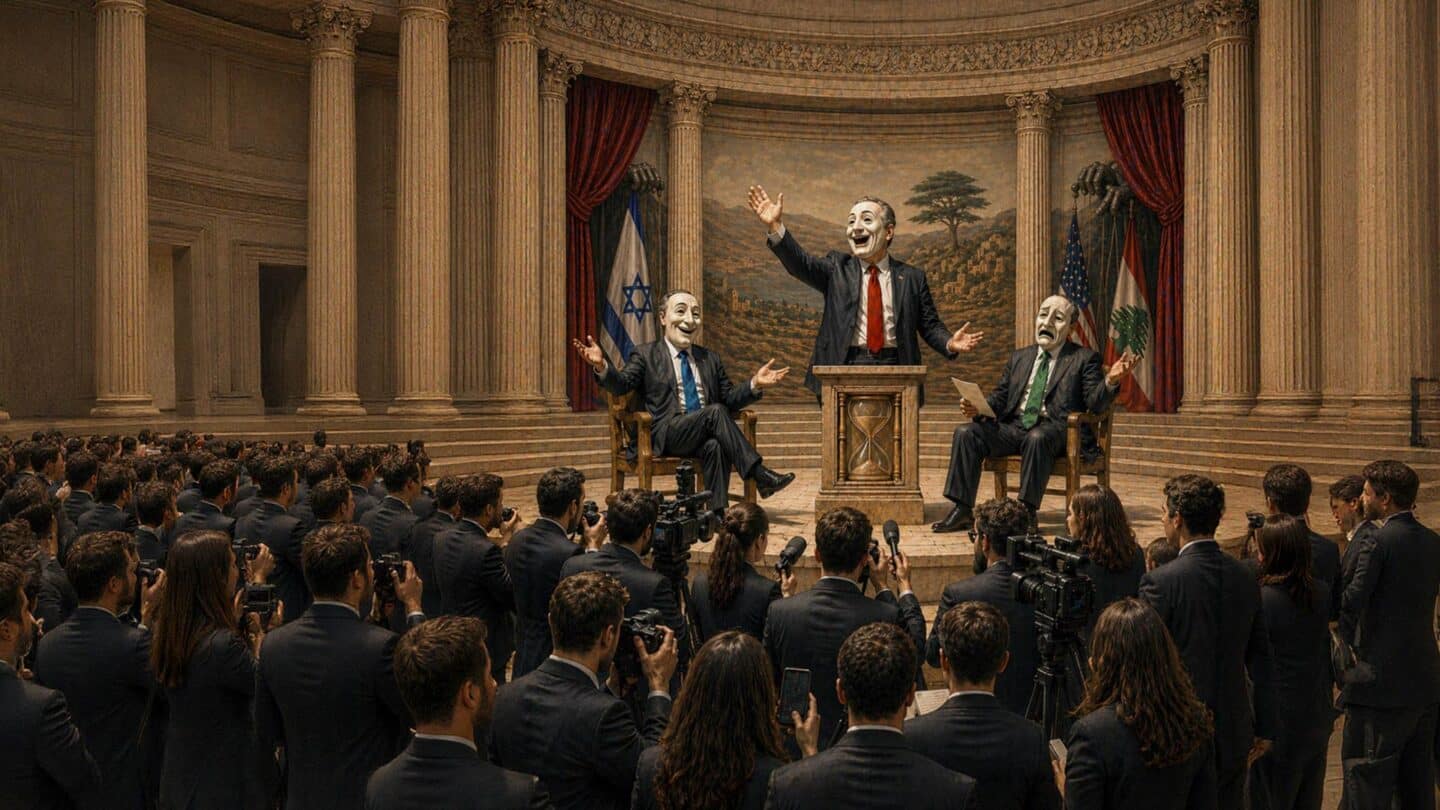
What is currently at play can be called many things, but “negotiations” is hardly the most appropriate term.
The Israeli-Lebanon ceasefire agreement the US State Department released on April 16 was not even shown to the Lebanese side before being made public, according to government officials who spoke to The Badil on condition of anonymity. This followed President Donald Trump having announced that Aoun and Israeli Prime Minister Benjamin Netanyahu would speak directly, without even consulting the Lebanese president.
Rather than negotiations, Lebanon has been subject to US notifications and told to fall in line. Aoun and Prime Minister Nawaf Salam have then delicately danced around Washington’s fait accompli while taking pains not to stir Trump’s ire. Meanwhile, the ceasefire they “agreed to” appears diminishingly limited: Israeli forces continue bombing and destroying South Lebanon amid unrelenting Hezbollah attacks, with the group also escalating its threats against the Lebanese government for talking to Israel at all.
What is currently at play can be called many things, but “negotiations” is hardly the most appropriate term. With Lebanon’s government in survival mode, operating within a shrinking space to maneuver, and between parties with much greater leverage, there is still a chance for a more sovereign Lebanon to emerge. That requires Lebanese leaders to play to the only dynamic working against more powerful parties: time.
Early the next day, the US ambassador to Lebanon called Aoun to inform him he would be having a joint call with Trump and Netanyahu, according to two Lebanese government officials who separately spoke with Badil. The Lebanese President flatly refused, the official claimed, only to be told that Trump was soon to post on social media that the call was indeed happening. Trump did so that evening, saying “It has been a long time since the two leaders have spoken, like 34 years. It will happen tomorrow. Nice!”
From Massacre to Ceasefire
The diplomatic track so far shows why Lebanon cannot afford to engage fully. The process was set up by an Israeli mass killing carried out within hours of Netanyahu sabotaging a ceasefire that should have stopped it. As US media reported, the Israeli Prime Minister first acquiesced, then reneged, on including Lebanon in the April 7 US-Iran ceasefire mediated in Islamabad. The next day Israel carried out a massive bombing campaign, striking more than 100 sites in Lebanon in 10 minutes, killing more than 350 and wounding more than 1,200.
For his part, Aoun had for weeks called for direct talks with Israel, but with four steps to be met in sequence: an immediate ceasefire, a strengthened Lebanese Army, continued progress disarming Hezbollah, and only then direct negotiation. Within forty-eight hours of the massacre, talks were on the table with none of the steps taken. By April 14, Lebanese Ambassador Nada Hamadeh Moawad was sitting down with her Israeli counterpart Yechiel Leiter at the State Department, the first official contact between the governments since 1993.
During their 29-minute chat, Aoun pressed Trump with a charm offensive, according to the officials who spoke with Badil, explaining why he could not speak with Netanyahu.
A regional Arab diplomat who spoke with Badil said he had counselled Aoun against publicly contradicting Trump and to instead find a way to refusal without confrontation. Following this advice, Aoun communicated his position to Secretary of State Marco Rubio, and then through the Lebanese embassy in Washington requested a direct call with Trump, which the White House granted. During their 29-minute chat, Aoun pressed Trump with a charm offensive, according to the officials who spoke with Badil, explaining why he could not speak with Netanyahu. Afterwards, Trump praised Aoun as “highly respected,” and announced that Israel and Lebanon had agreed to a 10-day ceasefire. Aoun’s office in turn issued a statement thanking Trump for his efforts.
The State Department then issued the ceasefire terms, saying they were “agreed to by the Government of Israel and Government of Lebanon,” despite the Lebanese side having not been shown the text, according to two officials who spoke with Badil. Notably, the document’s third clause gave Israel the “right to take all necessary measures in self-defence, at any time,” with no parallel right for Lebanon’s self-defence.
Aoun’s office, however, saw silence as the best of bad options: publicly disowning the text would have forced Trump to eat his words twice in two days, risking a backlash. It was only two weeks later that the Lebanese government officially commented on the ceasefire text. On April 27, Aoun’s office said the Lebanese government endorsed only the clause restricting Israel’s “offensive military operations” in Lebanon, and that “any other statements are not our concern and have no official Lebanese endorsement.”
The Delicate Dance
Aoun has since staked out his official position: an end to the state of war with Israel “along the lines of an armistice agreement” of 1949. That formulation rules out a peace treaty, normalisation, or any comprehensive settlement. It commits Lebanon only to the legal status that prevailed before Israel invaded in 1982. Salam has reinforced that position, stating that Lebanon “cannot sign any agreement that does not include a full withdrawal” of Israeli forces, rejecting any so-called buffer zone that would prevent more than a million displaced Lebanese from going home. Together, these positions draw a recognisably narrow line – the maximum the state can demand of talks without US rebuke, and the minimum stance against Israel necessary to fend off a domestic rupture.
The latter is increasingly important, with the pressure from Hezbollah against the Lebanese leadership becoming menacing. Hezbollah Secretary-General Naim Qassem said it was an insult that the US would “dictate” ceasefire terms and speak on behalf of the Lebanese government. Senior party figures, including Nawaf al-Moussawi, have since compared Aoun’s situation to that of Anwar Sadat, the Egyptian president assassinated in 1981 after signing a peace treaty with Israel. Hezbollah has also shown that what it cannot achieve through politics it will attempt to do so by force. The clearest precedent is May 2008, when Hezbollah and its allies seized West Beirut after the government tried to dismantle the party’s parallel telecommunications network.
Thus between Washington’s coercion, Israel’s bombing, and Hezbollah’s threat, the Lebanese government has been trying to build what leverage it can. The United Nations Interim Force in Lebanon (UNIFIL), which first deployed to South Lebanon following Israel’s 1978 invasion, is due to end operations this year after the US refused to renew its Security Council mandate. Salam’s April 21 visit to Paris, and the press conference at which President Emmanuel Macron offered French military participation in any post-UNIFIL force, was a deliberate move to cultivate a counterweight to Washington and Israel.
Another clear means by which the Lebanese state could assert its presence among the warring parties is to move forward with joining the International Criminal Court. Lebanon had begun the process in 2024, in the face of plausible Israeli war crimes during the last round of armed conflict, but subsequently dropped the effort. Renewing this track would likely garner widespread support among the population, especially if framed as a response to the Israeli army’s killings of Lebanese civilians, medical workers, and journalists.
Both Trump and Netanyahu face elections within the next seven months, and both are applying force on Lebanon from positions of domestic weakness, not strength.
Coercion’s Limits and the Thin Path to Sovereignty
A corollary to Lebanon’s position is that the current pressure it is facing may have a best-before date. Both Trump and Netanyahu face elections within the next seven months, and both are applying force on Lebanon from positions of domestic weakness, not strength.
Trump’s Republicans face midterm elections in November, and the picture is bad. Polling shows Trump’s approval at 37% and falling and that Republicans could plausibly lose both houses of congress. The US-Israel war on Iran has been unpopular, and the fuel price spikes it caused deeply problematic for the incumbent party. The fact that when Trump-announced three-week extension of the Lebanon-Israel ceasefire he also demanded that Israel keep military actions in Lebanon “calculated and limited” is among the indications he wants the Lebanese front calm as November approaches.
Netanyahu’s clock is shorter, and his position is worse. With Israeli elections this October, polls show the opposition bloc taking a plurality of seats. Were he to lose, Netanyahu would no longer be able to defer the ongoing corruption trial against him and would likely face jail. He thus desperately needs a victory to sell before the elections. This as, according to recent Israeli reporting, the country’s military is quietly walking back the “absolute victory” Netanyahu promised to the more limited goals: a political agreement with Lebanon and finding solutions to Hezbollah drones and rocket fire.
As is, Aoun and Salam are unable to leverage any meaningful concessions from the US, Israel, or Hezbollah. That may change, however, by year’s end, if political winds in Washington and Tel Aviv have shifted and Hezbollah is staggering on the battlefield.
Meanwhile, Hezbollah Secretary General Naim Qassem said that any outcomes from the Lebanese government’s talks with Israel “are as if they do not exist for us,” and that the group’s “defensive resistance” will continue until “the Israeli enemy will not remain on a single inch of our occupied land.”
None of this gives the Lebanese government an opening it can step through today. As is, Aoun and Salam are unable to leverage any meaningful concessions from the US, Israel, or Hezbollah. That may change, however, by year’s end, if political winds in Washington and Tel Aviv have shifted and Hezbollah is staggering on the battlefield. These weakened positions, combined with the planned drawdown of the international force securing the border in December, could create an opening for the Lebanese state, and perhaps, a face-saving exit from the conflict. Indeed, if a more sovereign Lebanon is to emerge from this moment, it will likely not arise from the so-called negotiations themselves, but rather the state’s ability to outlast them.
Related

Distorted State: How Hezbollah Survived, And What It Means For Lebanon
Thought to be shattered, Hezbollah’s return to the battlefield is challenging assumptions about the war, and reshaping Lebanon’s balance of power

Arab Diplomacy Unmasked: Behind the Veil of Unity on Gaza
Arab states' public support for Gaza contrasts with their strategic ties with Israel, revealing a gap between rhetoric and realpolitik.

Israel’s War on Journalism: One Year After Issam Abdallah’s Killing, the Silence Must End
The international community’s indifference to this attack has only emboldens Israel’s campaign on media workers

Sovereignty vs Subordination: Lebanon’s Fraught Affair with US Military Aid
As the Lebanese state seeks a monopoly on arms, it risks trading one master for another
-

Capable or Credible: Building Lebanon’s Leverage in Negotiations with Israel
Many claim the Lebanese government has no hand to play in negotiations, but leverage is more than a question of hard power.
-
Lebanon Cannot Be Bombed Into Sovereignty
A sovereign Lebanon and a demilitarised Hezbollah cannot happen without a credible political transition
-
No Refuge: Amid War, Scapegoating of Syrians Continues in Lebanon
Lebanese politicians still blame their failures on marginalised refugees