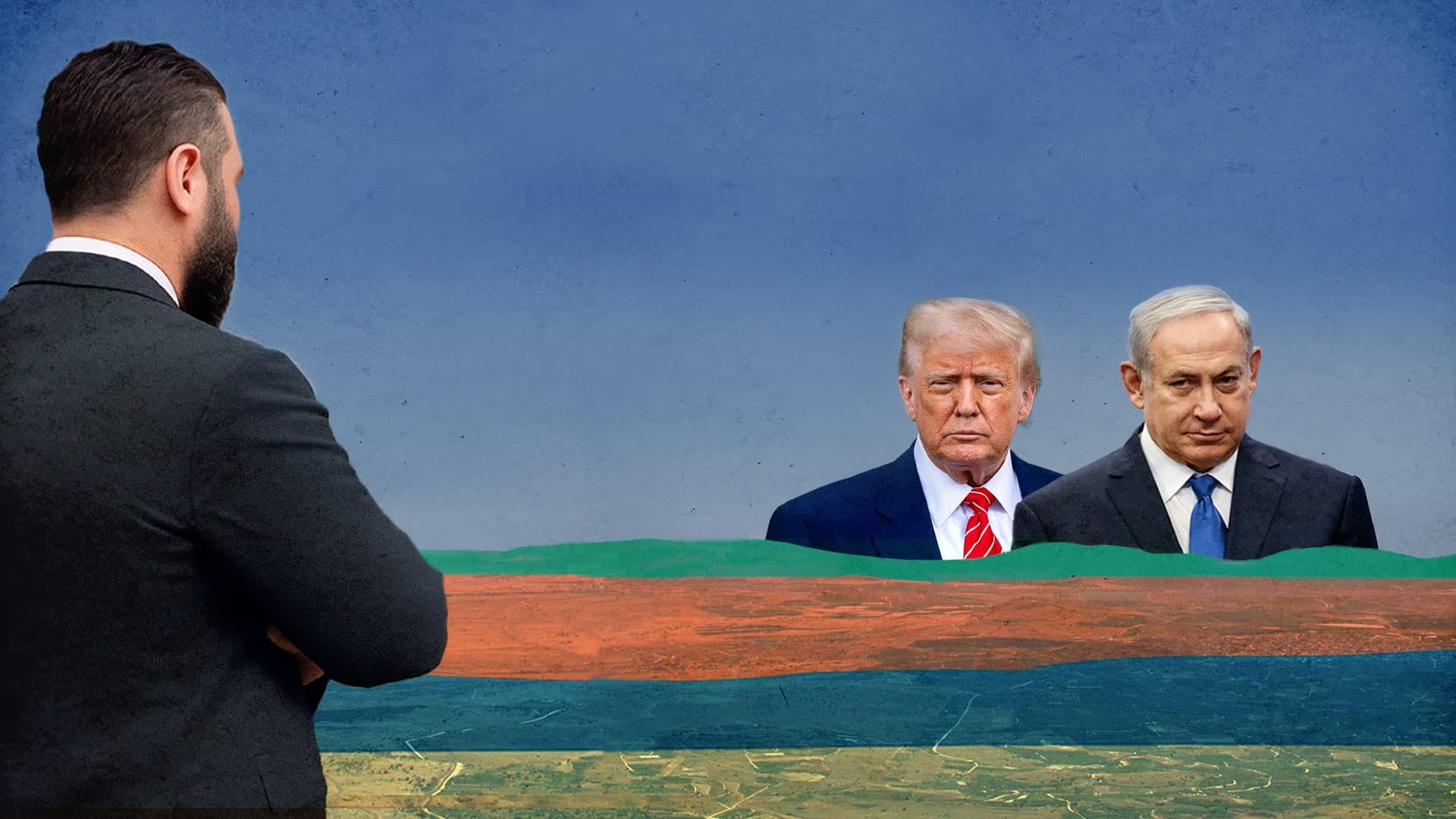


As Donald Trump hosted the Lebanese and Israeli ambassadors at the White House last week, direct negotiations between the two countries continued to press forward amid a divided domestic landscape. Hezbollah, factions allied to it, and many observers have already dismissed the talks as futile, arguing that the Lebanese state has no meaningful leverage and is negotiating from a position of weakness, capable only of offering concessions. This reductive view, however, misreads how bargaining power is actually built at the negotiating table.
The challenge before the state is whether it can deploy this leverage strategically rather than default to the short-term, crisis-driven diplomacy that has repeatedly weakened its hand in the past.
There is little question that Hezbollah, not the state, holds the greater share of ‘capability leverage’ on the Lebanese side, defined by its ability to use armed force and material pressure to influence the outcomes of the talks. But the hard power which creates consequences on the battlefield is not the only currency that matters in negotiations.
Despite much lacking capability leverage, the Lebanese government wields a different form of influence: its ‘credibility leverage’ that comes from international legitimacy, political goodwill, and a demonstrated commitment to the negotiation process. The challenge before the state is whether it can deploy this leverage strategically rather than default to the short-term, crisis-driven diplomacy that has repeatedly weakened its hand in the past.
Lebanon’s Credibility Arsenal
Lebanese negotiators are entering the talks with a stock of credibility assets that, if properly invested, can begin to narrow the capability gap. First, President Joseph Aoun and Prime Minister Nawaf Salam have accrued political capital by signaling a clear intent to consolidate state authority over arms and take visible steps in that direction. Washington has acknowledged these efforts, even as it continues to support Israel’s ‘right to defend itself’ and press the Lebanese state to do more to dismantle Hezbollah’s military infrastructure. At the same time, there is no doubt that Hezbollah’s continued ability to reposition forces in the south, sustain domestic production of weapons and drones, and continue to attack Israeli positions exposes the limits of state control as well as the gap between policy and operational reality. But these realities do not negate the state’s declared intent. However incomplete, the government’s sustained effort to assert a monopoly over the use of force provides a solid foundation upon which Lebanon’s credibility leverage can be built.
Second, and equally significant, is the government’s consistent political distancing from military action. The current administration’s refusal to align itself with Hezbollah’s Iran-sponsored armed activities marks a clear and principled departure from prior patterns. Cabinet decisions taken since the latest escalation, including formal prohibition of Hezbollah’s military wing, are in line with earlier decrees tasking the army with disarming non-state actors and endorsing the objectives of a U.S.-backed disarmament roadmap. This consistent stance, coupled with Parliament Speaker Nabih Berri’s tacitly supportive posture, strengthens the credibility of Lebanon’s political leadership.
Hezbollah’s unwillingness to relinquish its arms is an obvious constraint, and as long as Israeli occupation continues, the party retains both the justification and incentive to hold on to them, at the very least among its constituencies.
Third, Lebanon holds an underutilized form of credibility leverage in the body of international law and constellation of agreements that recognize its territorial rights. Lebanese negotiators are well positioned to invoke these frameworks as a legal floor below which no agreement should fall. They must insist that any emerging agreement explicitly reaffirm Lebanon’s territorial sovereignty, in accordance with United Nations Security Council Resolution 1701, the Blue Line demarcated in 2000, the Armistice Agreement of 1949, and the Maritime Boundary Treaty of 2022. Even if Tel Aviv and Washington hardly treat these instruments as binding reference points, Lebanon should firmly and publicly resist efforts to recast them as variables rather than constants.
Fourth, Lebanon is in a position to make a compelling argument, based on realities on the ground, that disarmament will not be achieved through military operations. Hezbollah’s unwillingness to relinquish its arms is an obvious constraint, and as long as Israeli occupation continues, the party retains both the justification and incentive to hold on to them, at the very least among its constituencies. This dynamic is compounded by structural constraints on the state. The Lebanese Army currently lacks the operational capacity to deploy effectively across the south and dismantle arms smuggling networks and weapons storage infrastructure. Nor can it begin to build that capacity while Israeli forces occupy the territory it is meant to secure.
The logic here points to an unavoidable conclusion: Israel’s continued occupation risks producing the outcome that all parties claim they wish to avoid. The prolonged absence of state authority in the south will only consolidate Hezbollah’s grip as communities will inevitably gravitate toward the only protection available to them. Occupation, in this context, does not weaken Hezbollah; it sustains it. Genuine progress on disarmament is therefore inseparable from Israeli withdrawal and the full restoration of Lebanese territorial integrity.
Finally, the Lebanese state has a point of leverage that renders it indispensable to any lasting agreement. It is the only actor at the table capable of engaging Hezbollah politically and shaping the conditions under which disarmament becomes possible. Persuading Hezbollah to break free from its own curse – a posture of permanent militarization – is a task that requires sustained, politically sophisticated engagement. Lebanon’s negotiating team is uniquely positioned to make this case, given the fact that Hezbollah is a constituent of the state itself, but also that the party has an interest to engage with the negotiation process outside of the public sphere. This reality, coupled with intra-Lebanese political dialogue, can be a significant asset which closes the state’s capability gap as talks persist.
Disarmament as a Negotiated Process
As U.S. and Israeli pressure to disarm Hezbollah intensifies, current realities also provide the Lebanese negotiating team with a strong basis to push back against unrealistic demands around disarmament being made by Washington and Tel Aviv. Given the state’s limited capacity and willingness to impose disarmament by force, a sustainable path forward requires a fundamentally different approach. Any viable framework must be anchored in carefully sequenced disarmament, demobilization, and reintegration (DDR) processes that address the social, economic, and security needs of combatants and their communities.
Far from empty-handed, Lebanon enters these negotiations carrying a form of leverage that is less visible than military capacity: the credibility of a government that has chosen institutional legitimacy over alignment with non-state armed actors.
Lebanese negotiators can draw on comparative experiences, from Northern Ireland to Sierra Leone, to show that DDR processes are more successful than coercive security measures. In most cases, progress is non-linear and unfolds over years, with full disarmament as the final, or near-final step. This sequencing is especially critical in Lebanon, where rising polarization and sectarian tensions make economic and social reintegration of Hezbollah’s fighters a prerequisite for the surrender of arms. In parallel, deep security sector reform is essential to integrate combatants into the state apparatus and build effective institutions capable of maintaining stability across Lebanese territory.
From Crisis Management to a Coherent Strategy
Far from empty-handed, Lebanon enters these negotiations carrying a form of leverage that is less visible than military capacity: the credibility of a government that has chosen institutional legitimacy over alignment with non-state armed actors. To convert this capital into durable political outcomes, the Lebanese team must shift away from reactive diplomacy toward a coherent strategy – one that treats the talks not as an end in themselves, but as part of a broader transition toward a sovereign and sustainable security order.
Absent this shift, Lebanon risks squandering the credibility leverage on which its bargaining power depends and, in doing so, confirming Hezbollah’s claim that diplomacy is ‘futile’ and Lebanon should ‘let the battlefield speak for itself’.
Nassim Abi Ghanem is Assistant Professor in International Relations and Peacbuilding at Bard College Berlin
The views expressed in this article are solely those of the author and do not necessarily reflect the views of BADIL | The Alternative Policy Institute or its editorial team.