
During the more than decade-long Syrian civil war, Türkiye largely approached Syria through the lens of risk management, aiming to protect its borders, manage the refugee crisis, maintain influence in Syria’s north, and prevent the People’s Protection Units (YPG), the Syrian Kurdish militia, from expanding. However, the fallout from the US-Israel war on Iran and the months-long closure of the Strait of Hormuz this year, through which a fifth of the global oil supply passes, has now created the potential for Syria to shift from a patron of Ankara to a projection of its power.
The Recalculation: Sponsored Client to Strategic Prize
After Syria’s new government took power in late 2024, Ankara shifted to a strategy of investing in Syrian stability to safeguard its own interests. This aimed to foster a centralized Syrian state capable of controlling its borders, preventing the return of ISIS, integrating the area east of the Euphrates, and severing links between Syrian Kurdish forces and the Kurdistan Workers’ Party (PKK) inside Türkiye, which Ankara considers a terrorist group. Turkish policymakers also wanted a Syrian state strong enough to resist the influence of rival regional powers, most notably Iran.
A leader in Damascus able to consolidate state authority reduced Türkiye’s need for direct military intervention and let it pursue influence through trade, infrastructure, and the rehabilitation of Syria’s institutions.
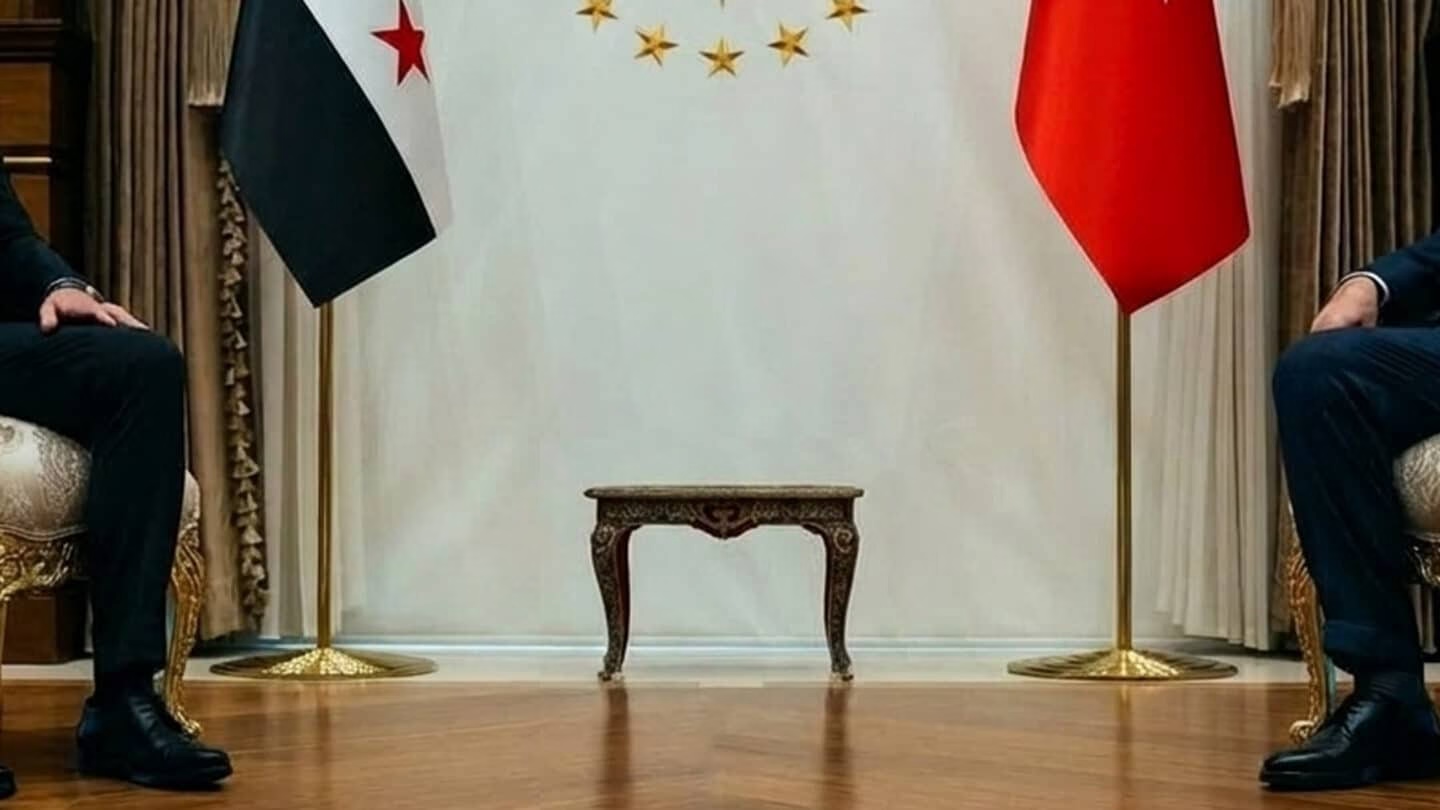
Turkish leaders saw Syrian President Ahmad al-Sharaa as central to these aims. A leader in Damascus able to consolidate state authority reduced Türkiye’s need for direct military intervention and let it pursue influence through trade, infrastructure, and the rehabilitation of Syria’s institutions. Al-Sharaa, in turn, needed Ankara to restart public services, rehabilitate transport networks, train and equip security and military institutions, and reconnect Syria to foreign markets. Türkiye’s proximity, resources, and long-established economic and security ties in Syria’s north made it an irreplaceable partner for Damascus.
And now that the Iran war has exposed the fragility upon which Gulf states built their wealth and global dependence on their oil exports, securing overland alternatives for Gulf energy and cargo has thus become a standing strategic priority, one that is quickly elevating Syria’s value in Türkiye’s regional calculations.
The Opportunity: Trade and Transit around Hormuz
The clearest expression of this realignment is the idea of Syria as an overland bridge between the Gulf and Europe. The vision, promoted by al-Sharaa under the banner of a revived “Four Seas” connectivity plan, would see Syria link the Gulf, Iraq, and Jordan to Türkiye and the Mediterranean by road, rail, and pipeline, offering exporters a route that bypasses both the Strait of Hormuz and the contested Red Sea.
A route that bypasses the Strait of Hormuz, however, also creates regional losers: Iran, for instance, sees its geostrategic leverage weakened, as does Russia, given the increased energy security the route would provide Europe.
Parts of it are already moving. Iraqi crude now travels overland to the Syrian coastal terminal at Banias for export from the Mediterranean, with Damascus and Baghdad having agreed earlier this year to move 500,000 tons of fuel per month along this route, allowing Syria to collect transit fees it badly needs. On rail, Türkiye, Saudi Arabia, and Jordan have announced plans to build a rail link through Syria that revives the old Hejaz line as a modern logistics corridor, a project Ankara sees as part of its Development Road and Middle Corridor plan to become a dominant transit route between Asia and Europe.
Many parties stand to benefit from such an arrangement: Gulf states gain a hedge against their current dependence on a single waterway for exports, Türkiye strengthens its claim as a fulcrum between East and West, and Syria gets to recast itself from a ruined country dependent on foreign aid into a transit hub essential to its regional neighbors. A route that bypasses the Strait of Hormuz, however, also creates regional losers: Iran, for instance, sees its geostrategic leverage weakened, as does Russia, given the increased energy security the route would provide Europe. Egypt also stands to lose transit fees from the Suez Canal. All three would thus have reason to want Syria’s hub project to fail.
The Obstacles: The Jazira and Israel
The dream of making Syria into the regional crossroads also faces other potential wake up calls. The first sits east of the Euphrates, in Syria’s Jazira region, which is the most potentially contentious area for the Turkish-Syrian partnership. Armed Kurdish groups and their associated governance structures have controlled the Jazira for more than a decade, and it holds a significant share of Syria’s oil, gas, and agricultural wealth, as well as acting as the land gateway to Iraq and the Gulf. The Syrian state is now gradually expanding its presence there as Damascus attempts a process of political, economic, and security reintegration, but the entrenched Kurdish administrative and security structures present a real obstacle. Damascus appears compelled to move gradually, deploying its forces in towns and government facilities, restoring symbolic sovereignty, integrating civil institutions, and leaving the military question for later stages.
Türkiye backs the state’s return to the Jazira as a way to dismantle Kurdish armed self-rule, but it is wary of any deal that re-legitimizes Kurdish military structures under a Syrian flag. Ankara treats the People’s Protection Units (YPG), the Kurdish core of the broader Syrian Democratic Forces (SDF), as an extension of the PKK, and wants to see it stripped of any semblance of an autonomous security role. The balance for al-Sharaa is delicate. He has to bring the Jazira under state control without triggering a Kurdish uprising, and satisfy Ankara without appearing to take its orders. If integration becomes an official formality that, in reality, leaves weapons and security decisions in Kurdish hands, friction with Türkiye will be inevitable.
Neither Damascus nor Ankara appears to want to turn Syria into a battleground with Israel. The Syrian government prioritises state-building, and Türkiye does not wish to lose its gains in Syria in a high-risk military confrontation.
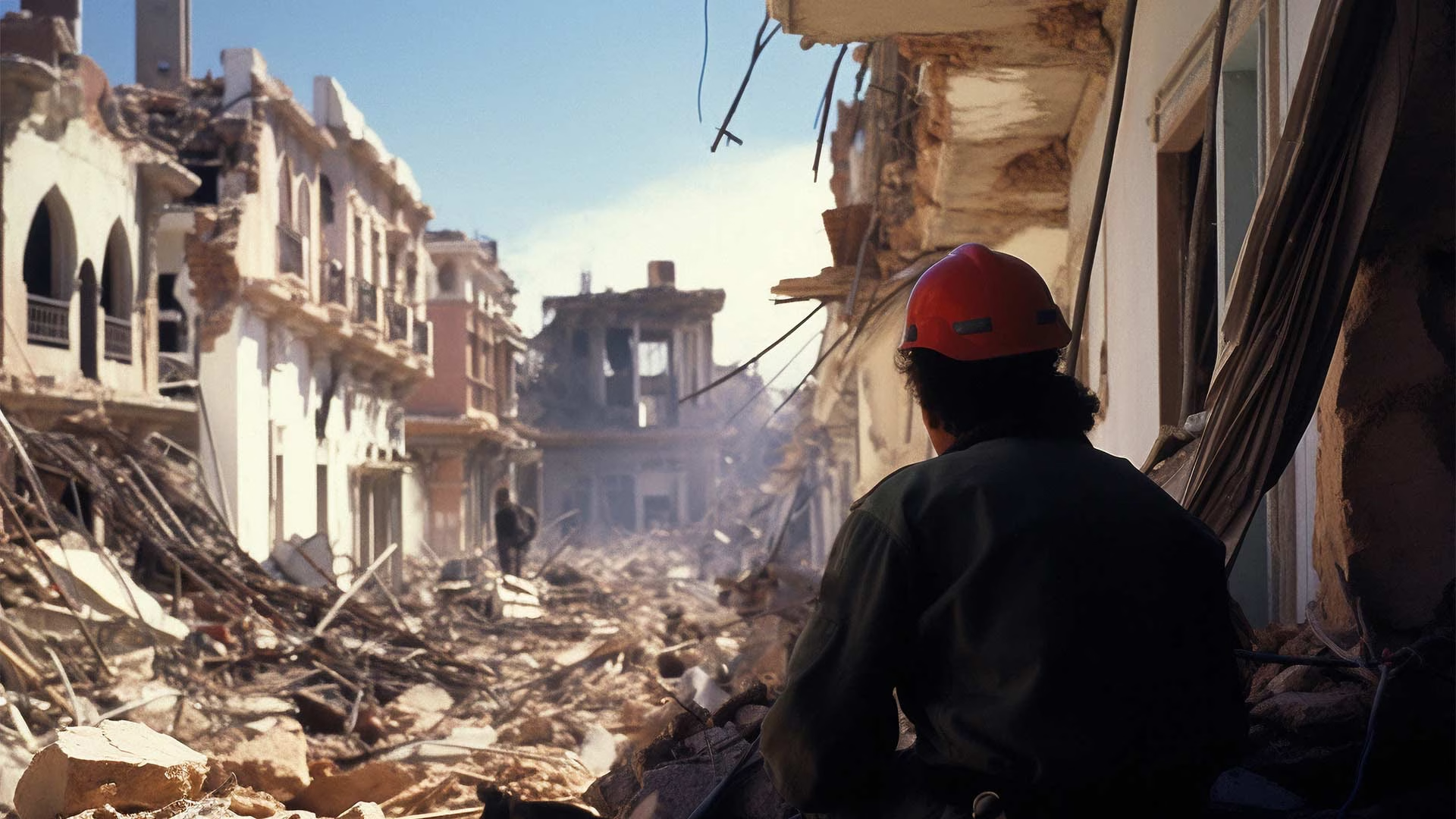
The second and more volatile obstacle is Israel. Where Türkiye wants a strong, unified Syrian state, Israel seems bent on the opposite. Almost immediately after al-Sharaa took power, the Israeli air force began destroying much of the military hardware the new government would have inherited, while Israeli ground forces seized swathes of territory along the Syrian border, areas which Israeli leaders today say they intend to hold indefinitely. Israel has since continued regular air strikes and raids inside Syria, and backed Druze factions resistant to central control that threaten to deepen the country’s fragmentation. Israel presents these actions as defending minorities and preventing threats along its border, but in practice, it has kept Syria’s militarily weak and geographically incongruous at a time when Damascus is trying to reconstitute the nation-state.
Neither Damascus nor Ankara appears to want to turn Syria into a battleground with Israel. The Syrian government prioritises state-building, and Türkiye does not wish to lose its gains in Syria in a high-risk military confrontation. The pragmatic approach they appear to have taken aims at containing the tension: stabilizing the Syrian state, preventing partition, rejecting a permanent Israeli sphere of influence, while leaving the door open to security arrangements that prevent escalation.
In this context, Türkiye is closely monitoring the Syrian–Israeli negotiation process. While it is unlikely to oppose any understanding that prevents war and restores stability, Ankara will almost certainly refuse to allow any Syrian-Israeli agreement becoming a pretext for sidelining Türkiye’s role, or imposing strategic restrictions on Damascus that would render Syria more akin to a buffer zone than an independent state.
The Accord: Syria’s Non-interference in Lebanon
Israel also appears intent on continuing its campaign against Hezbollah in Lebanon, regardless of the US pressure to comply with the ceasefire deal Washington inked with Iran, which includes Lebanon. Aiming to avoid a US-Israel split, various Western outlets have urged Damascus to take up the fight against Hezbollah instead, with US President Donald Trump also floating the idea that Syria might do the job Israel could not. Here, Ankara and Damascus are in clear agreement that Syria should not involve itself.
The notion that a Syrian army, whose heavy weapons Israel itself bombed into ruin, could succeed where Israel failed belongs to fantasy, and could be attempted only at the cost of a sectarian bloodbath that Syria would most likely lose anyway.
Indeed, the proposal that Syria march its army into Lebanon to disarm Hezbollah is not a serious one, however earnestly it is entertained in Washington. Israel, fielding one of the most capable militaries on earth, has been bombing and fighting Hezbollah since 2023 and has still not defeated it. The notion that a Syrian army, whose heavy weapons Israel itself bombed into ruin, could succeed where Israel failed belongs to fantasy, and could be attempted only at the cost of a sectarian bloodbath that Syria would most likely lose anyway. Damascus, still unable to reliably pay its own salaries or hold all of its own territory, has no reason to open a catastrophic third front for someone else’s benefit.
So al-Sharaa has declined, and Türkiye has rejected every attempt to push him toward it, with both nations framing their non-interventional stand as respect for Lebanese sovereignty. The reasons are, however, more a matter of interest than virtue: Damascus needs Gulf reconstruction money and sanctions relief, both of which a Lebanese adventure would put at risk; while the war-weary Syrian public has little appetite for a foreign campaign. Ankara needs Syria to stabilize, not bleed into a Lebanese quagmire.
The Future: Partner or Permanent Patron?
What is almost certain is that the Turkish-Syrian relationship will continue to deepen because of the re-pricing of Gulf energy risk, Syria’s geography, and Türkiye’s ambition to be the anchor for energy and trade between Asia and Europe. Particular projects may stall, the security situation may waver, and even in the best circumstances, the giant infrastructure projects proposed which are years from full operation may be cancelled, but the path for Syrian-Turkish integration is set.
The open question is whether Syria ends up sovereign enough to choose what that integration looks like. It could mature into a genuine partnership with Türkiye, in which Syria also diversifies its relations among the Gulf states and Europe and bargains as a sovereign nation, or its dependence could become entrenched, with a weak and indebted Damascus simply trading Iranian patronage under the Assad for Turkish tutelage under al-Sharaa.
Souhaib Jawhar is a Non-Resident Fellow at Badil | The Alternative Policy Institute
The views expressed in this article are solely those of the author and do not necessarily reflect the views of BADIL | The Alternative Policy Institute or its editorial team.