

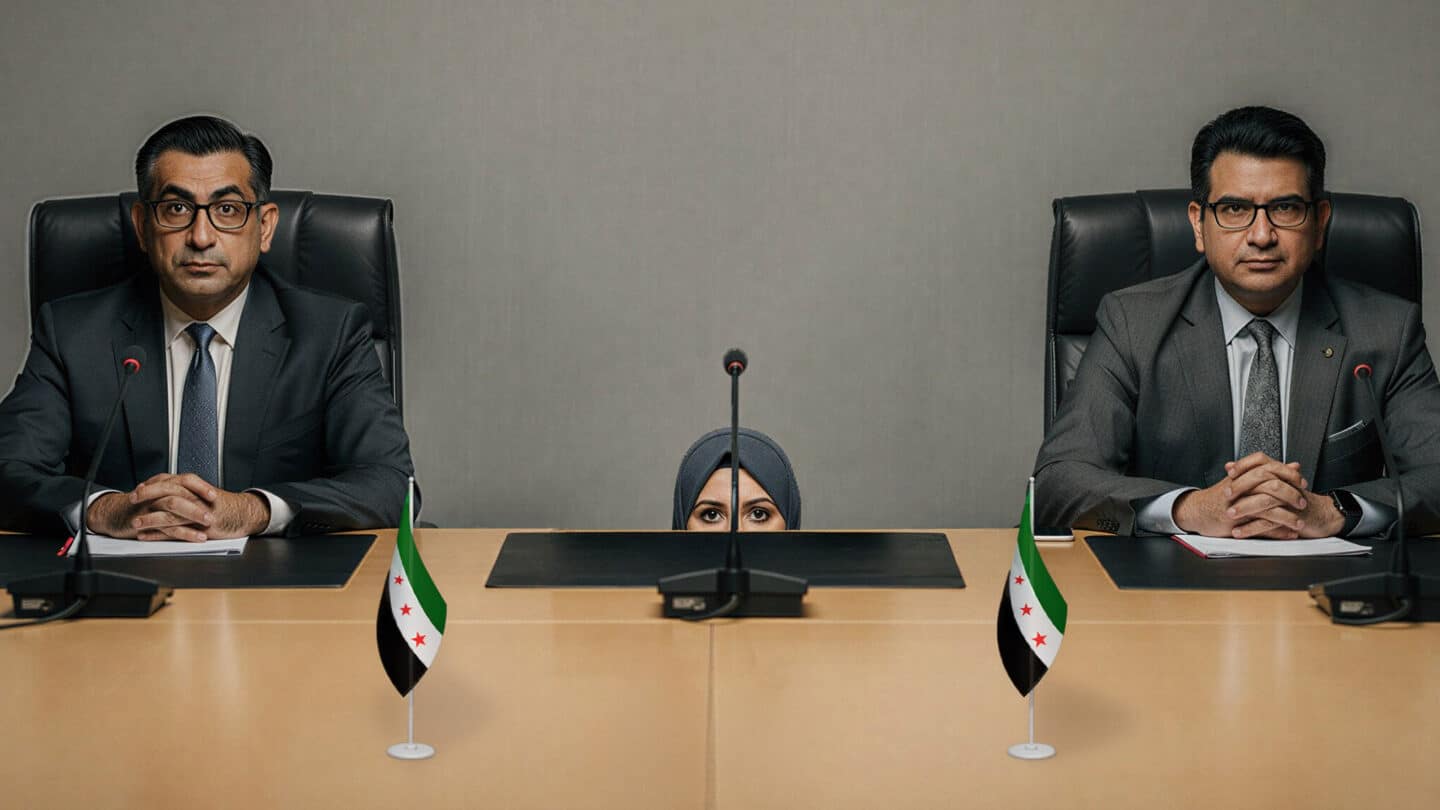
A year and a half into Syria’s post-Assad transition, it has become increasingly clear that roughly half the population — women — are being collectively pushed out of shaping the country’s future. This is not an oversight of a government overwhelmed by reconstruction. It is a pattern, sustained across official appointments, civil society licensing, electoral mechanics, and the daily texture of public life.
Many feminist activists, alongside their male counterparts, earned their stripes during the civil war years. Across humanitarian response, civic organizing, and community-based structures, women took on leadership roles at a scale the country had not seen before. The expectation, widely shared among the activists interviewed for this paper, was that this experience would translate into meaningful participation in a post-Assad order. That prospect is now being foreclosed.
What has taken shape in its place is not total exclusion. It is conditional, managed, and at moments openly decorative. Officially, women remain visible in meetings, advisory bodies, and public-facing roles, but with their ability to influence policy limited, while civic groups promoting women’s inclusion face increasing institutional hurdles. Unofficially, women face more explicit social pressure to conform to gender norms, limit themselves to family life, and are often exposed to threats or violence if they attempt to take on public roles.
In most of Syria, this ecosystem of exclusion is cloaked in an ambiguity the government can credibly deny. The government’s evasiveness on its approach to women was well captured by Syrian President Ahmed Al-Sharaa himself late last year: on December 6, during an interview at the Doha Forum, he told the crowd Syrian women were “empowered” under his rule. This, when just five days earlier, speaking to Syrian media, he had remarked that Syrian society was patriarchal and “not very keen” on having women in parliament.
This ambiguity is stripped away in regard to the government’s actions in Syria’s Kurdish northeast: as the central government has reasserted its authority here, it has shown its intent to dismantle mechanisms that had facilitated gender equity in local governance.
To better understand the dynamics shaping women’s inclusion in Syria’s transition, Badil spoke with 12 feminist activists, from northeast Syria, Damascus, Homs, Latakia, Idlib, and the diaspora, encompassing professors, grassroots organizers, and civil society and nonprofit workers. All spoke on condition of anonymity due to security concerns.
Feminist Activism from al-Assad to Civil War
Under more than five decades of Assad family rule, independent civil society in Syria was heavily restricted and often absorbed into state-controlled structures. Law No. 33 of 1975, for instance, monopolized civic engagement through state-affiliated unions, including the General Women’s Union, leaving little room for autonomous women’s organizing. The so-called “Damascus Spring” in the year 2000 briefly raised hopes for greater openness, with many organizations mobilizing and applying for licenses, but the respite was short-lived, with the authorities reimposing state domination over the space by the end of 2001. For civil society, the lesson was that independent organizing could only survive in limited, informal, or tolerated forms.