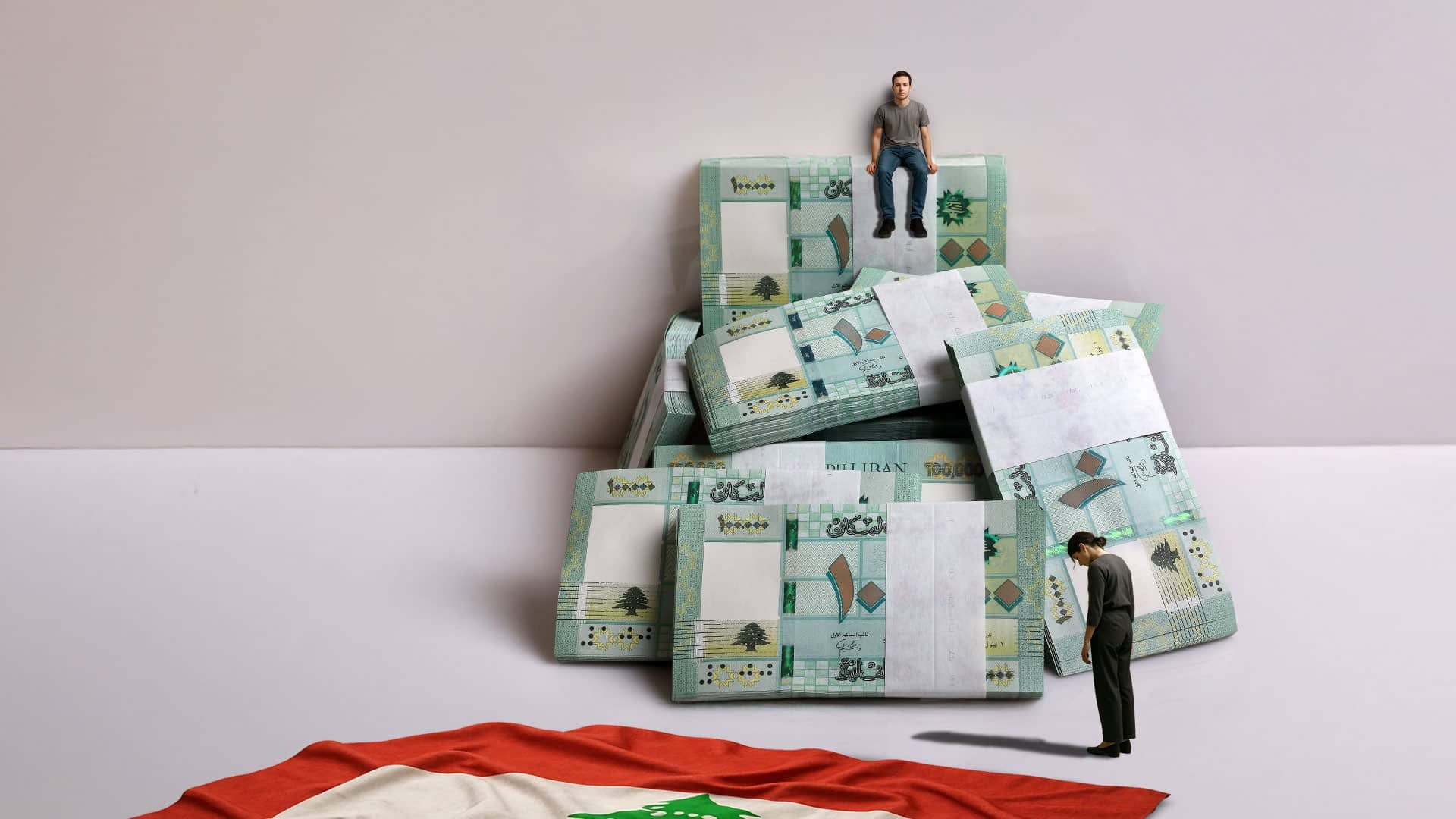


Lebanese women have endured economic marginalization for so long that their inequity with men is, for many, taken for granted, normalized to the point of being seen as part of the natural order. The reality, however, is that the barriers women face to exercising financial freedom are structured and deliberate – a fact made clear in a new study published by the global research firm Triangle, the parent organization of Badil.
Through a nationwide survey, the study reveals how interconnected social, legal, and institutional systems collectively undermine women’s ability to hold a job, own property. access credit, or otherwise exercise financial autonomy. While anecdotal evidence of individual women suffering financial harms is everywhere in society, Triangle has produced hard data documenting the pervasive systems of domineering power looming over Lebanese women as a whole – to such an extent that in many cases it is rightly classified as violence.
Unsurprising then, both men and women respondents reported that men wield the most financial decision-making capacity in households, such as whether to make large purchases or take on debt. Women’s decision-making power, however, varied significantly by marital status. Single or never-married women reported having the least influence of financial decisions, followed by married women, with divorced or widowed women reporting the most.
While the study highlighted how normalized economic violence has become, with 60 percent of respondents personally knowing a woman who has experienced financial abuse, it also showed that younger generations and women of all ages show greater openness to women’s economic agency, with older men remaining the least supportive.
Because economic dependence systematically limits women’s capacity to make decisions, meet their needs, and leave abusive environments, it inevitably traps them in unsafe situations.
Colloquially, “violence” has often been thought of in purely physical terms – the act of striking another. Today, however, there is widespread recognition that the term violence should also apply when economic harms are so severe as to deliberately or systematically control, constrain, and undermine a person’s life chances. Because economic dependence systematically limits women’s capacity to make decisions, meet their needs, and leave abusive environments, it inevitably traps them in unsafe situations. It harms their physical and mental health, limits access to education and healthcare, and can lock families into cycles of poverty that persist across generations.
In intimate relationships, economic violence does not always occur in isolation. It is frequently accompanied by physical, sexual, and psychological abuse, operating within a broader framework of coercive control rather than mere financial inequality. The term “economic gender-based violence” (EGBV) thereby encompasses the expansive economic means used to dominate women and enforce punitive gender norms and hierarchies.
EGBV Documents in Numbers
According to the study, when taken as whole groups, men are 2.1 times more likely than women to say they can generate an income, a disparity that exposes economic marginalization as a structural feature of society. Women also routinely reported being relegated to unpaid caregiving or engagement in informal, precarious work.
Access to education, and the accompanying increased likelihood of economic independence, thus appeared to be one of the strongest protective factors against a woman experiencing EGBV.
Although the study showed that education significantly increases women’s employment opportunities, at every level of education, men were seen to have substantially higher income prospects. The study also showed that young women’s prospects of earning income and developing financial autonomy increased more significantly with each higher level of education than those of men. Access to education, and the accompanying increased likelihood of economic independence, thus appeared to be one of the strongest protective factors against a woman experiencing EGBV. A countervailing finding was that many women reported that they are prohibited from pursuing higher education, particularly after marriage. As one woman describes it: “[I was studying to be a nurse] but I stopped [when I married at 17] …my husband refused to let me continue, and even my father supported him. He said, ‘a girl’s place is in her husband’s home.’”
Gendered financial dependence was compounded by women’s reported inability to keep stores of wealth. The study found that men are four times as likely as women to own movable assets, such as furniture, vehicles, or clothing. By contrast, women routinely reported that their valuables, usually jewelry, were seized by their husbands or male relatives when financial pressure arose. Women also reported being systematically excluded from owning land, homes, or other forms of property: among survey respondents, 39.4% of men reported being sole owners of land, whereas only 4.5% of women reported similarly. A primary contributor to this is Lebanon’s legal and religious frameworks that continue to prioritize men in inheritance.
Change will come from the bottom up, when survivors gain recognition, agency, and safe spaces to break their silence, mobilize, and counter patriarchal norms.
The future is thus not without hope, with younger generations’ shifting attitudes opening the door to change and increasing access to education a clear means of reaching that more equitable future. While Lebanon’s current legal framework is unlikely to recognize EGBV in the near term, the way forward is not blocked. Civil society organizations have already demonstrated that a robust network is ready to push for reform. Change will come from the bottom up, when survivors gain recognition, agency, and safe spaces to break their silence, mobilize, and counter patriarchal norms. The findings of this report remove any excuse for inaction. The evidence is national. The patterns are systemic. The responsibility to act is now collective and urgent.