
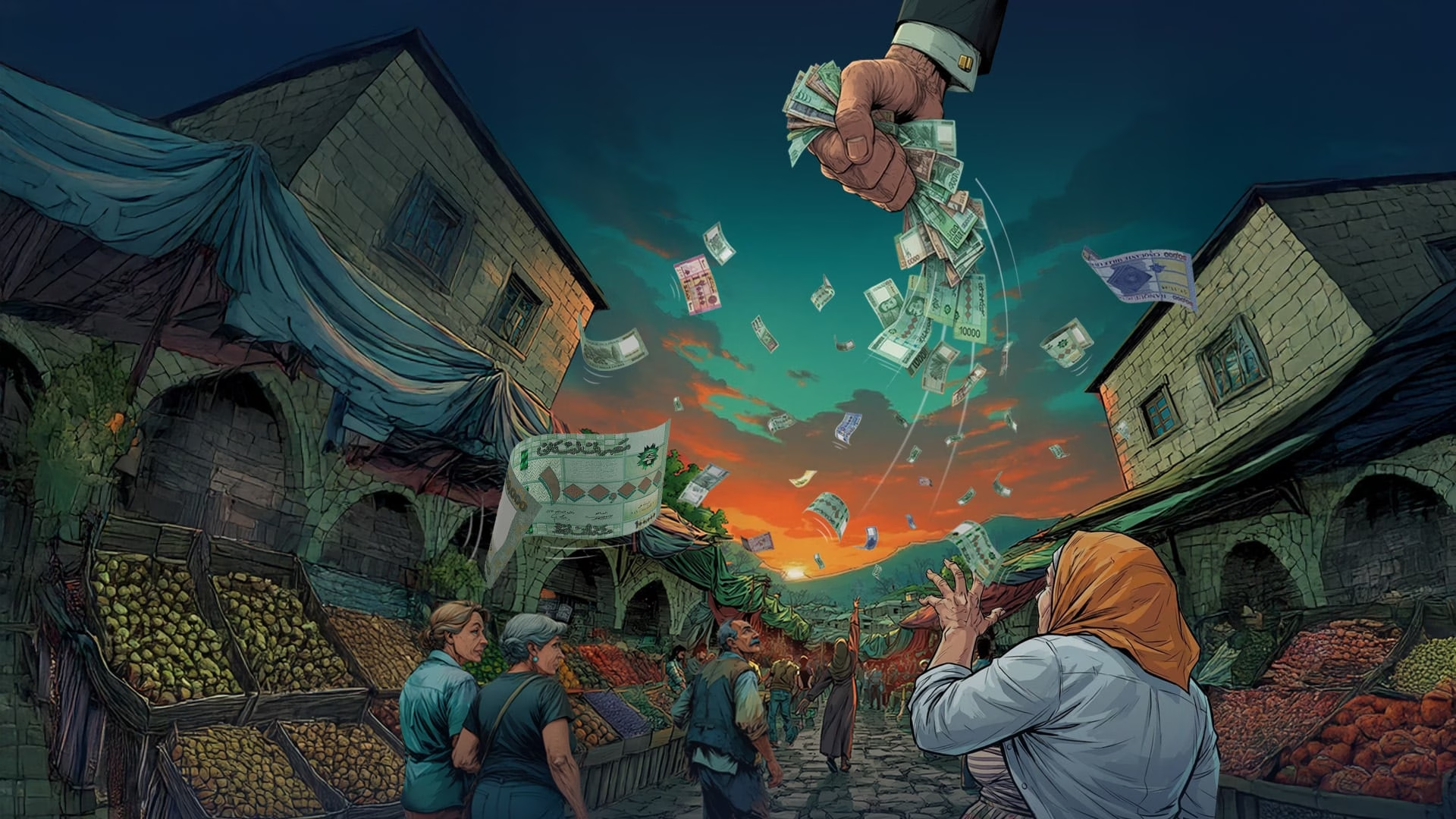


In Lebanon, crisis prices have a way of becoming permanent. Fuel spikes, war, displacement, and import shocks drive up food costs quickly. But when the pressure eases, prices rarely fall with the same speed — if they fall at all. As the country enters its third major food price shock in less than a decade, the machinery needed to discipline crisis profiteering remains performative, leaving households to pay prices that rise with every emergency and stay high long after.
The current crunch in global fuel supplies and mass population displacement in Lebanon has 1.24 million people facing crisis and emergency levels of food insecurity – nearly one in every four people in the country – according to a United Nations assessment in early June. This comes on the heels of Lebanon’s last war and mass population displacement in 2023-2024, which itself followed the continuous hyperinflation the country experienced from 2019-2023, with the nation’s financial collapse, the COVID-19 pandemic, the Beirut Port explosion, and the Russia-Ukraine war.
The ministry has one option with real teeth, referring cases to the Financial Public Prosecutor, but given the few cases it can handle, the ministry’s effective enforcement capacity is limited to just one tooth.
Through all of these crises, there were legitimate inflationary pressures. However, another factor is also at play: firms that control chokepoints in the country’s supply chains, the importers and distributors of essential goods, who turn national emergencies into money-making opportunities, tacking on an extra margin for themselves as costs rise, and lowering prices slowly, if at all, once the inflationary pressure eases.
The Lebanese government knows this happens: Economy and Trade Minister Amer Bisat, the government official ultimately overseeing consumer prices, recently said the regional crisis could reasonably justify price increases of around 10%, but that the increases moving through the Lebanese market today plainly exceed this. He called the situation a mix of war economy, monopoly and hoarding. Agriculture Minister Nizar Hani has pointed to a similar gap between the price a farmer is paid and the price on the shelf, calling it a flaw in the supply chain and the way goods are priced. Inspectors working in Bisat’s ministry even caught three large meat traders in the act in late February, holding back stock and raising prices unjustifiably, but this drop in the ocean has done little to hold back the waves of market abuse.
The body designed to fix all of this, the National Competition Authority, received its legal mandate in 2022 but has sat unformed for four years, mostly because the political class that would assemble it is the same class that trades in the goods it would police.
On paper, Lebanon has the tools to remedy this situation. The Ministry of Economy and Trade tracks the supply chain, notes abnormal price movements, and dispatches inspectors who file hundreds of violation reports. Where it fails is in everything that follows: the official price margins for judging violations are useless, given that they are more than half a century old, and so ministry officials use ad hoc criteria that are never made public, thereby failing basic transparency and integrity requirements. The cases that survive this opacity then enter a years-long judicial process, during which an offender can keep breaking the law unbothered. The maximum fine that might eventually be imposed is then minuscule, since the penalties have not been updated since the currency collapsed, thus the deterrent effect has evaporated. The ministry has one option with real teeth, referring cases to the Financial Public Prosecutor, but given the few cases it can handle, the ministry’s effective enforcement capacity is limited to just one tooth.
The body designed to fix all of this, the National Competition Authority, received its legal mandate in 2022 but has sat unformed for four years, mostly because the political class that would assemble it is the same class that trades in the goods it would police. What remains is a system dressed in the costume of price regulation that, in reality, shields those profiteering from crises.
The Price Shock
Prices normally climb each year during Ramadan, as households buy more and demand rises, and it’s a trend Lebanon’s Ministry of Economy and Trade tracks each year with its Fattoush Index, which follows the cost of the components of this traditional salad. The 2026 holy month, running from mid-February to mid-March, began with that familiar cost curve.
The real price shock came at the end of February, when the United States and Israel opened up a war on Iran. Tehran responded by closing the Strait of Hormuz to cargo and fuel shipments, throttling global hydrocarbon supplies and causing the global benchmark of Brent crude to rise from $71 per barrel in February to $120 in April. For Lebanon, which imports roughly 80% of what it eats and runs its trucks, generators and water pumps on imported fuel, the increased fuel costs rippled through the economy almost immediately: domestic diesel rose 61% between February and May, gasoline 39%, and private generator fees an average of 53%, based on BADIL calculations. Notably, while global Brent prices had retreated to $107.5 by May, fuel and generator prices in Lebanon remained elevated into June.
The armed conflict with Israel at the beginning of March has also lead to the displacement of more than one million people in South Lebanon. This includes some 78% of southern farmers, with domestic citrus, olive, and banana crops heavily affected, and almost two million livestock and poultry animals lost by early May.
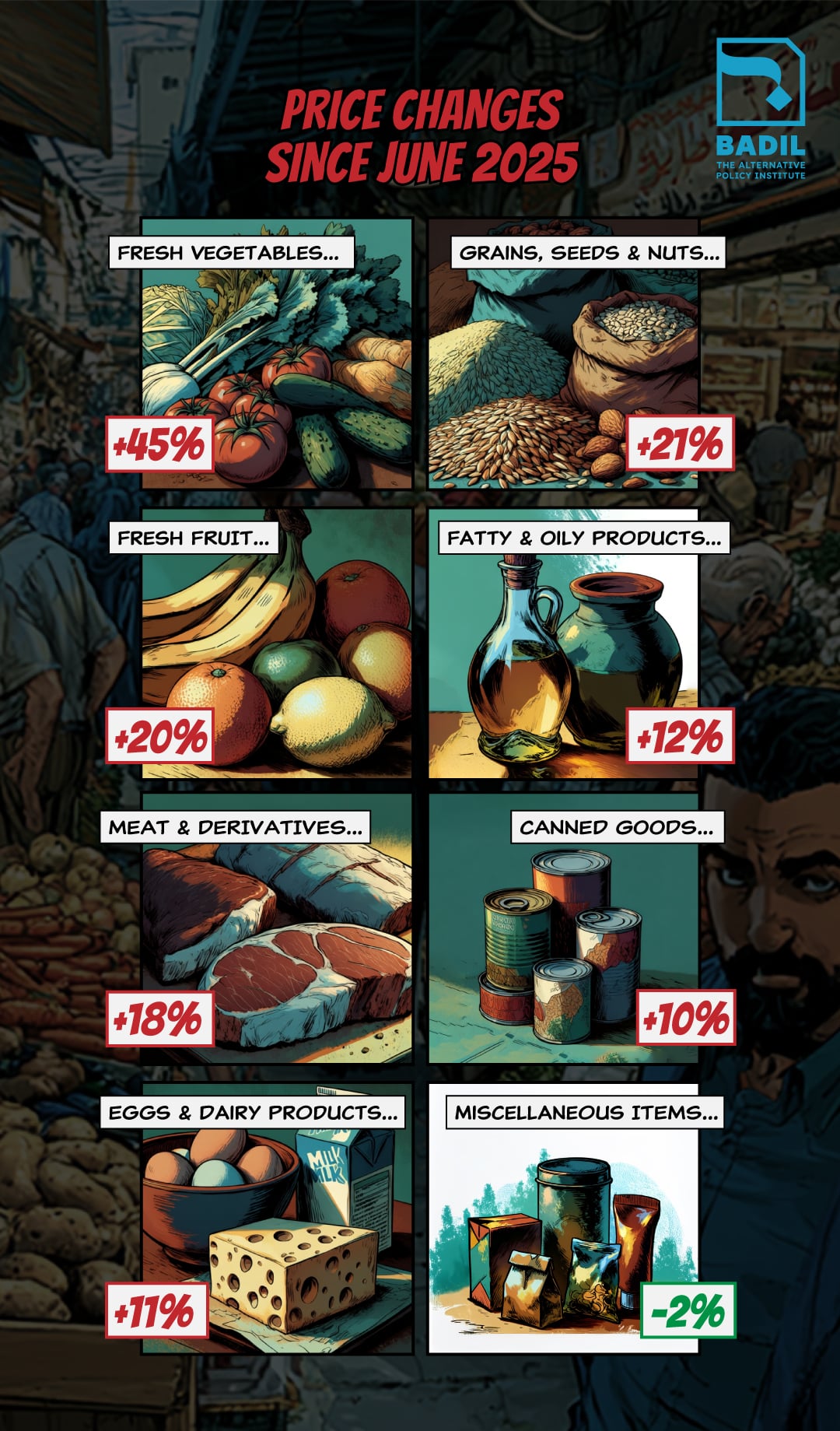
Cumulatively, the external and internal price shocks helped double Lebanon’s inflation rate between January and April, from 10.9% to 20%. By June, the food categories showing the highest inflation year-on-year were fresh vegetables (45%), fruits (20%), grains, seeds and nuts (21%), and meat and poultry (18%).
Layers of Laws
Lebanon began building the legal foundations of its consumer price regulations half a century ago. Decision 277/1 of 1972, later amended by Decision 173 of 1977, caps the profit margin at each stage of the supply chain for each category of product covered by the decisions. The power to intervene more forcefully came with Decree Law No. 73 of 1983, which allows the minister to set maximum prices and profit rates, requires traders to declare their stock, and, where no ceiling is set, forbids selling any good for more than twice its cost. Its sixteenth article makes an abnormal or unjustified increase an offense in itself, and the decree defines monopoly, hoarding and the concealment of goods as violations. In 1996, the maximum fine for violations was set at LL100 million, roughly $66,000 at that time, and prison terms of a few days to three months.
The Consumer Protection Law 659 of 2005 established the Consumer Protection Directorate (CPD) and directed the state’s attention to a product’s place on the shelf, regulating price displays, labeling, misleading advertising, complaints, and inspection reports. It was made to protect the shopper, not to police the supply chain, which is why judging margins still falls back on the older texts.
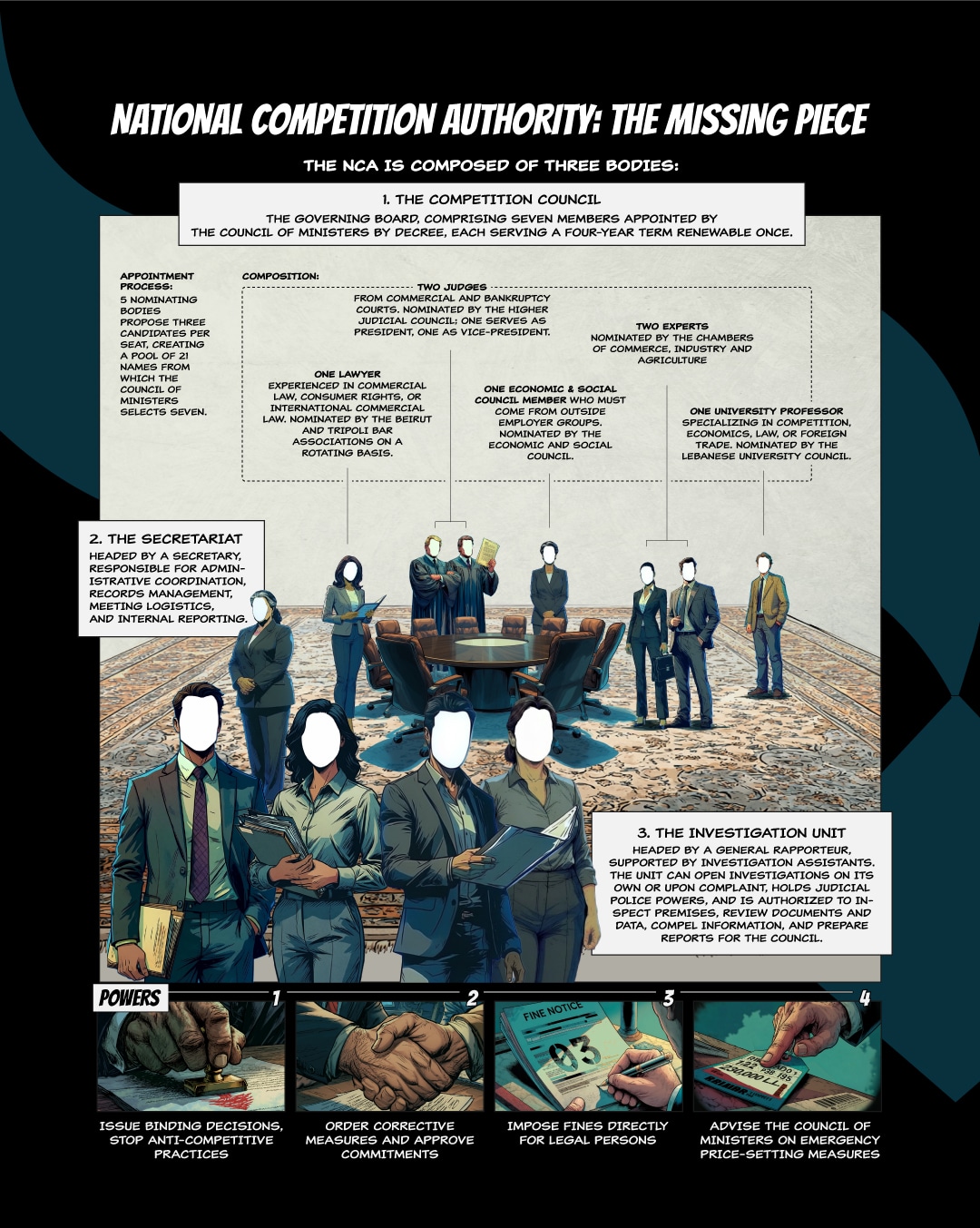
The newest addition, the 2022 competition law, Law 281, was meant to supply what the others lacked: a way to act on market power itself. It bans cartels and the abuse of dominance, and it creates a National Competition Authority (NCA) with a seven-member council, an investigation unit with powers equivalent to judicial police, and the ability to fine individual offenders 100% of their revenue from the product, and fine firms up to 10% of their entire business volume from the previous year, and force businesses to close for up to three months. The law even allows the cabinet to set temporary prices in an emergency, though only after the authority has given its opinion. In the four years since the 2022 competition law, however, the NCA remains yet to be established.
Where the Wheels Come Off
The legal apparatus to guide state regulation of consumer prices is supported by a reasonably effective monitoring mechanism. The Director General of the Ministry of Economy and Trade, Mohammed Abou Haidar, described to BADIL a system that keeps tabs on the whole supply chain, as well as “looking at how much prices had actually risen abroad, so we could see how much profit [importers] were adding.” The ministry notes abnormal price movements and sends inspectors after them. Since the start of the war, the Consumer Protection Directorate has carried out 5,708 inspection visits and filed 256 violation reports.
The weakness is in the standards that inspectors use in their reports. Officially, these margins’ thresholds have not been updated since the 1970s and no longer apply to the modern economy. Inspectors thus use them with “a margin of leniency adopted within defined limits,” as CPD head Tarek Younes described it to BADIL. Put differently, the ministry has developed its own ad hoc in-house standards for assessing consumer price margins. Where a product’s cost cannot be fully reconstructed, the case rests on the looser test of a so-called “abnormal increase”. In either case, the public never sees the considerations behind a judgment, as the ministry has never published the current cost methods and margin criteria by which prices are assessed, and has let lapse its previous price indicators. Without those, no outside verification of a violation report is possible, whether by shoppers or journalists.
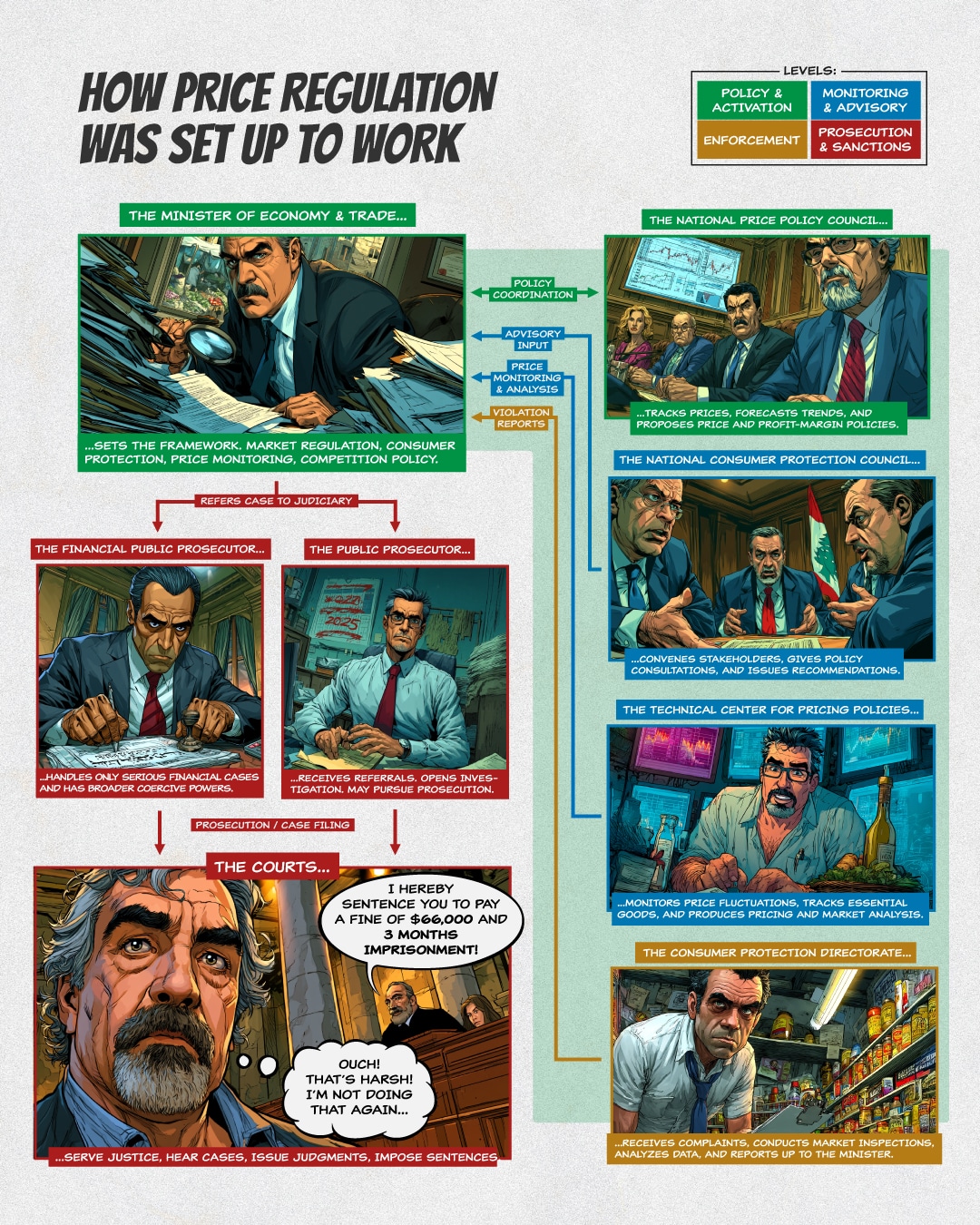
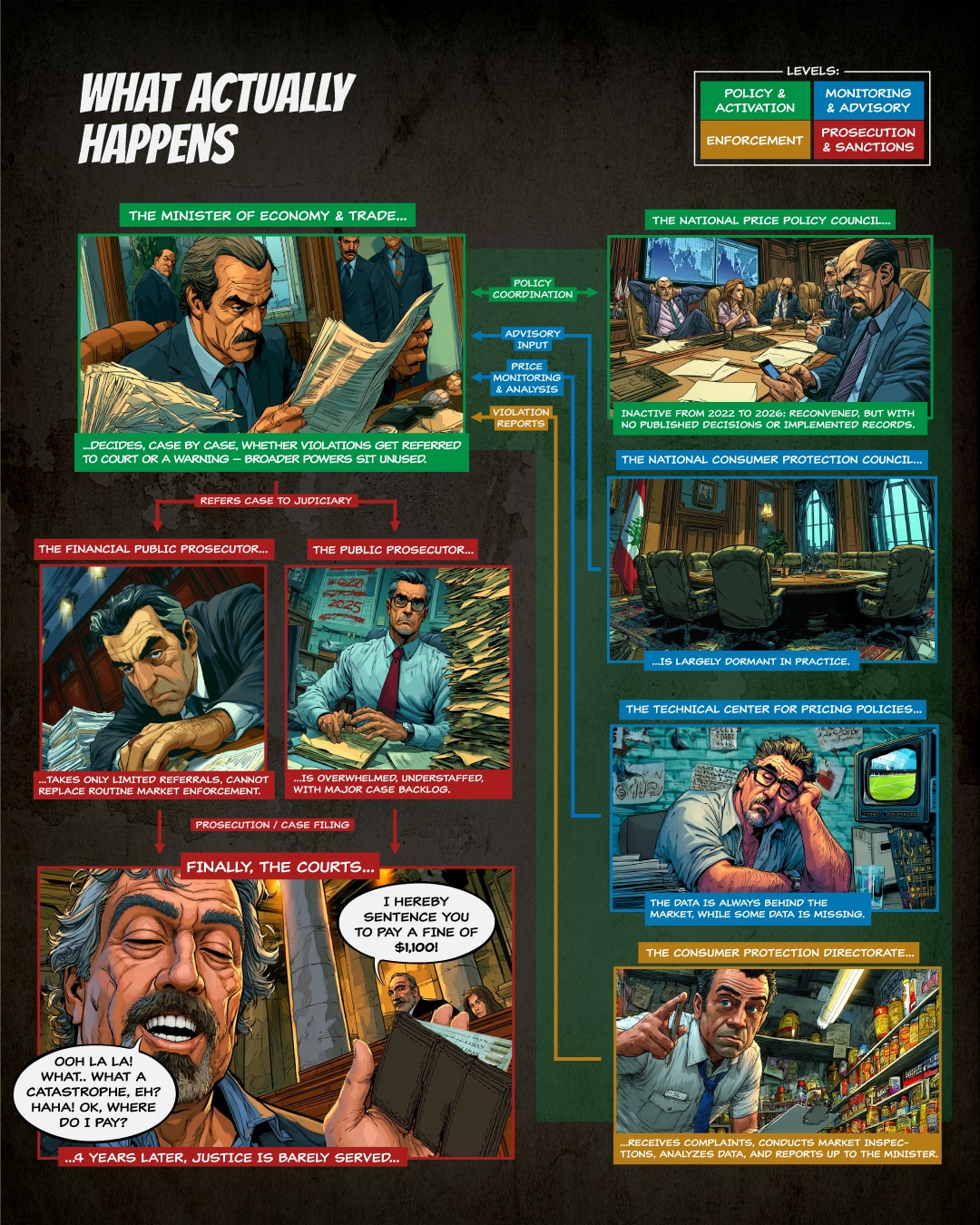
Alongside the CPD, there is the National Consumer Protection Council (NCPC), the inter-ministerial National Price Policy Council (NPPC), and the Technical Centre for Pricing Policies (TCPP). The NCPC acts as an advisory body, the NPPC coordinates policies among ministries, and the TCPP monitors market prices and publishes reports. (See Graphic).
As the economist and journalist Ali Noureddine told BADIL, it is a difficult task to parse between when a business is merely passing on higher fuel and shipping costs and when price increases result from, in his words, “monopolistic practices, abuse, or exploitation of the crisis.” This is where published standards and a working competition authority would help immensely in establishing the credibility and integrity of the process.
Once a report reaches the courts, Younes explains, “the issuance of a judgment takes approximately four years,” a delay that “allows offenders to continue disregarding the law.”
When determinations are made against a business, the report is sent to the Minister of Economy and Trade, who by law may take one of two roads: He can send it back for a warning, which asks the trader to comply, or he can refer it to the judiciary. However, once a report reaches the courts, Younes explains, “the issuance of a judgment takes approximately four years,” a delay that “allows offenders to continue disregarding the law.”
Once those four years are up, even if the accused is found guilty, the penalty is essentially too small to matter. The maximum fine, LL100 million, was worth roughly $66,000 at the exchange rate just before the 2019 financial collapse (LL1,507 = US$1). Following Lebanon’s currency collapse, that fine now equals just over $1,100. As economist Mounir Younes told BADIL, “even when oversight does exist, the fines are very low.” Put differently, if the cost of breaking a law is smaller than the profit from doing so, a guilty ruling acts more as a licensing fee than a deterrent.
A somewhat more expedited option the economy minister has is to refer a file to the Financial Public Prosecutor (FPP), whose powers include detaining suspects and sealing their premises. Indeed, in April, Minister Bisat sent the FPP a file naming importers, distributors and generator owners. But this is a temporary measure, an exception to the rule, as “you cannot flood the Financial Prosecutor’s office with cases that the Ministry of Economy and Trade is supposed to be handling continuously across the whole market,” according to Noureddine. As such, FPP referrals are a stopgap measure in the current crisis and cannot replace the longer-term institutional solution of forming and operationalizing the National Competition Authority, which would have the full legal mandate and powers to deal with anti-competitive practices and market manipulation on a continuous basis.
The Path to Price Governance
On paper, the National Competition Authority is straightforward to assemble. The law requires a council of seven, two of whom are judges, put forward by the body that oversees Lebanon’s courts, with the rest drawn from economic, legal and academic fields. Four years after the NCA was mandated, its formation remains stalled.
Zouhair Berro, president of the advocacy group Consumers Lebanon, says the resistance to forming the NCA lies in the structure of Lebanese power, noting that “most of the political class and their relatives work in trade” and would thereby be subject to the authority. The competition law similarly appears to cater to this segment, treating a firm as dominant only once it holds 35% of a market which, in a market as small as Lebanon’s, effectively shields cartel-like behavior by letting a handful of businesses split a sector without any one of them crossing a legal threshold.
Standing up the NCA would, however, only be the first step in creating effective oversight capacity. The National Anti-Corruption Commission, for instance, was appointed in January 2022, but has been rendered ineffective by a lack of funding and resources.
A system that can discipline abusive pricing and protect consumers is also a system that can attract investment, because it signals predictable rules rather than discretionary extraction.
Establishing and properly supporting the NCA would give Lebanon a body mandated to go after anti-competitive agreements, price-fixing, market-sharing, abuse of dominance, economic concentration, and any other coordination that restricts competition. The NCA would help relieve the backlog of cases facing the judiciary, and would also provide the Council of Ministers an avenue to use emergency pricing powers during a crisis, given that the legal prerequisite for such powers is that the authority first issues an advisory opinion.
The second task is for the parliament to make the legal penalties meaningful deterrents again. Fines tied to inflation, a firm’s turnover, or the size of the violation would turn enforcement from a fee back into a threat.
The third task, transparency, is the cheapest and quickest, since the state already reconstructs costs and margins and needs only to make the method public. Publishing the cost methodology, reviving the price indicators the ministry has left idle, and setting out the margin criteria would allow third parties to see for themselves where a price has far exceeded its costs.
Building credible price governance is a political choice, not a technical problem, and it sits at the heart of post-2019 recovery. Doing so would signal a break from the lawlessness and predatory market behavior that helped drive the country into financial collapse. A system that can discipline abusive pricing and protect consumers is also a system that can attract investment, because it signals predictable rules rather than discretionary extraction. Such as system would build domestic credibility for the state, not as a slogan, but as an institution that is present and willing to intervene when markets are manipulated against its citizens. Breaking oligopoly dynamics and confronting cartels would be more than an economic reform. It would be a signal that the state has returned.