Disarm for Dollars: Trump’s ‘Cash-for-Peace’ Deal May Leave Ordinary Lebanese out in the Street

US ties aid for Lebanon to a demilitarized Hezbollah and detente with Israel, kicking financial reforms to the curb

Washington is once again dangling financial incentives in front of Lebanon to disarm Hezbollah and make peace with Israel. This week, for the first time in more than three decades, Lebanon and Israel held official talks, with the US ambassadors of both countries sitting down in Washington under the auspices of Secretary of State Marco Rubio. Following the meeting, the State Department said it hopes the follow-on negotiations will go beyond the scope of the 2024 ceasefire and unlock “reconstruction assistance and economic recovery for Lebanon.”

Amid a 10-day ceasefire meant to curb Hezbollah rocket fire and Israel’s ongoing invasion and reoccupation of South Lebanon, Washington is, at the same time, packaging a future peace deal through the lens of economic recovery, ostensibly as a reward for the Lebanese government to “restore the monopoly of force and to end Iran’s overbearing influence,” according to the State Department. The question, however, is what kind of “recovery” the Trump administration has in mind, whether it will meet the basic needs of everyday Lebanese citizens, or if instead it will exacerbate the state failures that allowed Hezbollah to build its parallel military, financial, and institutional ecosystems.


From Reform to Compliance

Lebanon has yet to recover from its 2019 financial collapse, which the World Bank called among the worst in modern history. Until last year, the deal on offer from the international community was relatively straightforward: reform for bailout. If Lebanon restructured its banking sector, allocated losses transparently, and met International Monetary Fund (IMF) conditions, agreed at staff level in April 2022, international financial assistance would follow. The IMF’s conditions were imperfect, but they shared a common theme: the institutions that caused the crisis would bear a meaningful share of its costs.

How the current negotiations handle economic issues will almost certainly reflect the extent to which Lebanon’s commercial banking sector is held accountable for financial collapse it caused, but also what happens to the hundreds of thousands of Lebanese who are depend on Hezbollah’s financial services.

Since President Donald Trump took office last year, among the few consistent policy orientations coming out of the White House has been a disdain for multilateral institutions, including the IMF. This seemed to be reflected in statements by Trump’s Deputy Special Envoy for the Middle East, Morgan Ortagus, when she questioned the necessity of an IMF role in Lebanon’s financial recovery last year. At a May 2025 event in Doha, she said the Fund is “not the only solution” for Lebanon and that she had “an ambitious plan and vision in which Lebanon could even do without the IMF.” Instead, Ortagus – who now cohorts openly as the partner of billionaire Lebanese banker Antoun Sehnaoui – suggested US and Gulf capital could bankroll Lebanon’s recovery in an arrangement in which Hezbollah’s disarmament would open the door to economic progress, creating what she called “a nation conducive to investments.”

Tuesday’s State Department announcement similarly placed Washington as the overarching authority prodding the Lebanon-Israel talks toward a peace agreement, with no mention of any prospective multilateral role. This is consistent with the Trump administration’s established preference for bilateral foreign relations, in which the US is freer to leverage its financial and military heft to impose its preferred terms. Any such US terms for a Lebanese bailout, however, seem to differ from those of the IMF, with Washington’s primary concern being Hezbollah’s disarmament rather than financial sector reforms. The difference matters enormously for ordinary Lebanese. How the current negotiations handle economic issues will almost certainly reflect the extent to which Lebanon’s commercial banking sector is held accountable for financial collapse it caused, but also what happens to the hundreds of thousands of Lebanese who are depend on Hezbollah’s financial services.


Parallel Finance Amid State Failure

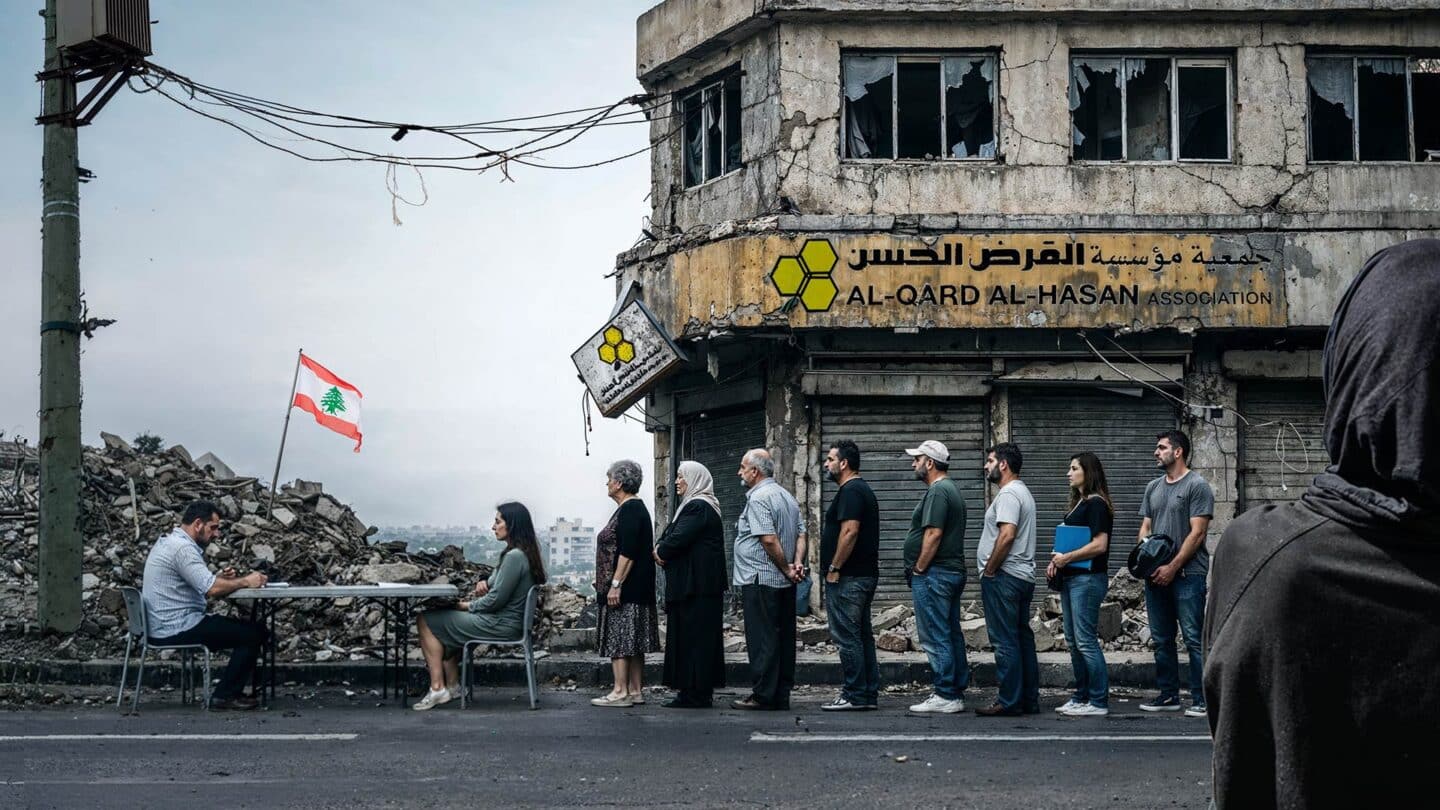
Hezbollah did not assume its military role by chance, but rather grew out of an environment of institutional failure during the 1975-1990 Lebanese civil war, when the state was unable to provide security or force Israel to withdraw its forces from South Lebanon. Similarly, the party’s financial and social security networks arose from the state’s failure to provide these services and protections to the Shia community, with Al-Qard Al-Hassan (AQAH) a primary example of how parallel, informal institutions fill the gap.

When the financial crisis erupted in late 2019, commercial banks locked people out of their savings. AQAH continued to provide access to loans and withdrawals.

Established in the 1980s in the wreckage of Israel’s invasion during the Lebanese Civil War, AQAH is institutionally rooted in the Islamic principle of qard hasan (the benevolent loan), offering interest-free microcredit and basic banking services to a mostly Shia customer base, building both a social safety net and a durable base of political loyalty for Hezbollah. Officially licensed as a nonprofit by the Ministry of Interior in 1987, it operates entirely outside the regulatory authority of Banque du Liban, Lebanon’s central bank. The US Treasury accuses AQAH of facilitating Hezbollah’s financial activities, with Washington beginning sanctions against the organization in 2007. None of this stopped the institution from growing, with annual lending rising from roughly $75 million in 2007 to $500 million in 2019. Estimates range, but AQAH is said to have supported 1.9 million people since its inception, with an active user base of some 300,000 clients.

When the financial crisis erupted in late 2019, commercial banks imposed informal capital controls overnight, locking out ordinary depositors from their hard-currency savings while the well-connected elite were able to transfer billions of dollars out of the country. AQAH, however, continued to disburse US dollar loans and process account withdrawals. This led to a surge in business, with AQAH’s senior management asserting that the organization doubled its customer base in the first year of the financial crisis.

During the previous round of fighting between Hezbollah and Israel in 2023-24, Israel began treating AQAH as a military target, and since the conflict’s resumption on March 2 this year, it has been doing so again, striking most, if not all, of the organization’s 30 branches. Both Amnesty International and Human Rights Watch have argued that the strikes constitute war crimes.

As Mohammad Fheili, a risk strategist and political economist at the American University of Beirut, recently told Money Laundering Bulletin, the Israelis “have disrupted operational continuity, but they have not in any shape or form destroyed AQAH. The pressure has created a need to move from visible branches to more fragmented mechanisms, and they’ve started doing that.”


The Compromised Alternative

The pressure on AQAH is not coming from Israel and Washington alone. The Lebanese state has joined the campaign, though more as a compliance measure under US pressure than a sovereign strategy. Banque du Liban’s Circular 170, issued in July 2025, prohibits regulated institutions from transacting with unlicensed or sanctioned entities, and explicitly names AQAH. At the same time, neither the state nor the BDL has ever taken the time to build a pro-poor microfinance sector, nor even a sector-wide regulatory architecture for all microfinance institutions (MFIs) as a distinct supervised class. This has opened the door for informal actors such as AQAH, but also those such as Emkan Finance, which once operated as an MFI under BankMed – owned by the Hariri family, political opponents of Hezbollah – as an ostensible counterweight to AQAH.

These moves against AQAH thus beg the question: where are the institutions’ customers – indeed, any normal Lebanese citizen – supposed to turn for financial services? For all AQAH’s ills as an arm of Hezbollah, its services fulfill an essential socioeconomic role for hundreds of thousands of people.

In the highly unlikely world where Lebanon succeeds in disarming Hezbollah in exchange for a US-backed financial bailout, and AQAH is snuffed out of existence, many Lebanese would be forced out of a functioning, if politically compromised, financial refuge and back into the hands of predatory banks now shielded by a geopolitical arrangement that allows them to skirt a domestic accountability process.

What is more likely, regardless of how the talks in Washington or the war in South Lebanon play out, is further financial market bifurcation: AQAH and similarly unregulated financial actors will adapt, entrench, and facilitate a growing informal economy, which the World Bank said made up nearly half of all economic activity in Lebanon by 2022. This would not be due to any inherent criminality, but rather to the lack of a credible formal system to turn to.
For many Lebanese, the return to Hezbollah’s parallel financial system would not be a matter of loyalty, but of necessity.

Yet even as Prime Minister Nawaf Salam insists that South Lebanon “will not be abandoned again,” the current trajectory suggests otherwise. The imposition of sovereignty, absent credible financial reform, risks repeating the very neglect that allowed parallel systems like AQAH to emerge in the first place. One cannot expect the hundreds of thousands of Lebanese who relied on AQAH to return to a banking sector that has evaded all accountability since 2019. In practice, this leaves them without access to lawful, functional, and trusted financial services, even as Washington ties reconstruction and recovery to disarmament. For many, the choice will not be ideological but structural: a return to Hezbollah’s parallel financial system—not out of loyalty, but out of necessity—thereby reinforcing the very social base the state claims it seeks to replace.

Related