
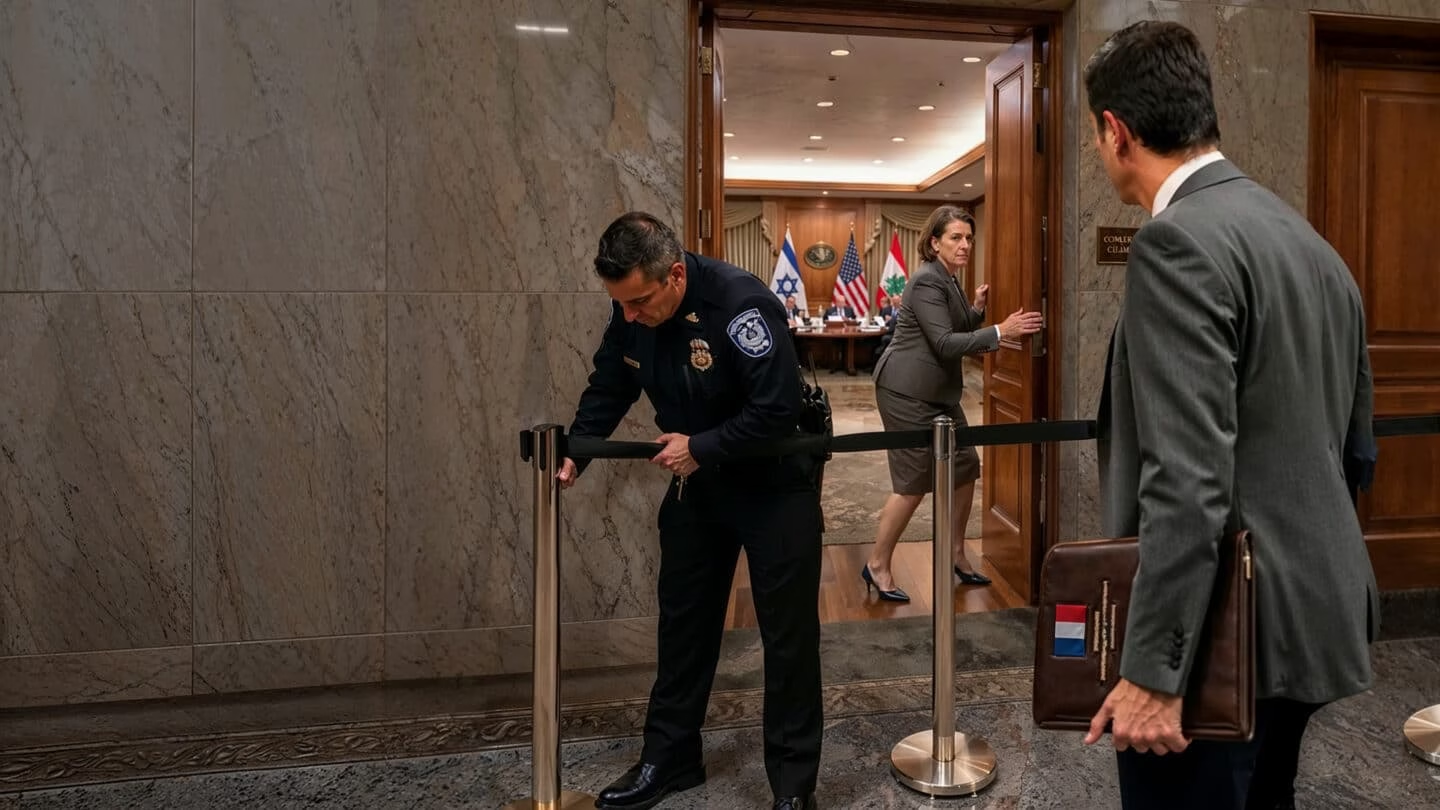

On July 14th, Lebanese and Israeli delegations reconvened in Rome under US mediation to begin implementing the framework agreement they had signed in Washington the previous month. France, usually a key ceasefire negotiator and diplomatic actor in Lebanon, was absent. That absence was deliberate: two months earlier, Israel’s ambassador to the United States, Yechiel Leiter, said his government intended to “keep the French as far away as possible from pretty much everything, but particularly when it comes to peace negotiations.” That exclusion was striking because, less than two years earlier, France had helped broker the November 2024 cessation of hostilities and secured a seat on the mechanism created to monitor it.
Successive French governments have sought to preserve influence in its former colony by embedding France in the institutions, diplomatic mechanisms, and security arrangements surrounding Lebanon.
Fighting to Stay at the Table
France’s absence from the negotiating table is especially significant because Paris had spent decades trying to prevent precisely this kind of marginalisation. Since Lebanon’s independence in 1943, successive French governments have sought to preserve influence in its former colony by embedding France in the institutions, diplomatic mechanisms, and security arrangements surrounding Lebanon.
That strategy rested on what former French diplomat Denis Bauchard described to BADIL as a “constant political orientation” towards maintaining a privileged relationship. Long associated with protecting Lebanon’s Christian communities, French policy broadened markedly under French President Jacques Chirac, whose close relationship with Lebanese Prime Minister Rafik Hariri, a Sunni, helped reorient Paris towards the political system as a whole. France also cultivated working contacts with the Shia political sphere. Chirac shook hands with former Hezbollah Secretary General Hassan Nasrallah, while several French ambassadors met with him over the years. In the same spirit, French President Emmanuel Macron, on one of his post-2020 visits, made a point of meeting Mohammad Raad, the head of Hezbollah’s parliamentary bloc. As Bauchard put it, “There has always been a close relationship between the French ambassador and the ‘three presidents,’” the Maronite presidency, the Sunni premiership, and the Shia speaker of Parliament, among which power is divided.
France’s role was especially visible in 1996, during Israel’s “Grapes of Wrath” offensive during its previous occupation of South Lebanon. Paris later played a central role in the diplomacy ending the 2006 war with Israel, codified in UN Security Council Resolution 1701, which, among other things, called for the Lebanese Armed Forces to be deployed to the south and strengthened the United Nations Interim Force in Lebanon along the border.
The CEDRE conference France hosted in 2018 tied $11 billion in pledges to reforms Beirut never made. France’s influence also entrenched itself into strategic sectors of the Lebanese economy. A consortium led by French multinational TotalEnergies won Lebanon’s first offshore exploration blocks in 2018 while CMA CGM, the shipping giant built by the Franco-Lebanese Saadé family, went on to acquire the Tripoli container terminal in 2021 and the Beirut port facility in 2022. Its chief executive, Rodolphe Saadé, developed an unusually close relationship with Macron, while the company increasingly functioned as a strategic asset of the French state.
After the 2020 Beirut port explosion, Macron travelled to Lebanon twice within a month, met political leaders across the spectrum, and pressed them to accept a French-backed roadmap for government formation and economic reform. The resulting “French Initiative” aimed to make Paris the external power capable of breaking Lebanon’s paralysis and unlocking international support, though the effort ultimately yielded little.
Israel’s Coup De Grâce
Israel’s feud with France gained steam in October 2024, when Macron called for a halt to deliveries of the weapons to the Israeli military, an appeal Israeli Prime Minister Benjamin Netanyahu denounced. On November 21, 2024, the International Criminal Court (ICC) then issued arrest warrants for Netanyahu and his former defence minister for crimes against humanity in Gaza. France, a founding party of the court, was bound to enforce them, and initially signalled it would. Israel then made clear it would not accept a French role in implementing the ceasefire mechanism Washington was circulating to end the year-long war with Hezbollah, so long as Paris stood behind the warrant.
Both Macron and Netanyahu then backed down from their positions in a quid pro quo documented by French, Israeli, and American media. Israel agreed to allow France on the ceasefire committee, and within a day of the ceasefire taking effect, the French foreign ministry “discovered” that Netanyahu enjoyed immunity as the leader of a state that is not an ICC signatory, a reversal that human rights organisations condemned and legal scholars dismantled.
French influence on the ceasefire mechanism was apparent, on paper at least. Israel abandoned its demand to enforce the ceasefire unilaterally and agreed to submit disputes to the body Washington and Paris chaired. In practice, however, Israeli military operations continued with Washington’s permission. UNIFIL documented more than 10,000 Israeli violations during the “ceasefire”, with close to 400 people killed and more than 1,100 wounded.
When Washington convened direct Lebanon-Israel talks in April, Israel’s veto on France joining was public and absolute.
France and Israel continued to spar elsewhere, however. Paris twice barred Israeli firms from its defence exhibitions; in the autumn of 2025, Paris and Riyadh led the push for recognition of Palestine at the United Nations; and by the spring of 2026, after France refused overflight rights to aircraft carrying American weapons for the war on Iran, Israel halted its arms purchases from France altogether.
In November 2025, Lebanese and Kuwaiti outlets carried leaks that Israel wanted the ceasefire mechanism reduced to three, an American chair flanked by Lebanon and Israel, with the French representative dropped. The next war then reshaped the landscape. On March 2, 2026, two days after the United States and Israel opened their war on Iran, Hezbollah fired on Israel for the first time since the 2024 ceasefire, and Israel answered with an air and ground assault across Lebanon. By mid july, the Lebanese Health Ministry counted 4,328 people killed and 12,229 wounded since the escalation began in March, while more than 412,000 people remain displaced.
When Washington convened direct Lebanon-Israel talks in April, Israel’s veto on France joining was public and absolute. Paris was reduced to co-signing, with 18 other states, a statement urging the parties to seize the moment.
Steamrolling Multilateralism
Excluding France is more than a bilateral diplomatic spat. It reflects a broader shift in Israeli statecraft since October 7, sharpened by the wars that followed. Israel has increasingly sought to turn military superiority into a new regional order, pushing for maximalist gains by using force to alter realities on the ground and Trump’s maverick approach to dealmaking to consolidate the resulting balance of power. In Lebanon, this has meant preserving freedom of military action, weakening external constraints, and resisting arrangements that could limit Israel’s room for manoeuvre.
France sits awkwardly within that approach. Paris continues to favour negotiated ceasefires, multilateral oversight, and some measure of reciprocity between states. Those instruments – the UNSC, monitoring mechanisms, and coordination with European partners – have often proved ineffective, but they still introduce constraints and oversight that Israel rejects. By contrast, Washington offers a far more favourable channel, as the current US administration is exceptionally close to Netanyahu and far more receptive to Israeli security demands.
“Lebanon now finds itself forced to enter into a negotiation process in which it is face-to-face with Israel, without a neutral mediator.”
Excluding France removes from the negotiating table the actor who may have contested Israeli demands, pressed for reciprocal obligations, or pulled negotiations back towards the language of Lebanese sovereignty, international law and multilateral oversight.
For Washington, the narrower format fits the desire to control mediation through direct, personalised, transactional bargaining. An administration that prizes bilateral dealmaking has little use for the multilateral scaffolding France embodies.
As for the Lebanese state, it reached a bleak conclusion: international law has proved unable to constrain Israel for years, while Lebanon’s traditional “friends,” from France to the Gulf states, lack the leverage, or the will, to contain it. That leaves Washington, Israel’s patron, as the only actor Beirut believes can force the IDF to retreat. Yet, as Karim Bitar, professor of international relations at Saint Joseph University in Beirut, told BADIL, “Lebanon now finds itself forced to enter into a negotiation process in which it is face-to-face with Israel, without a neutral mediator.” Lebanese President Joseph Aoun made this constraint explicit when he declared that Lebanon had “no other choice.”
France’s exclusion points to a broader change in regional and international diplomacy: decisive negotiations are increasingly confined to narrow channels controlled by the strongest actors.
The Middle Power Dilemma
France’s experience in Lebanon matters because it is unusually well equipped for a middle power: nuclear-armed, a permanent member of the Security Council, militarily present in Lebanon and deeply embedded in its institutions. France’s exclusion points to a broader change in regional and international diplomacy: decisive negotiations are increasingly confined to narrow channels controlled by the strongest actors, regardless of the institutional standing or accumulated influence of those left outside.
This narrowing of diplomatic access is especially consequential when military force determines the terms on which diplomacy begins. In Lebanon, Israel expanded the territory under its control in the south and published a new map before talks began. The discussion was no longer about immediate withdrawal, but about which areas might later be transferred to the Lebanese army. The same pattern appeared in Syria: Israel seized territory after the fall of Syria’s Assad regime, then used those positions as leverage in US-mediated talks while pressing Damascus to accept a wide demilitarised zone. By the time international institutions respond or coalitions come together, the balance has already shifted.
For other middle powers, this raises the prospect of a steadily narrower role. They may retain embassies, aid budgets, military partnerships, corporate stakes, and seats in multilateral institutions, yet still be called in only after the decisive bargain has been struck: to finance reconstruction, train security forces, monitor implementation, or absorb the costs of instability.
Shut out of the negotiations themselves, France looks to be trying to recover influence through the spaces still open around them. Its much-publicized conference to mobilise support for the Lebanese Armed Forces illustrates both that ambition and its limits. Announced for March 2026, it was postponed to April as war returned to the region and, by July, Paris was still promising to hold it “as soon as circumstances permit.” Supporting the army gives France an indirect route to influence implementation, but the delay exposed the gap between Paris’s ambitions and its ability to keep pace with events.
Paris is also seeking greater leverage through regional partnerships. It has drawn closer to Saudi Arabia, Qatar, Egypt, and Turkey, that, despite competing interests, share concern over unchecked Israeli dominance over the Levant. French and Saudi officials have coordinated on military support and disarmament, co-chaired the recognition of Palestine at the UN, and Cairo has helped prepare France’s conference on Lebanon’s security forces. These relationships give France access to complementary assets it cannot mobilise alone: Gulf financial resources, Egyptian and Turkish diplomatic channels, and greater regional leverage. By working through such partnerships, Paris may be better placed to remain involved in negotiations affecting Lebanon and to limit its exclusion from a broader regional settlement.
Beyond coalition-building, Paris is also seeking to secure a place in Syria’s emerging order. As Turkey, Israel and the Gulf states compete to shape the country’s future, France is coupling diplomacy with strategic commercial assets. Macron’s recent visit to Damascus, accompanied by the chief executives of CMA CGM and TotalEnergies, highlighted this approach. CMA CGM is not a newcomer to Syria: it maintained its presence at Latakia throughout the civil war and the Assad years, even as the port became associated with the regime’s Captagon export networks. Its continued presence, and subsequent expansion under the new authorities, gives a company closely intertwined with the French state a strategic footprint spanning Beirut, Tripoli and Latakia. This offers Paris another channel through which to preserve its regional influence and remain involved in developments affecting neighbouring Lebanon.
Lebanon Alone and a Long Way from Justice
France’s exclusion from the Trilateral agreement between Lebanon, Israel and the US, leaves Lebanon further isolated. With one of the few external actors capable of broadening the process sidelined, Lebanon must place its hopes in Washington’s willingness to restrain its closest ally. It is now compelled to implement terms it cannot shape, with no independent mechanism yet in place to emerge to guarantee terms are honoured if Israel fails to comply.
Relatedly, UNIFIL’s withdrawal also risks removing one of the few mechanisms able to monitor and document violations. France and Italy have proposed a multinational coalition for the post-UNIFIL period, an initiative welcomed by the Lebanese authorities. But its value will depend on whether it materialises and whether its mandate preserves meaningful international oversight.
International law and multilateral institutions cannot erase the imbalance of power with Israel, but they provide a weaker state with forums to document violations, mobilise international pressure, and pursue accountability.
Without independent oversight, the agreement will likely remain a largely bilateral process in which the stronger party can define compliance. And this matters beyond the immediate loss of legal recourse. It weakens the multilateral system and the states, including France, that seek to preserve it.
France has an interest in upholding that order partly because its permanent seat on the UN Security Council, its role in international institutions, and its diplomatic networks give it disproportionate influence within it. But the same system is also comparatively favourable to Lebanon. International law and multilateral institutions cannot erase the imbalance of power with Israel, but they provide a weaker state with forums to document violations, mobilise international pressure, and pursue accountability outside a bilateral process dominated by military coercion and American leverage.
The current agreement framework further insulates the bilateral process from external scrutiny by restricting Lebanon’s ability to challenge Israel through international forums under Article 13, such as the ICC or UN bodies, further insulating the Lebanese-Israeli “conversation” from the rest of the world. A senior diplomatic source told BADIL that the temporary suspension of such legal action resulted from US threats to expose Lebanon to proceedings in American courts and Congress on terrorism-related grounds, including the possibility of designating it a state sponsor of terrorism. Given the scale of destruction to Lebanese lives, land and infrastructure, Lebanon’s accession to the ICC has only become more urgent: preserving access to international legal mechanisms matters now more than ever.
For Lebanon, the lesson is stark. If all international players other than Washington are confined to humanitarian aid, trade openings, or symbolic military support, the country has no options to adjust global balance of power politics to its interests. For France, remaining relevant in Beirut will require more than aid and a handful of armoured vehicles. It will need to invest the political capital necessary to challenge Washington’s dominance of the trilateral framework, and translate its broader influence into concrete leverage. That is very unlikely to happen. What is more likely is that France will take its place alongside every other sidelined middle power—its long postcolonial claim to a privileged seat in Beirut ending with Paris discovering that nostalgia is not leverage.