
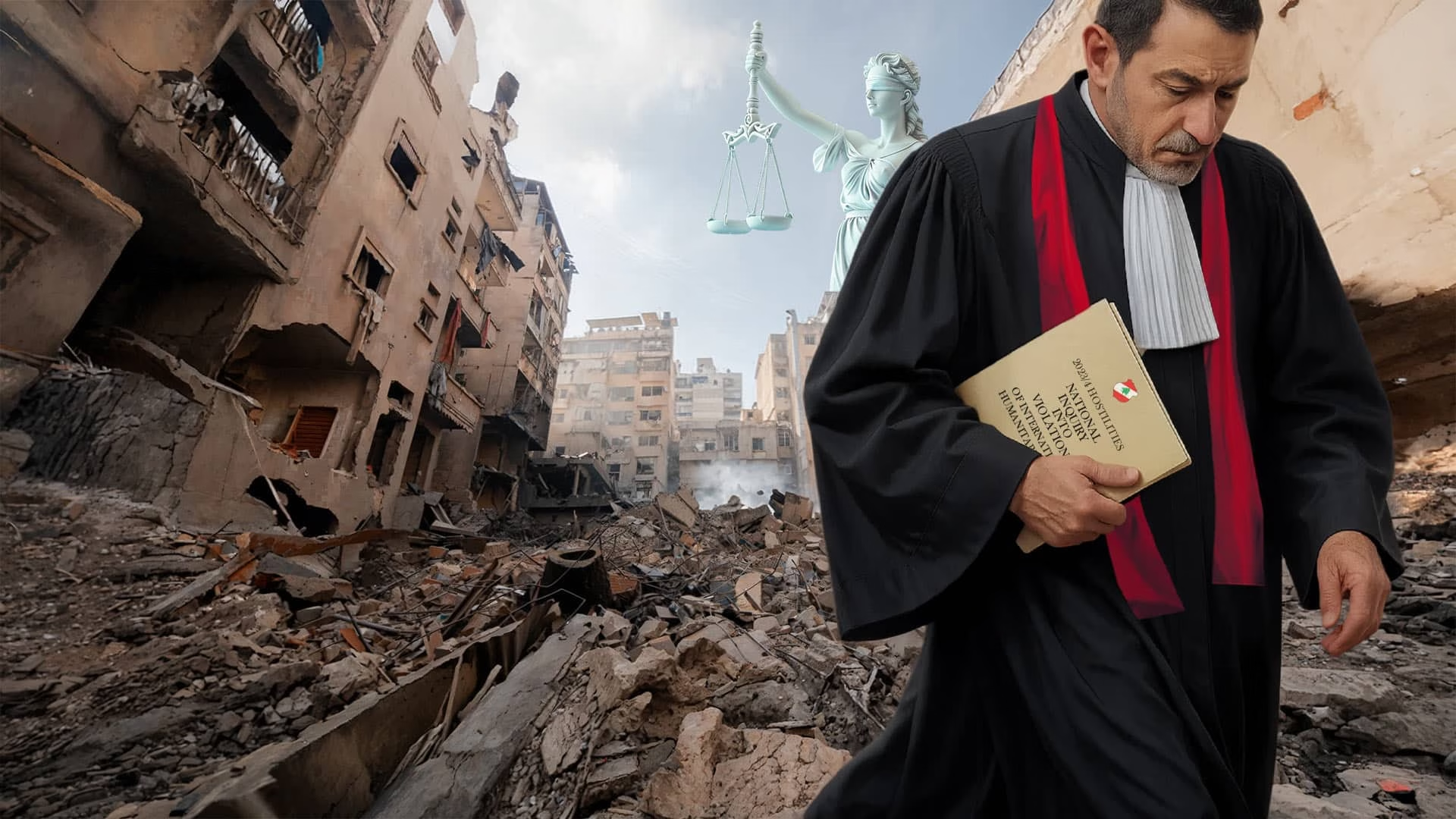

After enduring months of Israeli bombardment last year that killed thousands and displaced hundreds of thousands more, and amid continued attacks despite the ceasefire, the Lebanese people now confront a quieter injustice from within. Their government has documented the death toll, counted the ruined homes, and filed diplomatic complaints, but has launched almost no investigations to examine whether Israeli actions constituted war crimes.
In abandoning the pursuit of justice for its own people, the Lebanese state is itself violating international law and allowing others to write the legal record of what happened on Lebanese soil. Moreover, a state that fails to investigate war crimes within its territory is, in essence, surrendering sovereignty itself.
All the Hallmarks of War Crimes
The 2023-2024 hostilities revived familiar debates over responsibility and impunity, but also raised a more pressing question with sovereign stakes: What must the Lebanese state do when serious violations occur within its borders? The answer in international law is far clearer than the politics around it.
Two bodies of law obligate Lebanon to investigate alleged violations committed on its territory, regardless of the perpetrators’ nationality or the feasibility of prosecution. Through the Geneva Conventions, international humanitarian law mandates inquiries into “grave breaches” of the laws of war. This obligation is reinforced in human rights law, codified in the International Covenant on Civil and Political Rights (ICCPR), which compels states to protect the right to life and probe unlawful killings. Lebanon has ratified both treaties and is legally bound by them. The duty to investigate is therefore not a moral aspiration; it is a legal requirement at the core of sovereign responsibility.
In one of the war’s most egregious incidents, the Israeli air force bombed a residential building in Ain el-Delb on September 29, 2024, killing at least 45 people, including entire families, and injuring around 70 others. Two similar strikes on Younine killed 33 civilians, 15 of them children, in September and November 2024. Given the scale of civilian loss and lack of clear military targets, these attacks – among the deadliest of the conflict – suggest possible violations of distinction and proportionality under international humanitarian law. Distinction requires targeting only military objectives while proportionality forbids attacks where civilian harm outweighs military advantage.
Human rights organizations have stressed that all incidents involving civilian deaths must be investigated. Yet no Lebanese authority has opened a judicial or fact-finding inquiry to determine whether these strikes amounted to war crimes.
Other incidents followed the same pattern. Israeli forces used white phosphorus munitions in populated areas along the southern border, exposing civilians to indiscriminate harm. The Lebanese government opened an ecocide inquiry over severe environmental damage, but not a legal investigation into the use of these weapons against people. Between late 2024 and early 2025, Israeli bombardments destroyed or damaged more than 240,000 residential and non-residential units. State bodies such as the Council for the South documented and verified these losses. Yet no national authority has examined the legality of the strikes or their compliance with the principles of distinction and proportionality.
The state’s failure to systematically investigate war crimes deprives victims of their basic right to legal recourse.
These are a few among hundreds of Israeli attacks that bear the markings of war crimes. A handful of investigations – such as those into the killing of Reuters journalist Issam Abdallah and the so-called “pager attack” – have been launched, but these limited efforts fall far short of addressing the scale of atrocities inflicted on the Lebanese population. The state’s failure to systematically investigate war crimes deprives victims of their basic right to legal recourse. It is not only a political and moral failure, but a breach of Lebanon’s binding obligations under international humanitarian and human rights law.
Where Violations Occur, Investigation Must Follow
The 1949 Geneva Conventions require states to criminalize grave breaches of international humanitarian law, search for suspected perpetrators regardless of nationality, and either prosecute or extradite them. These provisions do not linger on the term “investigation,” but the obligations are incoherent without it. States cannot credibly search for suspects, build a case for extradition, or bring a person before national courts without gathering, verifying, and analyzing evidence. Investigation, therefore, is a legal duty, not a choice. It is the mechanism that makes the entire system of accountability work.
This duty is not limited to the grave breaches listed in the Geneva Conventions. Contemporary doctrine and practice interpret it more broadly: states must investigate war crimes committed by their nationals or on their territory and, where appropriate, prosecute those responsible. Prosecution may depend on the availability of suspects, jurisdiction, or political feasibility, but the investigation itself is unconditional and must always take place. The International Committee of the Red Cross (ICRC) affirms this interpretation in its analysis of rules that have become binding through consistent state practice.
Two principles are particularly relevant to Lebanon. First, territorial connection is decisive: the state where the conduct occurred is the primary duty-bearer. Second, the duty to investigate applies whether prosecution follows or not. Investigation is the legal baseline, not an optional prelude to trial.
Once the territorial prism is applied, Lebanon’s responsibility becomes clear. Because the alleged violations occurred on its soil, the Lebanese state bears the primary duty to investigate – even if suspects are foreign, and political or operational constraints complicate prosecution. In legal terms, this is an obligation of means, not of results. The state does not have to guarantee any particular judicial outcome, but it must initiate a prompt, genuine, and effective process to determine whether international humanitarian law was violated, by whom, and with what consequences. This process begins with the incident and does not wait for a suspect to be identified.
Documentation by international bodies or NGOs can inform and support state action, but it cannot replace a national investigation with judicial consequences.
Just as the duty to investigate follows the territory where violations occurred, it also endures over time. The legal architecture for fighting impunity and holding war criminals accountable remains in force even after a ceasefire. For Lebanon, this means that the passage of time may erode evidence, but it does not erase legal obligations.
Beyond the Laws of War: The Human Rights Perspective
Though emerging from distinct traditions, international humanitarian law and human rights law converge when violence results in civilian harm. Humanitarian law sets rules for how wars are fought while human rights law – enshrined in the ICCPR – reinforces accountability by requiring states to investigate unlawful deaths. According to the UN Human Rights Committee, this obligation is inferred from Article 6, which protects the right to life, and Article 2, which mandates respect for human rights and effective remedies when those rights are violated.
The ICCPR applies during armed conflict, imposing a duty on states to conduct independent, prompt, and thorough investigations into potentially unlawful killings, and to keep victims’ families informed. When core principles of humanitarian law are violated –such as targeting civilians, launching indiscriminate or disproportionate attacks, or using human shields – the UN Human Rights Committee treats these acts as Article 6 violations that must be investigated.
Two key responsibilities arise for any state where such violations occur. First, serious deprivations of life normally call for criminal processes to satisfy the ICCPR’s requirement for effective remedies. Second, the state cannot outsource its obligations. Documentation by international bodies or NGOs can inform and support state action, but it cannot replace a national investigation with judicial consequences.
During months of bombardment, the facts visible on Lebanese territory – mass civilian displacement, destruction of civilian infrastructure, and the use of white phosphorus in populated areas – easily met the threshold to trigger an investigation. ICRC/Geneva Academy guidelines on investigating violations of the laws of war describe this as a “reasonable grounds” test, and once credible information indicates a war crime may have been committed, a criminal investigation must be opened. The guidelines also outline a basic sequence that states should follow in both peace and wartime: record operational data, report incidents, assess their credibility and legal character, and then proceed to a criminal or administrative investigation. By those standards, Lebanon had more than enough factual basis to act promptly. The incidents were public, widely documented, and acknowledged by national authorities themselves. What was missing was not information, but institutional action.
Documenting Violations Is Not Enough
Since the outbreak of hostilities in 2023, Lebanon’s public discourse has treated documentation and complaints to international bodies as synonymous with investigations. Lebanese lawyer Diala Chehade, an expert in international criminal law, told BADIL that the state’s response has primarily focused on recording casualties and damage, not investigating crimes. A genuine investigation, carried out under judicial authority, requires witness hearings, evidence collection, and prosecutorial oversight. Documentation may inform history, but it does not meet the procedural duty imposed by international law.
Chehade also underscored the territorial principle: a state is responsible for investigating every crime committed on its soil, including international crimes, even when suspects are nationals of a more powerful foreign state and prosecutions seem unlikely. She stresses that capacity and access constraints during active bombardment and occupation may justify delays or affect investigative methods, but they do not excuse inaction, particularly once hostilities subside or where parts of the territory were always accessible.
Yousef Wehbe and Ingy Abouloyoun, senior legal advisors at the International Humanitarian Law Centre, also affirmed Lebanon’s duty to investigate alleged war crimes committed on its territory. They told BADIL that cooperation with international mechanisms can complement but not replace domestic processes. The Rome Statute, which established the International Criminal Court (ICC), operates on the principle of complementarity, meaning the ICC only intervenes when national authorities are unwilling or unable to investigate and prosecute serious international crimes. Although Lebanon has not ratified the Statute, its logic is clear: an external inquiry is not a substitute for a state’s responsibility to act.
When the Lebanese government reversed its decision to accept ICC jurisdiction last year, it further narrowed accountability options, precisely when national and international efforts could have complemented each other.
Claims that Lebanon lacks the means to investigate because its institutions are weak, scenes are inaccessible, or suspects are beyond reach do not suspend the state’s obligations. International law accepts that capacity and security constraints influence how investigations are conducted, but not whether they occur. Under both the Geneva Conventions and ICCPR, investigations are judged by their effectiveness, not perfection. Practical limitations may arise in wartime, but the state must still ensure a genuine process capable of establishing facts and responsibility.
As Chehade explains, even when bombardment limits physical access, the state can still gather witness statements from displaced populations, commission satellite imagery, and preserve medical and forensic records. The territorial link reinforces this point. The state controlling the territory where violations occur is best placed to collect evidence, locate witnesses, and conduct the initial legal assessment, even if prosecutions later depend on international cooperation or extradition.
In international humanitarian law, territorial primacy and presence-based jurisdiction work together to prevent accountability vacuums. This is why the Geneva Conventions cast many implementation duties, such as maintaining investigative infrastructure, as peacetime obligations. A state that waits for war to build its accountability machinery has already stacked the odds against compliance.
No International Fix for Lebanon’s Accountability Deficit
While the Lebanese constitution gives ratified treaties precedence over domestic law, this has not translated into practice. The state has yet to enact legislation that defines war crimes and criminalizes grave breaches, leaving prosecutors without the necessary tools to apply international humanitarian law in domestic courts. When the Lebanese government reversed its decision to accept ICC jurisdiction last year, it further narrowed accountability options, precisely when national and international efforts could have complemented each other.
To meet its obligations under the Geneva Conventions and ICCPR, Lebanon must establish a legal framework that penalizes serious violations of international humanitarian law and designates competent authorities to prosecute them. The absence of such legislation does not suspend the duty to investigate. It is itself a failure to comply with the very obligations these treaties impose.
In Lebanon’s political discourse, calls for an “international investigation” are often equated with accountability. International mechanisms such as UN fact-finding missions and commissions of inquiry can settle contested facts, develop rigorous methodologies, and mitigate the spiral of reciprocal allegations. But they do not replace the state’s duty to investigate.
The Geneva Conventions’ framework for repressing grave breaches and the Rome Statute’s complementarity doctrine are based on the premise that international justice only steps in when national systems are unwilling or unable to act. The implication is clear: Lebanon should fully cooperate with international processes while simultaneously pursuing its own domestic investigations.
The UN Human Rights Committee has repeatedly treated the failure to investigate as a distinct violation, even if the underlying conduct is contested. Remedies in such cases often require what was missing in the first place: effective investigations with the potential for prosecutions when supported by evidence.
From a sovereignty perspective, failing to investigate is a form of self-inflicted marginalization. A state that does not build its own record of evidence allows others to define what happened on its soil. This undermines deterrence because potential perpetrators learn that the territorial sovereign will not act. It also erodes public confidence at home by denying victims the possibility of a national remedy and affirms the oft-heard Israeli accusation that Lebanon “does not meet the definition of a country.”
Injustice Upon Injustice for the Lebanese
Lebanon’s legal responsibilities are clear. The grave breaches regime requires states to criminalize violations, search for suspects, and prosecute or extradite them where possible – all of which hinges on investigation. Customary international humanitarian law extends this obligation to all war crimes committed on a state’s territory, while human rights law adds a procedural duty to probe unlawful killings, even during armed conflict. When violations occur on Lebanese soil, the primary duty to investigate rests with Lebanon, regardless of practical obstacles or the perpetrator’s nationality.
Ultimately, sovereignty depends on a factual record validated by law. Knowing the facts is both the precondition and substance of accountability, which is why building investigative capacity during peacetime is a core function of governance. Delays erode both evidence and authority, but the obligation itself never expires.
Lebanon’s approach to accountability has been piecemeal and reactive. The few inquiries that have been opened, such as those into the targeting of journalists, demonstrate that investigation is indeed possible. However, the absence of a unified, judicially anchored process reveals an ongoing failure to meet the state’s international humanitarian and human rights commitments.
The government has yet to launch a comprehensive national investigation into the hundreds of civilian deaths, the widespread destruction of residential areas and essential infrastructure, and the use of weapons with indiscriminate effects. Such efforts are complicated by political divisions, institutional fragility, and security constraints. But the law calibrates for difficulty; it does not absolve obligations.
The legal imperative is unmistakable: investigate, build a record of evidence, and cooperate with international mechanisms without abdicating to them. In doing so, Lebanon would not only comply with its treaty obligations, it would reclaim a measure of sovereignty that is exercised not through slogans at the podium but through facts established in law. Failure to do so would leave the Lebanese state heaping further injustices upon its own citizens.
The author would like to thank Yousef Wehbe and Ingy Abouloyoun, Senior Legal Advisors at the International Humanitarian Law Centre, for their invaluable insights.