

Executive Summary
The Lebanese government doesn’t just tax tobacco; it manufactures, distributes, and profits from nearly every cigarette smoked in Lebanon today. Through its fully state-owned monopoly, the Régie Libanaise des Tabacs et Tombacs, the state controls an industry that, by conservative estimates, kills between 5,300 and 9,200 Lebanese every year. To put that in perspective: the 1975-1990 civil war is generally thought to have killed between 100,000 and 150,000 people. Extend smoking’s annual fatalities over 15 years and the death tolls are close to even. While militia violence during the civil war was horrific, in many ways it could be expected; killing people is what militias do. What people don’t expect is for their own government to sell them an addictive product that kills them in roughly equivalent numbers.
Since the 2019 financial crisis, the government’s dependence on this lethal industry has deepened sharply. Tobacco revenues jumped from just under 4% of the national budget before the economic collapse to over 10% by 2024. And who controls that revenue has shifted just as dramatically. Before the crisis, for every dollar the Regie transferred to the treasury, the Ministry of Finance collected roughly five and a half dollars directly through customs duties and taxes. By 2024, that ratio had inverted: some 60% of the government’s tobacco income flowed through Regie profits, not direct taxation.
There is a proven, globally tested tool that would simultaneously raise government revenues and save Lebanese lives: an escalating per-unit excise tax on all tobacco products.
That inversion did not happen by accident. Beginning in 2016, the Regie signed licensing deals with transnational tobacco companies to manufacture their brands domestically, shifting production away from taxable imports and toward a supply chain the Regie controlled end to end. The financial crisis then supercharged this consolidation: Lebanon’s currency collapse made local production costs irresistibly cheap for foreign companies, while the Regie’s own manufacturing standards met international benchmarks. The result is that today, over 99% of cigarettes sold in Lebanon are manufactured in-country by the Regie, a fact most Lebanese don’t realize. Lebanon has achieved technical manufacturing mastery of an industry that causes wholly preventable death.
Throughout this entire period – from the licensing deals through the crisis-era consolidation – one political faction has sat on both sides of the table. Parliamentary Speaker Nabih Berri’s Amal Movement has controlled the Regie since the post-civil war period. And since 2014, Amal affiliates have held the Ministry of Finance in unbroken succession. The ministry that nominally oversees the Regie has been controlled by the same faction that controls the Regie itself, for over a decade, spanning the entire period in which tobacco revenue migrated from state taxation to monopoly profits.
Meanwhile, more Lebanese are smoking. Rates climbed during the financial crisis and the displacement caused by the 2024 war with Israel, with heightened distress being a well-documented driver of increased tobacco use. The Regie’s revenues are thus, in a structural sense, indexed to Lebanese misery.
None of this was inevitable. There is a proven, globally tested tool that would simultaneously raise government revenues and save Lebanese lives: an escalating per-unit excise tax on all tobacco products. The evidence is unambiguous, and even the Regie’s own board members have conceded that incremental tax increases would work. But every serious attempt at tobacco taxation in Lebanon has been blocked, and the blockage has consistently originated from the same institutional and political nexus benefiting from the status quo.
The choice facing Lebanon is morally unequivocal. The government can continue to sell poison to fund its budget and entrenched political patronage networks, or it can adopt the policies that the rest of the world has proven effective, and raise more revenue while saving Lebanese lives in the process.
“Controlled Harm”
On paper, the Régie Libanaise des Tabacs et Tombacs is one of the Lebanese state’s rare success stories. Established in 1935 during the French Mandate and restructured after the civil war into a fully state-owned monopoly, it is officially tasked with overseeing every dimension of the tobacco sector, from importing raw materials and finished cigarettes, to licensing cultivation and purchasing local crops, to manufacturing, pricing, and distribution. Legally anchored under the Ministry of Finance, it is meant to embody a classic developmental bargain: the state centralizes control over a harmful but lucrative commodity in order to generate stable revenues, protect consumers from illicit products, and shield small domestic farmers from global market volatility.
Its defenders present an institution that has managed to escape the institutional rot afflicting most Lebanese public enterprises. In his recent book, Moral Farming of Immoral Tobacco, long-time Regie board member Mazen Abboud describes the monopoly as both a revenue engine and a vehicle for social policy. Through guaranteed procurement of their crops at administered prices, the Regie offers some 25,000 small-hold farmers predictable cash income in otherwise neglected regions, discouraging out-migration and reinforcing what Abboud calls “resilience” in border areas scarred by conflict and state abandonment. Tobacco, in this framing, is tightly woven into communal identity and dignity; the monopoly is a means by which a historically marginalized community secures economic recognition and a tangible share of state resources.

Financially, the Regie casts itself as a pillar of fiscal stability. By monopolizing imports and production, it argues it can optimize prices, curb smuggling, and ensure profits flow back to the public purse rather than to foreign multinationals, functioning as a quasi-tax instrument that spares the government the political cost of overt excise hikes. Abboud highlights annual transfers to the treasury, a portfolio of corporate social responsibility projects – scholarships, municipal infrastructure, cultural sponsorships – totaling $10.6 million between 2016 and 2019, and a Sustainable Development Plan launched in 2016 as evidence that the Regie recycles tobacco revenues into public goods.
The Regie has also invested in operational credibility. Abboud documents how, in 2016, it modernized its production lines and received ISO 9001 certification, affirming that its operations met global industry standards. By 2017, the Regie had begun manufacturing cigarettes under license for Philip Morris International, Imperial Brands, and Japan Tobacco International. The Regie’s organizational overhaul drove profit margins to levels Abboud called “a phenomenon rarely observed in public service management.” These manufacturing standards would prove good enough that, when Lebanon’s currency collapsed after 2019, transnational tobacco companies deepened rather than abandoned their reliance on the Regie’s factories.
At the core of Abboud’s thesis is a pragmatic challenge to critics: in a fragile state like Lebanon, where institutions are weak and the black market thrives, the choice is not between good and bad, but between controlled harm and chaotic harm. The Regie, in this telling, is the best of a set of bad options: a flawed institution doing necessary work in impossible conditions.
It is a coherent argument, and elements of it are true. What it leaves out is who controls the Regie, how they have used that control, and what it has cost Lebanon, in revenue, in health, and in lives.
Follow the Money
The Lebanese government collects tobacco revenue through two channels: the Regie’s transfers to the Ministry of Finance from its sales profits, and taxes the government levies directly, primarily customs duties on imported tobacco and value-added tax (VAT). How the balance between these two channels has shifted over the past decade is central to understanding the political economy of tobacco in Lebanon today.
According to financial data the Regie provided to Badil, total government tobacco revenues grew from roughly $93 million in 1994 to a peak of $680 million in 2012, before declining gradually to around $477 million by 2019. In the two decades before the financial crisis, tobacco averaged approximately 4% of government revenues; a meaningful contribution, but not one the budget depended on.
What mattered more than the total was the balance within it. In 2012, at the revenue peak, 87% of the government’s tobacco income came from direct taxes – customs duties and VAT – collected by the Ministry of Finance. The Regie’s own transfers to the treasury accounted for just 13%. The state, not the monopoly, controlled the overwhelming majority of tobacco revenue.
Then the balance began to shift. In 2016, the Regie signed licensing agreements with Philip Morris International, Imperial Tobacco, Japan Tobacco International, and British American Tobacco to manufacture their products domestically. The financial logic was straightforward: customs duties on finished imported cigarettes run at roughly 115%, while duties on raw tobacco imported for local production are approximately 25%, according to a Regie official who spoke with Badil. Each pack of Marlboro or Winston manufactured in the Regie’s factories rather than imported from abroad meant substantially lower customs revenue for the Ministry of Finance, and substantially higher gross profits for the Regie.

The chart traces the consequences. The blue line, Regie gross profits, and red line, direct tax revenues, begin converging in 2016, the year of the licensing deals. But the metric that matters most for public finances is not the Regie’s gross profits but what it actually transfers to the treasury after deducting its own expenses. By 2019, on the eve of the financial crisis, Regie transfers to the treasury and direct tax revenues had reached near-parity: Regie transfers made up 49% of the government’s total tobacco revenue, direct taxes 50%. A ratio that had been roughly 1:7 at the 2012 peak had, in seven years, reached 1:1.
The financial crisis then supercharged the consolidation. Lebanon’s currency collapse – from LL1,507 per dollar before the crisis to the eventual unified rate of LL89,500 – made local production dramatically cheaper in dollar terms. International tobacco companies, rather than pulling out, deepened their reliance on the Regie’s factories because, as a Regie official explained to Badil, production costs in Lebanon had become attractive and the Regie’s manufacturing standards met the companies’ own requirements. By 2024, the Regie confirmed to Badil that it was manufacturing more than 99% of the cigarettes sold in Lebanon.
The years of severe exchange rate volatility, from 2020 through 2023, are difficult to account for with precision, given the lira’s collapse, the proliferation of parallel exchange rates, and how the Regie adapted by using its own complex three-tiered revenue collection mechanism involving cash dollars, Lebanese pounds, and dollar checks. But by 2024, with exchange rates unified, the picture had clarified: total government tobacco revenues stood at approximately $402 million, broadly comparable in nominal terms to pre-crisis levels, but now 60% flowed through Regie profits and just 40% came from direct taxation. The inversion was complete.
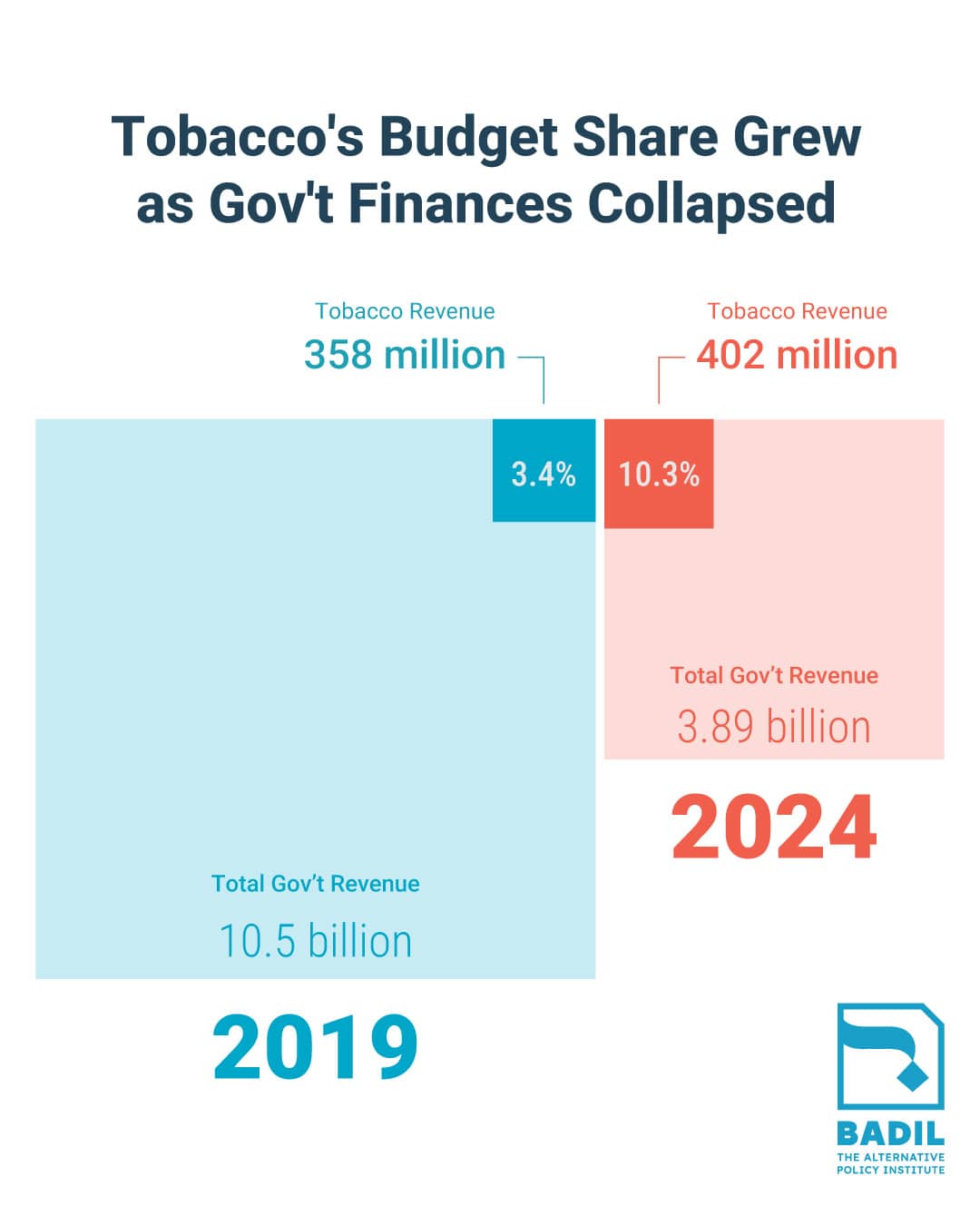
What’s more, with other government revenues having collapsed while the tobacco industry stayed burning, public spending became far more dependent on the Lebanese continuing to inhale its poison. According to the Ministry of Finance’s own Public Finance Monitor, total government receipts that year came to approximately $3.9 billion. Tobacco revenues – Regie transfers plus customs and VAT on tobacco products – totaled roughly $402 million, or more than 10% of state income. The government had become two and a half times more dependent on the tobacco sector than it was before the crisis.
Several factors compounded the surge in Regie revenues over the past six years. A nationally representative survey by researchers at the American University of Beirut found that 66% of Lebanese adults reported being regular smokers in 2024. The Regie’s own accountant, in an interview with Badil, confirmed that the company had recorded an increase in smoking prevalence. The displacement caused by the 2024 war with Israel likely added further pressure: situations of heightened distress, trauma, and displacement are well-documented drivers of increased tobacco use. There was also what a Regie official described as “reverse smuggling”: whereas before the crisis, illicit cigarettes flowed into Lebanon from neighboring countries, the collapse in local production costs reversed the flow, with Lebanese-manufactured cigarettes being smuggled abroad, boosting sales volumes. This dynamic tapered off by 2024 but contributed to elevated production during the years of currency volatility.
But the financial disclosures stop where the most consequential questions begin: the terms of the licensing agreements with transnational tobacco companies remain undisclosed.
What the Regie showed Badil, and what it didn’t, tells its own story. The Regie cooperated with Badil’s research to a degree unusual for an institution historically guarded about its finances, providing revenue and cost data and making its accountant available for a detailed interview. That openness is worth acknowledging. The data confirms the broad revenue picture and the structural shift toward domestic manufacturing. But the financial disclosures stop where the most consequential questions begin: the terms of the licensing agreements with transnational tobacco companies remain undisclosed, the basis on which the Regie calculates its transfers to the treasury is unexplained, and the wild year-to-year fluctuations in those transfers – from $158 million in 2020 to $342 million in 2021 to $93 million in 2022, before rebounding to $241 million in 2024 – are presented without the accounting context that would allow independent verification. The Regie opened a window into its finances, but it chose which window and how wide.
Meanwhile, the Regie’s own brand, Cedars, now commands roughly half the domestic cigarette market, with essentially all remaining cigarettes also manufactured by the Regie under foreign license. The monopoly does not merely regulate the tobacco sector, it is the tobacco sector, from field to factory to point of sale.
The question, then, is not just where the money goes, but who has been sitting at the controls while the dials were turning.
Tobacco’s Political Architecture
At the heart of the political economy built around tobacco is parliamentary speaker Nabih Berri and his Amal Movement. Berri cemented control over the Regie during Lebanon’s post-civil war transition, when the state-owned tobacco monopoly was allocated to Shia political elites as part of the confessional spoils system that carved the Lebanese state into sectarian fiefdoms. Berri, who had led the Amal militia during the civil war, took the speakership of parliament in 1992 and has held it ever since, one of the longest-serving parliamentary speakers in the world. Under his patronage, the Regie was restructured from a mismanaged legacy of the French Mandate into the streamlined manufacturing operation it is today.
Mazen Abboud, the Regie board member, documents this transition with evident admiration. In his telling, Berri “reoriented the Regie’s operations toward economic efficiency and prioritizing the welfare of its 25,000 farmers, who became a cornerstone of his political strength and popularity.” That formulation – farmers as a “cornerstone of political strength” – is revealing. Abboud presents as a managerial success story what is, viewed from the outside, a textbook case of state capture: a public enterprise repurposed to serve the political interests of the faction that controls it.
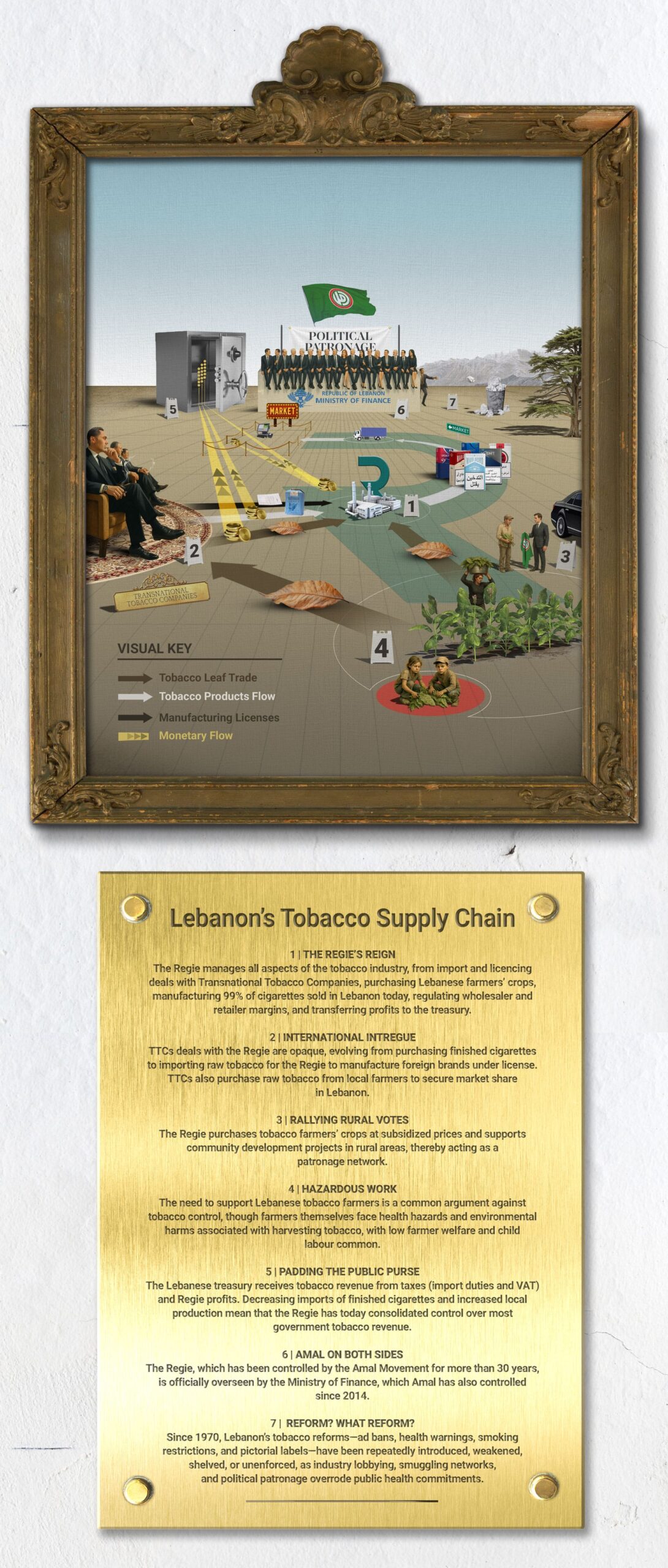
The capture runs deeper than the Regie itself. Since February 2014, the Ministry of Finance – the very institution that formally oversees the Regie – has been held in unbroken succession by Amal-affiliated ministers: Ali Hassan Khalil (2014–2020), Ghazi Wazni (2020–2021), Youssef Khalil (2021–2025), and the incumbent Yassine Jaber. Before 2014, the ministry was largely held by political opponents of Amal or by relatively independent figures, officials who had at least some institutional incentive to scrutinize the Regie’s transfers and press for greater tax revenue. After 2014, that tension disappeared. So the entire period documented above – the licensing deals, the migration of revenue from direct taxation to Regie profits, the crisis-era consolidation that left the Regie manufacturing 99% of the country’s cigarettes – occurred while the same political faction sat on both sides of the oversight relationship.
The case of Ali Hassan Khalil illustrates how this dual control operates in practice. As Minister of Public Health from 2011 to 2014, Khalil banned the import and sale of e-cigarettes and e-waterpipes, citing health risks. When he moved to the Ministry of Finance in 2014 and began working directly with the Regie, he vetoed tobacco taxation proposals, oversaw the gradual reintroduction of e-cigarettes into the market, and became an avid public proponent of the Regie and its personnel. The same official who restricted nicotine products on health grounds reversed course once he occupied the ministry that shared institutional interests with the monopoly.
Around this institutional core, the Regie has built an ecosystem that fuses economic power, philanthropy, and electoral influence. Economist Ali Abboud (no relation to the Regie board member) describes a monopoly that “controls the licensing, the production, the advertisement, the pricing… in all aspects” and is “obviously politically connected.” Beyond the factory gates, he notes, the Regie “has their own kind of social programs. They offer scholarships, they build public libraries, they maintain public gardens… they support municipal candidates in certain villages in the South.” This, says Ali Abboud, creates an ecosystem of political and social connections through which to influence policies and outcomes. In a state that has largely abandoned its developmental responsibilities in peripheral regions, these activities function as one component of the broader machinery by which Amal consolidates loyalty in the South Lebanon and the Bekaa Valley.
Tobacco farmers are placed at the center of this political theatre. Berri has repeatedly framed the crop as a symbol of steadfastness and resistance, with farmers cast as “guardians” of the borders and of national dignity, a narrative Mazen Abboud’s book reproduces at length, drawing a direct line from nineteenth-century Shia tobacco rebellions to contemporary Regie policy. That idealized history is invoked each time tobacco control measures are proposed, positioning any tax increase or regulatory reform as an attack on the livelihoods of a historically marginalized community.
But the numbers complicate the mythology: a pre-crisis Ministry of Agriculture census estimated the number of full-time tobacco farmers at 11,000. Even using the higher number of 25,000, they and others in Regie-affiliated employment would have made up roughly 1% of Lebanon’s workforce in 2019, and agricultural subsidies to farmers are lower now than at any point in the Regie’s history. Public health experts and economists who spoke with Badil were blunt: the farmers are being used as human shields for an industry that kills thousands of their fellow citizens every year.
The result is a political architecture in which every lever of reform – taxation, regulation, transparency – must pass through institutions controlled by the faction with the strongest interest in preventing reform. The Ministry of Finance cannot be the engine of tobacco taxation when it is held by allies of the monopoly it oversees. Parliament cannot legislate meaningful tobacco control when its speaker has built his political base on the industry in question. And the Regie cannot be expected to restrain its own growth when the faction controlling it benefits from every expansion.
The Body Count
Two out of every three Lebanese adults smoke. As noted above, a 2024 AUB survey found that 66% of Lebanese were regular tobacco users, 76% of men and 56% of women. Among cigarette smokers, 97% reported smoking every day. The average consumption was nine packs per week. Smoking prevalence barely varied across income brackets or education levels, and remained persistently high across every age group from 18 to 64. Perhaps most alarming, the age at which Lebanese begin smoking has been falling steadily: for those born after 1990, the average age of onset is below 18, the legal purchasing age.
These are not the numbers of a country that has tried and failed to reduce smoking. They are the numbers of a country that has never seriously tried.
The economic weight of the habit is also crushing for many households. At nine packs per week and current retail prices, a typical smoker spends roughly $40–$60 per month on cigarettes. In a country where large segments of the population earn between $200 and $400 per month, tobacco can consume 15–20% of a low-income household’s budget, money diverted from food, medicine, and children’s education toward a product that will, for many, eventually kill them. The addiction is not merely a health crisis; it is a poverty trap, and one from which the state profits.
Conservative estimates place annual tobacco-attributable deaths in Lebanon between 5,300 and 9,200. The range reflects methodological differences between studies, but even the lower bound represents a staggering toll for a country of roughly five million people. The civil war killed an estimated 100,000 to 150,000 over fifteen years. Extend smoking’s annual fatalities over the same period and the death tolls are close to even; the difference being that the civil war ended, while the tobacco deaths continue, year after year, with no ceasefire in sight.
A 2024 investment case study by UNDP, World Health Organization, and the Lebanese Ministry of Public Health put a price on the damage: $140 million per year, equivalent to 1.9% of GDP, in direct healthcare costs and lost productivity from tobacco-related illness and premature death. Set that figure against the $402 million the government collected from tobacco in 2024, and more than a third of the revenue is consumed by the harm the product causes, before accounting for the suffering that no ledger can capture. The same study found that implementing the WHO’s recommended tobacco control policies could avert over $400 million in economic losses and save 40,000 lives over fifteen years. It estimates that a 50% increase in cigarette prices alone would prevent 17,000 deaths among the poorest income quintile, compared to 9,000 among the wealthiest.
The timing compounds the tragedy. Smoking rates climbed during the financial crisis, as economic devastation and psychological distress drove more Lebanese toward tobacco, a pattern consistent with global research showing that situations of heightened stress, trauma, and displacement increase tobacco use. The 2024 war with Israel, which displaced over one million people within Lebanon, added further pressure. The Regie’s revenues are, in a structural sense, indexed to Lebanese suffering: the worse things get, the more people smoke, and the more the monopoly earns.
Lebanon signed the WHO Framework Convention on Tobacco Control in 2005. The international treaty obliges signatories to implement measures including substantial tobacco taxation, comprehensive advertising bans, smoke-free public spaces, and prominent health warnings on packaging. Nearly two decades later, Lebanon has among the lowest tobacco taxes and highest smoking rates in the world. It is a signatory that owns the industry the treaty was designed to restrain, a conflict of interest so fundamental that it renders the commitment, in practice, meaningless.
Why Nothing Changes
Lebanon has not lacked for tobacco control proposals. It has lacked the political conditions for any of them to survive.
In signing the FCTC in 2005, Lebanon committed to implementing advertising restrictions, smoke-free public spaces, prominent health warnings on packaging, and, critically, substantial tobacco taxation. In 2012, parliament passed Law 174, a comprehensive tobacco control statute that banned smoking in enclosed public spaces, restricted advertising, and mandated pictorial health warnings on cigarette packs. On paper, it was among the stronger tobacco control laws in the region. In practice, enforcement has been negligible: smoking in restaurants, cafes, and offices remains common, and the pictorial warning requirement was quietly shelved after resistance from the Regie and its political patrons. The law exists; its implementation, for the most part, does not.
Tax proposals have fared worse. Despite overwhelming evidence that tobacco taxation is the single most effective tool for reducing consumption – and despite the fact that even the Regie’s own board member, Mazen Abboud, concedes in his book that incremental tax increases would work and that the argument that such taxes are regressive is flawed – every serious attempt to raise tobacco excise rates has been blocked. The blocking has consistently originated from the same nexus: the Regie, its allies in parliament, and the Ministry of Finance.
The defense has relied on a familiar playbook. The primary argument is that higher taxes will drive consumers to the black market, costing the treasury revenue without reducing smoking. Abboud’s own book reproduces the canonical cautionary tale: in 1999, when Prime Minister Selim el-Hoss’s government raised tobacco import duties from 35% to 138% in a single move, smuggling surged and smoking rates did not decline. The Regie’s leadership, backed by Speaker Berri, had opposed the increase at the time, warning it would invigorate the illicit market, and events appeared to vindicate them.
But the lesson drawn from 1999, never raise taxes, is precisely the lesson that serves the Regie’s interests. What the episode actually demonstrated was that a reckless, overnight tripling of duties, implemented without enforcement infrastructure and coinciding with the establishment of a free-trade zone on the Syrian border, will produce smuggling. It says nothing about the effects of gradual, well-enforced excise increases of the kind that have reduced smoking rates in dozens of countries. The Regie’s own accountant told Badil that during Lebanon’s financial crisis, the smuggling dynamic actually reversed: Lebanese-manufactured cigarettes were being smuggled out of the country, because the currency collapse had made local production so cheap. The smuggling threat, in other words, is not the iron law the Regie claims; it is opportunistic, context-dependent, and increasingly manageable.
In July 2025, Finance Minister Yassine Jaber announced the installation of container scanners at the ports of Beirut and Tripoli as part of the International Monetary Fund’s anti-corruption plan, significantly boosting inspection capacity. As agricultural economist Ali Chalak told Badil, these technologies “provide less and less excuses for central governments to avoid increasing taxes on the grounds of reduced smuggling.”
The current system grants the Regie what economist Ali Abboud calls “too many degrees of freedom” to blur the lines between costs, taxes, and profit margins. An excise tax – a fixed per-unit levy collected by the government before the product reaches the consumer – would impose the clarity the current arrangement is designed to avoid. The government would set the rate. The government would collect the revenue. And the Regie’s role would be reduced to what a monopoly manufacturer’s role should be: making the product, not determining how much of its proceeds reach the public purse.
The pattern across two decades is consistent: proposals enter the system and emerge denuded. The political architecture documented in this investigation, one faction controlling both the monopoly and the ministry, farmers invoked as shields, smuggling cited as an immovable obstacle, is not a series of coincidences. It is a system functioning as designed.
Breaking the Bad Habit
There is nothing mysterious about how to reduce tobacco consumption. The policy toolkit is well established, globally tested, and backed by decades of evidence from countries at every income level. The single most effective instrument is an escalating per-unit excise tax, a fixed levy on each pack of cigarettes, collected by the government, that increases annually at a rate that outpaces inflation. The tax must apply uniformly across all brands to eliminate the substitution loopholes that Lebanon’s crisis has already exploited: when Cedars costs almost as much as Marlboro in real terms but remains nominally cheaper, smokers trade down rather than quit. A uniform excise removes that escape route.
The structural benefits are equally important. An excise tax is collected directly by the state through a transparent mechanism, not filtered through a monopoly’s operating account before whatever remainder is transferred to the treasury. It would, in other words, begin to reverse the shift this investigation has documented: moving tobacco revenue back toward direct taxation and away from the Regie’s discretionary control. The government would set the rate, the government would collect the money, and the public would be able to see exactly how much was raised and where it went.
The health returns are equally clear, and they favor the poor. Lower-income smokers are more responsive to price increases and more likely to quit when cigarettes become expensive. The UNDP study quoted earlier also found that a 50% price increase would prevent nearly twice as many deaths in the poorest income quintile as in the wealthiest. The argument that tobacco taxes are regressive, that they punish the poor for an addiction they cannot escape, ignores the savings from avoided illness, avoided catastrophic health spending, and avoided early death. Those savings accrue most powerfully to the people with the least financial cushion.
None of this requires dismantling the Regie overnight or abandoning the farmers who depend on tobacco cultivation. Economist Ali Abboud, who has studied the Lebanese tobacco industry extensively, is explicit that the monopoly’s subsidies and contracts can be redesigned, that farmers could be supported through crop diversification programs, and that the fiscal gains from higher taxes would more than cover the transition costs. Even Mazen Abboud, the Regie board member, concedes in his book that incremental tax increases are workable and that the regressivity objection does not hold. The intellectual argument against reform has, in effect, already been conceded by the people closest to the industry. What remains is the political obstacle.
Lebanon is now governed by a new administration that has signaled interest in institutional reform across the public sector. The IMF program requires fiscal transparency and anti-corruption measures. The port scanners are being installed. The conditions for tobacco tax reform are, for the first time in years, at least conceivable. But conceivable is not the same as likely, not while the Ministry of Finance remains in the hands of the faction that controls the monopoly, not while the speaker of parliament presides over the institution that would need to legislate the tax, and not while 25,000 farmers remain available as political shields against any proposal that threatens the status quo.
This investigation began with a comparison: the tobacco industry kills roughly as many Lebanese annually as the civil war did. The difference is that the civil war, for all its horror, was not a business model. The tobacco economy is. It generates revenue for the state, profits for the monopoly, patronage for a political faction, and, as a byproduct that everyone acknowledges but no one in power acts upon, mass addiction, disease, and early death. The government can continue to administer this arrangement, or it can adopt the policies that dozens of countries have proven effective and, in doing so, raise more revenue while saving Lebanese lives. The tools exist. The evidence is settled. The only question is whether the political will can be found to use them, or whether, as has been the case for two decades, the interests of those who profit from the current system will once again prevail.
Editor’s Note:
Badil would like to thank the following for their time and the expert insights they generously provided to this investigation: Dr. Ali Abboud, Dr. Ali Chalak, Dr. Rima Nakkash, Dr. Nisreen Salti , and Dr. Ghazi Zaatari.
Badil also expresses its appreciation to the accounting and communications staff at Lebanon’s Régie Libanaise des Tabacs et Tombacs for their cooperation in facilitating access to information for this report.
Special thanks go to Perla Khaled and Ségolène de Mathelin who contributed reporting, as well as Alexandros Chazipanagiotou for graphics.