

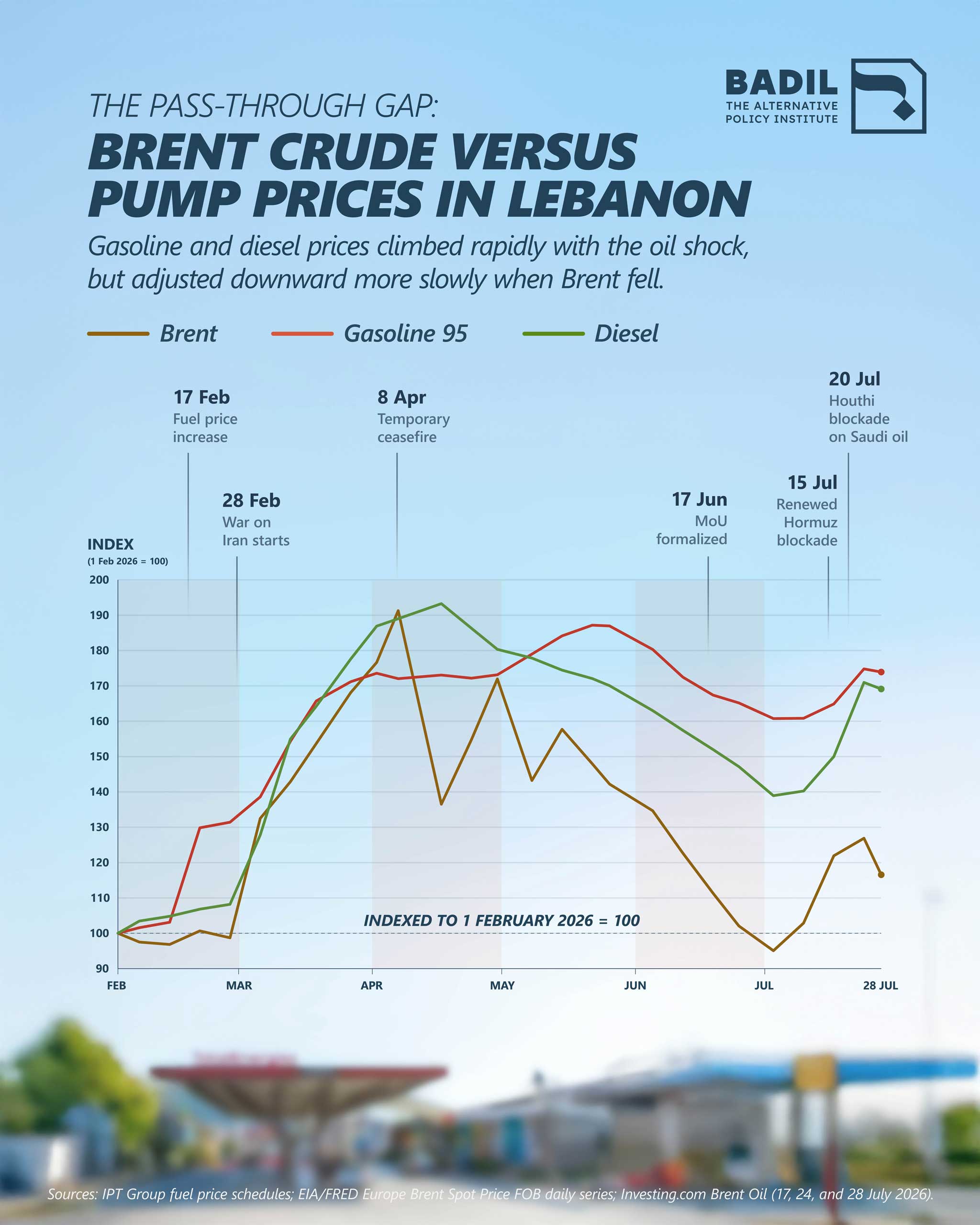
During the spring, everyone said the same thing: the Iran War had pushed oil prices up, causing gasoline and diesel prices to rise as well. Oil then came down again, with the global benchmark Brent crude dipping below its pre-war price by July, but Lebanese were at the pump, and prices are now climbing again.
So if oil caused our pump prices to rise, why didn’t it cause them to fall?
Looking the Wrong Way
Part of the answer is that we were watching the wrong number. Lebanon does not buy crude. It buys diesel and gasoline refined from crude and shipped by cargo tankers, using daily benchmark prices assessed and published by an agency called Platts. While crude prices had fallen significantly by July, refined products remained roughly 30% more expensive than they were in February. Figures from the Ministry of Energy and Water show Lebanon’s pump prices roughly following the rise and fall of the Platts price between February and early July.
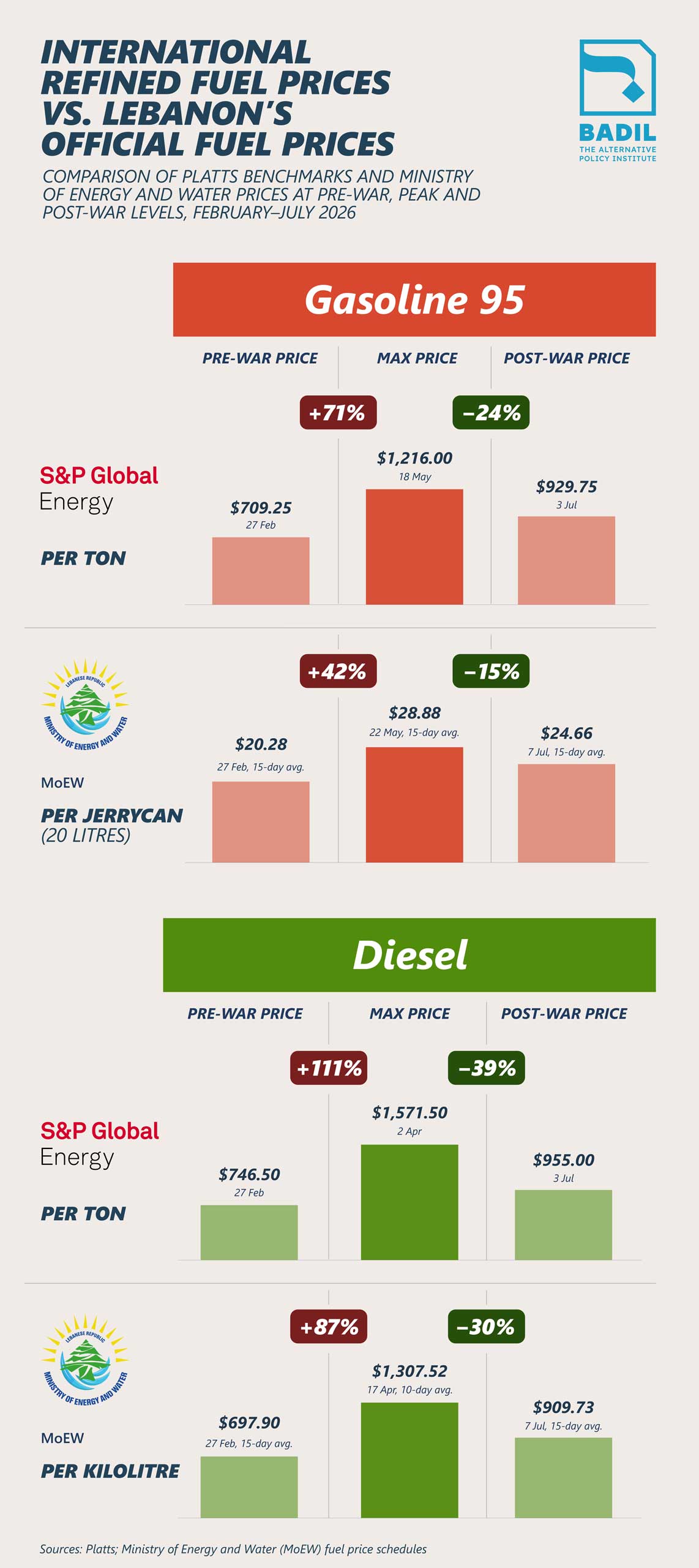
Oil Alone Doesn’t Set International Fuel Prices
Platts measures what bulk fuel deliveries actually sell for, with crude oil being only one component of that price. The other three components are the refinery’s cut, which depends on how much refining capacity is running; the supply of that specific fuel in the region, because diesel and gasoline are separate markets with their own shortages, and the cost of getting a cargo ship to its destination, including freight costs and war-risk insurance. All that is built into the price of Lebanon’s fuel imports before they even arrive.
When the fighting between the US, Israel and Iran eased, crude oil prices fell with it. The other three factors in fuel prices, however, did not. For instance, refineries and shipping routes serving this end of the Mediterranean were still disrupted, and insurers were still charging for the risk.
What Lebanese Pay at the Pump
The Ministry of Energy and Water regularly issues the breakdown of the price that Lebanese pay at the pump for gasoline and diesel (see diagram below).
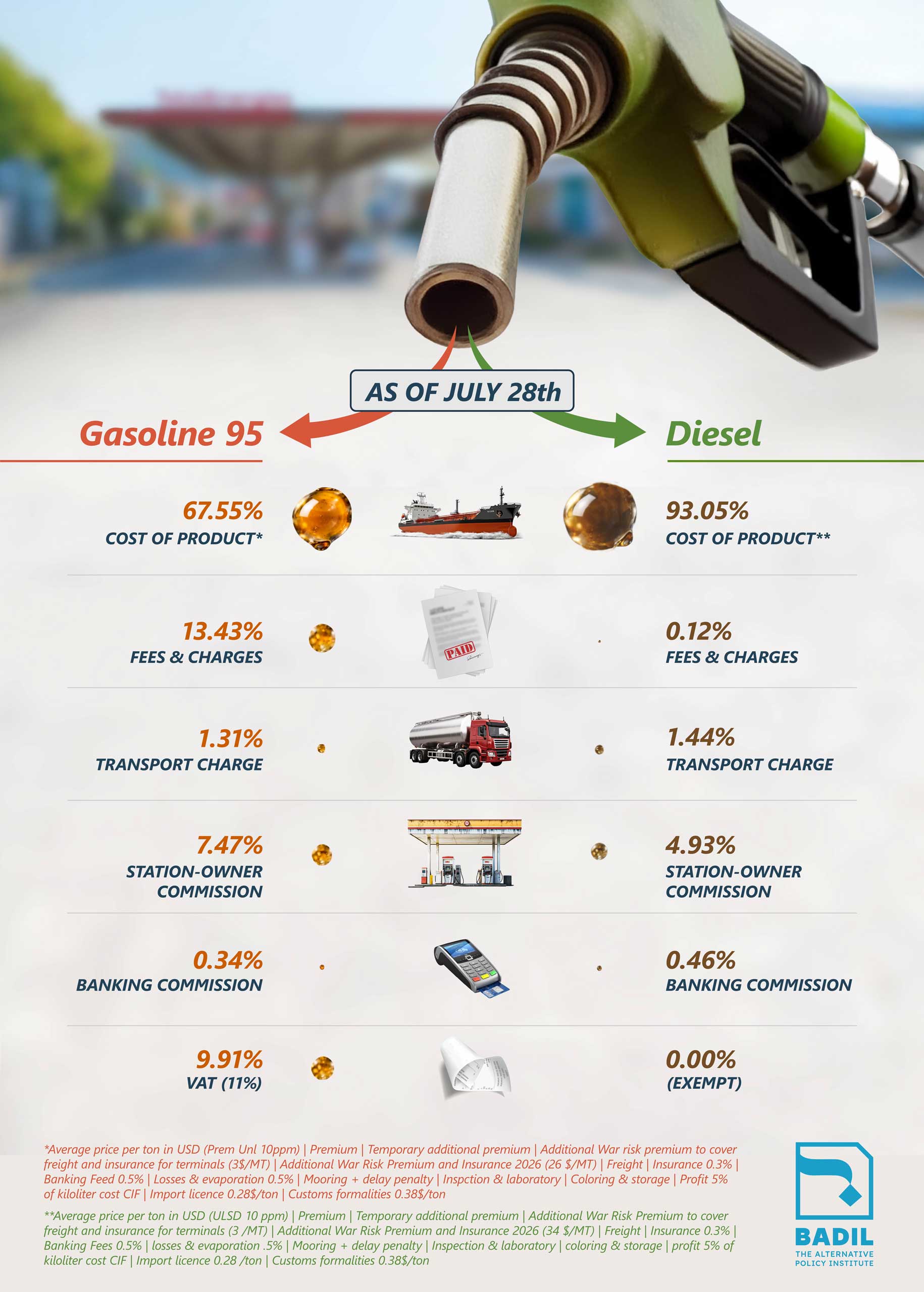
For gasoline, the cost of the product to the importer accounted for 67.5% of the final price, followed by government fees and charges at 13.4%, VAT at 9.9%, the station-owner commission at 7.5%, transport at 1.3% and banking fees at 0.3%. For diesel, which is exempt from VAT and the gasoline fiscal charge, the importer cost represented 93.1% of the final price.
The ministry’s tariff formula explains what sits inside the importer-cost category: the Platts benchmark, premiums, war-risk charges, freight, insurance, banking fees, losses, handling, storage, customs formalities and the importer’s profit margin. It also specifies rates for several items, including a profit margin equal to 5% of the cost, insurance and freight value. However, the 28 July table combines these inputs into one figure and does not show how much each contributed to the final price. This makes it difficult to assess precisely how far transport or insurance costs drove the increase.
Meanwhile, gas station owners receive a separate fixed commission of $2 per 20 litres of gasoline and $1.20 per 20 litres of diesel.
A lasting cost increase that has been blurred out by the war also happened in February, when the government imposed a flat LBP 300,000 fiscal charge on every 20 litres of gasoline under the “fees and charges” category. The charge is regressive, as it absorbs a larger share of lower-income households’ budgets, and will outlast the conflict.
The Next Price Surge
Renewed disruption in the Strait of Hormuz has placed fresh pressure on global oil prices. At the same time, Yemen’s Houthis have declared a maritime blockade targeting Saudi Arabia, the world’s largest crude oil exporter, and warned companies against using Saudi ports. With the price of the refined gasoline and diesel Lebanon imports thus rising, Lebanese look set to endure another round of price shocks at the pump.